

NEW DELHI, June 25, 2026, 6:04 p.m. IST – A new bipartisan U.S. nonprofit backed by leading AI labs, cloud providers, employers and philanthropies launched Thursday with more than $500 million in commitments to help workers adapt as artificial intelligence changes jobs across the economy.
The group, called RAISE US, is led by former U.S. Commerce Secretary Gina Raimondo and former Indiana Governor Eric Holcomb. Its anchor partners include Amazon, Anthropic, Microsoft and the OpenAI Foundation, according to the launch announcement distributed by BusinessWire. The organization says it has already secured more than half of a planned $1 billion in multi-year commitments.
For developers, DevOps engineers and platform teams, the news matters because AI adoption is no longer just a model selection or prompt engineering problem. Large employers are now treating AI as an operating-model shift that touches training, internal mobility, workforce analytics, security, governance and the way technical teams measure automation outcomes.

What is confirmed
RAISE US says its first state partnerships will run in Arkansas, Connecticut, Maryland and Utah. The initial work will test earn-and-learn apprenticeships, short-term credentials linked to employer demand, incentives for companies to retrain and redeploy workers, transition supports such as wage insurance, and AI-powered career navigation.
The group also plans a Policy Lab to study labor-market impact and recommend policy changes. Its launch materials state that the Policy Lab will not be funded by corporate contributions, a notable governance choice for a coalition that includes companies building and deploying AI systems.
In Arkansas, RAISE US says it is supporting an AI-powered career navigation platform called Arkansas LAUNCH. In Maryland, the work includes service-year pathways in fields such as healthcare and education, a competitive fund for career-transition models, and an accelerator for displaced workers who want to pursue entrepreneurship.
The Associated Press reported that the coalition is starting with more than $500 million and is designed to partner with states and large employers rather than wait for a federal program. Axios reported that RAISE US is meant to create a playbook that states and employers can copy as AI changes work beyond the technology sector.
The technical background
The practical challenge is that AI changes tasks before it cleanly changes job titles. A support engineer may spend less time triaging tickets and more time supervising AI-generated summaries. A developer may spend less time writing boilerplate and more time reviewing agent-produced changes, test plans and dependency risk. A platform team may be asked to provide AI tools while also enforcing identity controls, audit logs, data boundaries and model-use policies.
That is why workforce transition is becoming a technical architecture issue. If enterprises want to redeploy workers instead of simply cutting headcount, they need reliable internal skill maps, safe access to AI copilots, private knowledge retrieval, evaluation pipelines, and observability for AI-assisted workflows. GravityDevOps readers building those foundations can connect this story with our guides to prompt engineering for developers, retrieval-augmented generation, LLMOps and modern CI/CD tooling.
Why platform leaders should care
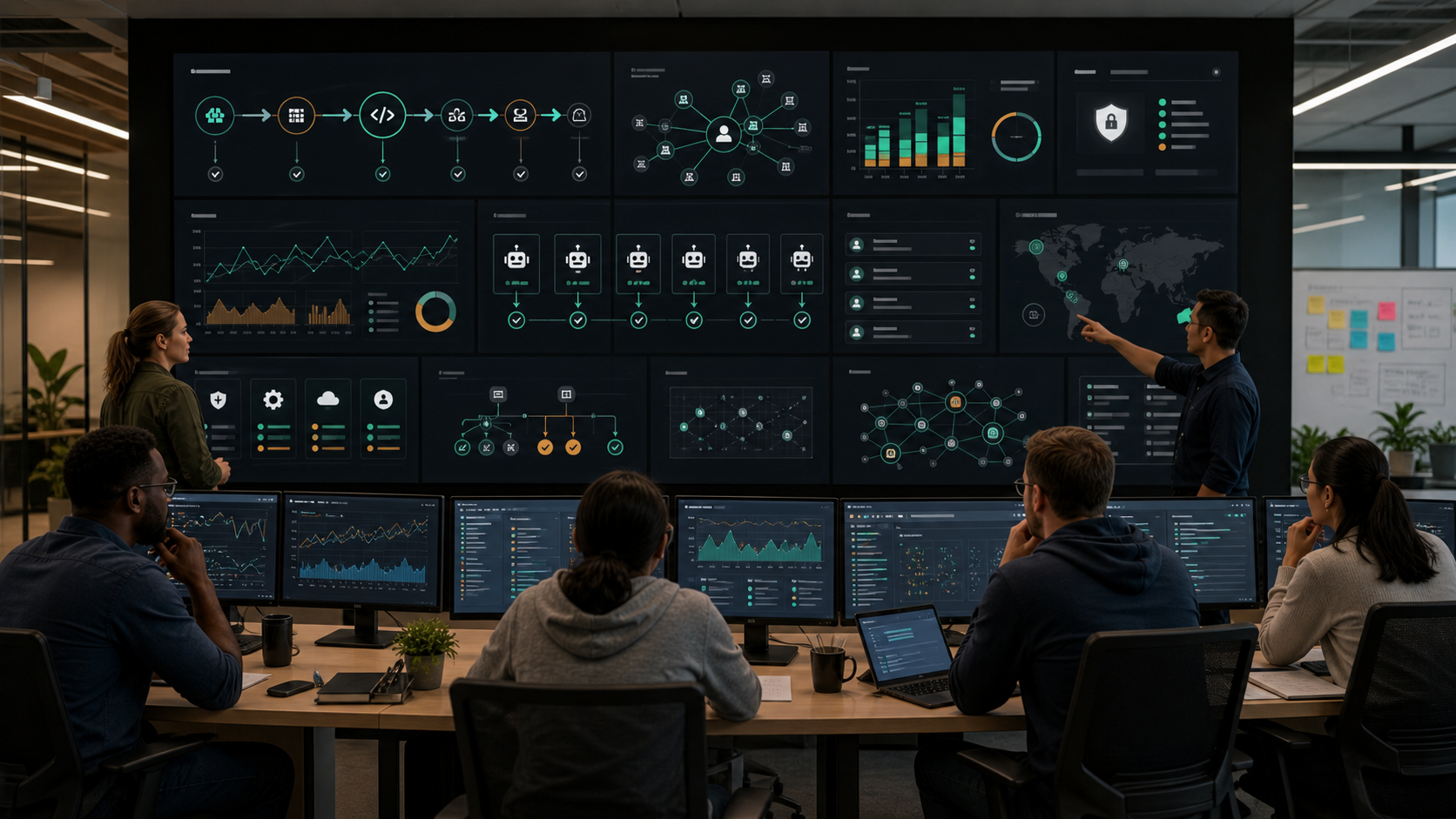
RAISE US is focused on the U.S. labor market, but the operational lesson travels. Enterprises in India, Europe and other regions face the same internal question: how to introduce AI agents into software delivery, operations, finance, support and analytics without losing control of security, quality and institutional knowledge.
For DevOps and cloud leaders, the near-term action is not to forecast exactly which roles disappear. A more useful starting point is to identify workflows where AI is already changing handoffs: incident response, test generation, documentation, ticket routing, knowledge-base search, release notes, compliance evidence gathering and cloud-cost analysis. Those workflows need owners, guardrails, measurable outcomes and a training plan for the humans expected to supervise the systems.
The coalition also underscores a procurement issue. If AI-powered career navigation and training platforms become part of workforce transition, they will handle sensitive employment, education and performance data. Security teams should expect questions about data retention, access control, vendor model usage, bias testing, auditability and whether employee data can be used to train or improve third-party systems.
What remains uncertain
The launch is substantial, but it does not prove that large-scale retraining will work. Axios noted that earlier workforce-transition efforts have had mixed results, and that it remains unclear which programs will actually move workers into less automation-exposed roles. AP also pointed to wide disagreement over the scale and timing of AI-driven job displacement.
The more defensible reading is that employers and AI companies are preparing for uneven disruption rather than a single clean labor-market shock. Some roles will be augmented, some career ladders may narrow, and some teams will need new controls around AI-generated work. Technical leaders should plan around that uncertainty by measuring real workflow impact instead of relying on vendor claims or broad productivity promises.
Anthropic has separately argued for stronger labor-market measurement and transition support in its Economic Policy Framework, including research funding and fellowships. The OpenAI Foundation has also announced 2026 funding for nonprofits using AI in community settings. RAISE US brings those concerns into a broader employer-and-state coalition, making workforce adaptation one of the clearest AI governance themes of the week.
Bottom line
The evening signal is not that AI job disruption is settled. It is that major AI builders, cloud companies and employers are now putting serious money behind transition infrastructure. For engineering organizations, that means AI adoption plans should include more than tool rollout. They need skill development, secure AI platforms, evaluation, audit trails and a realistic view of how human work will change once agents become part of everyday delivery pipelines.
Sources
Sources used for this report include the RAISE US launch announcement, Associated Press, Axios, Anthropic’s Economic Policy Framework, and the OpenAI Foundation’s 2026 People-First AI Fund announcement.


