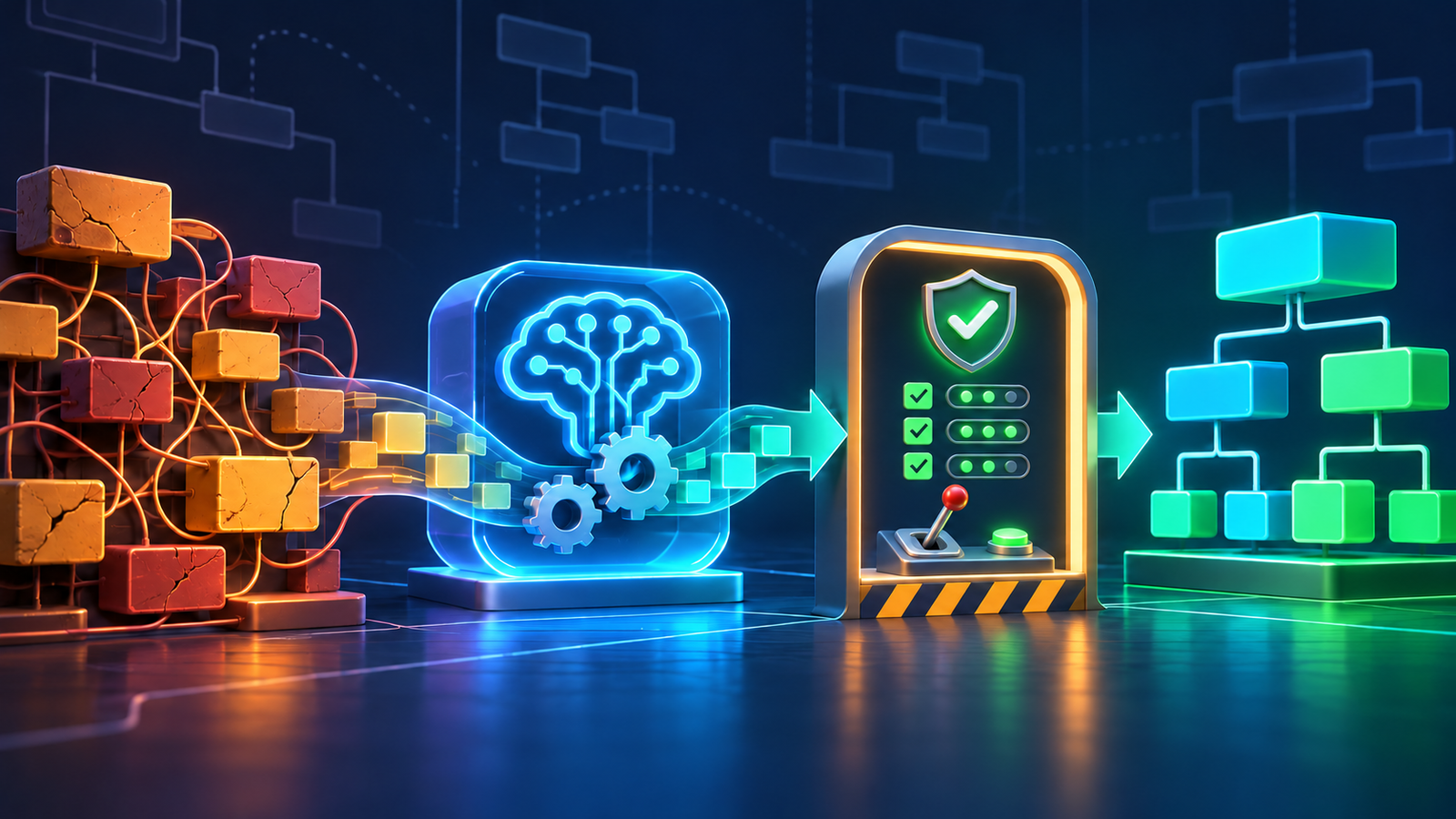

AI refactoring tools can help teams understand, restructure and modernize legacy code, but they should not be trusted to perform a one-click rewrite. The safest pattern is to capture existing behavior, map dependencies, give the tool one narrow change, run deterministic checks, review the diff and release behind a rollback path. Use AI for discovery and proposed edits; keep compilers, tests, static analysis and people as the authorities.
This guide explains where AI adds value, which tool category fits each job and how to refactor an old codebase without quietly changing business behavior. It is for maintainers working with poorly documented services, aging frameworks, tangled dependencies or a backlog of technical debt—not teams looking for a reason to replace a working system.
What AI refactoring actually means
Refactoring changes the internal structure of software while preserving its observable behavior. That is different from adding a feature, fixing a known defect or rewriting a service in a new language. In legacy systems, the distinction matters because undocumented behavior may be relied on by users, batch jobs, downstream services or compliance processes.
Traditional IDE refactorings remain the safest option for transformations a language service can prove, such as renaming a symbol, extracting a method or changing a signature. Both Visual Studio Code and IntelliJ IDEA provide structure-aware operations and previews. AI becomes useful when the task requires interpretation across files: explaining an unfamiliar subsystem, locating duplicated rules, proposing a seam around a dependency, drafting characterization tests or coordinating a sequence of small edits.
The boundary is simple: deterministic refactoring tools know syntax and symbol relationships; AI agents infer intent. Inference can be helpful, but it can also be confidently wrong. A good workflow combines the two.
Which tools fit which refactoring jobs
“AI refactoring tool” covers several different products. Compare them by transformation boundary, not by the size of the model or the length of a feature list.
| Tool category | Best fit | What it can change | Main limitation |
|---|---|---|---|
| IDE refactorings | Rename, extract, move, inline and safe delete | Symbols and references understood by the language service | Cannot infer undocumented business intent |
| Repository coding agents | Cross-file analysis, test drafting and bounded migrations | Files, commands and tests allowed by the agent’s permissions | Probabilistic output and potentially broad authority |
| Semantic recipe engines | Repeatable framework and dependency migrations | Typed syntax trees across many repositories | Requires a suitable recipe and supported language |
| Modernization platforms | Large .NET, Java, mainframe or cloud migrations | Assessment, dependency mapping, transformation and reports | Vendor, region, data-path and target-platform constraints |
Examples illustrate the split. GitHub Copilot agent mode can edit multiple files and run commands, while Claude Code exposes plan and permission controls through its command-line interface. OpenRewrite recipes apply repeatable semantic transformations rather than free-form text replacement. AWS Transform targets enterprise modernization and migration workflows, including assessment and specialized transformations.
These categories are complementary. An agent may identify a migration pattern, a recipe engine may apply it consistently, and an IDE refactoring may finish a local symbol change. Current plans, usage allowances and enterprise controls change frequently, so verify the vendor documentation before procurement rather than treating a feature table as a contract.
A safe seven-step workflow
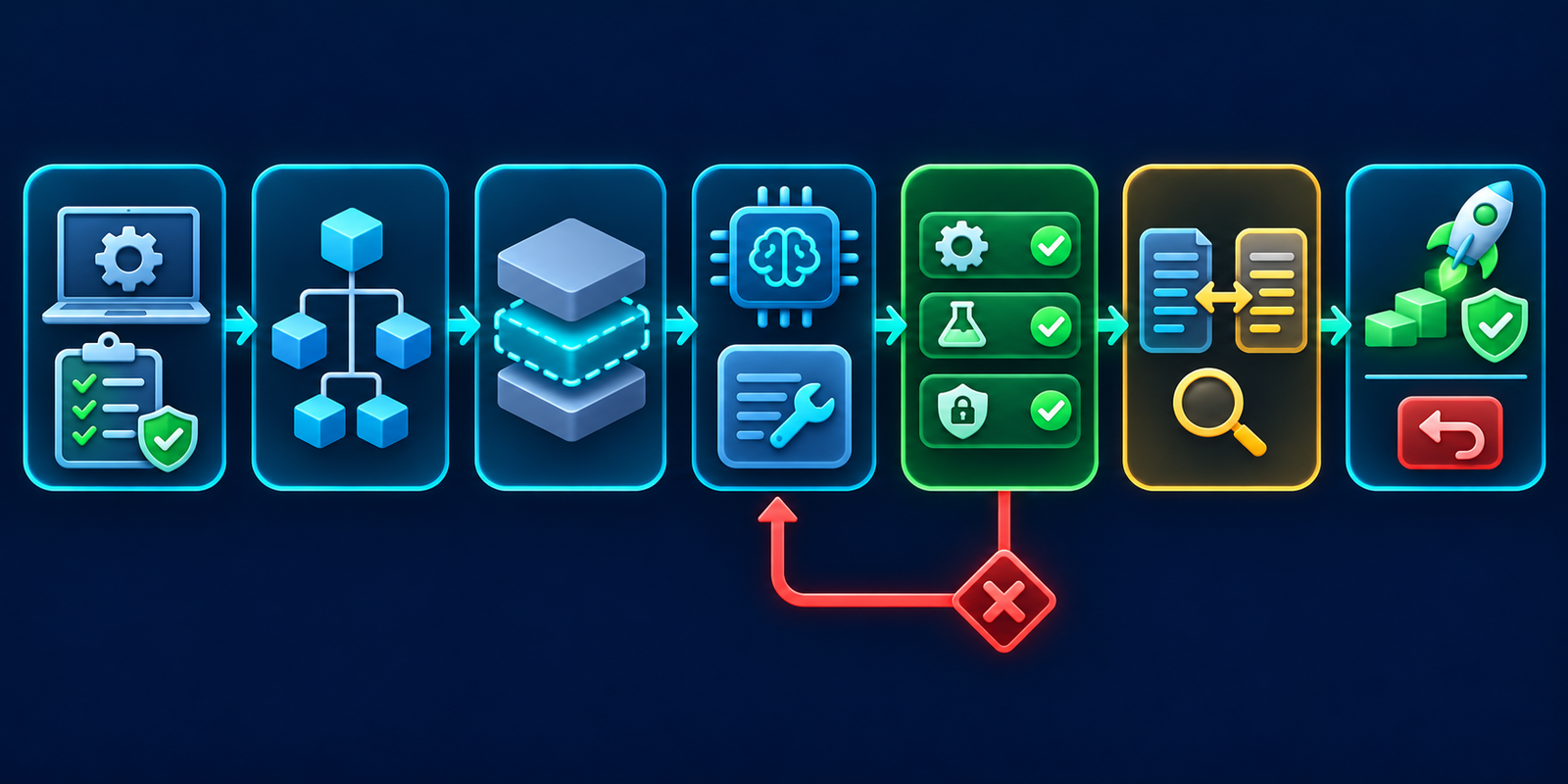
- Define the behavior to preserve. Write down inputs, outputs, side effects, latency expectations, error behavior and compatibility constraints. “Clean up this module” is not an acceptance criterion.
- Capture a baseline. Run the existing build and tests. Add characterization tests around critical paths before changing implementation details. Record known failures so the agent does not “fix” them by weakening assertions.
- Map dependencies and trust boundaries. Identify callers, databases, queues, file formats, public APIs, authentication boundaries and deployment configuration. Ask AI to propose a map, then verify it with code search, runtime evidence and subject-matter experts.
- Choose one seam. Select a small, reversible unit: extract one parser, wrap one external client, upgrade one dependency family or replace one duplicated rule. Avoid mixing refactoring, feature work and platform migration in the same pull request.
- Generate a patch with constraints. Start in a read-only or plan mode where available. Grant write and command permissions only for the repository and tools required. Require the agent to show assumptions and stop when evidence is missing.
- Validate independently. Run compilation, unit and integration tests, linters, type checks, static security analysis, dependency scanning and contract tests. The agent’s explanation is not evidence that behavior is preserved.
- Review, stage and observe. A maintainer reviews the complete diff, including generated tests and lockfiles. Release behind a feature flag, canary or small deployment wave, watch behavior and performance, and keep an explicit rollback procedure.
This approach extends the verification discipline in our production-ready AI code checklist. If the baseline is already failing or the system is poorly observable, address that first; AI cannot prove equivalence when the team has no reliable definition of correct behavior.
Three practical legacy-code examples
Extracting a long billing method
Ask the agent to identify branches, side effects and external calls without editing. Add tests for representative invoices, rounding, discounts, taxes and failure paths. Then extract one calculation at a time using the IDE’s structure-aware refactoring. Reject a patch that changes rounding types, exception behavior or database call order merely because the new code looks cleaner.
Upgrading a framework across repositories
For a repeated migration such as JUnit 4 to JUnit 5, a semantic recipe is often safer than asking a general agent to improvise hundreds of edits. OpenRewrite documents how recipes can compose annotation, assertion, visibility and build-file changes into one migration. Use AI to inventory exceptions and explain failures, while the recipe provides a repeatable transformation. Pilot one representative repository before scaling.
Modernizing a .NET or mainframe application
Large migrations need more than code generation. They require dependency discovery, business-rule recovery, target architecture, data migration, equivalence tests and an operating cutover plan. AWS Transform, for example, documents assessment and transformation workflows, but teams must still review the plan and transformed code. Its documentation also notes cross-Region inference and processing considerations, which matter for regulated source code and data. Review the data path before uploading a repository.
A prompt that limits scope
A useful prompt describes evidence, constraints and stop conditions instead of asking for a vague cleanup:
Analyze the selected module without editing first. List its callers, outputs, side effects and assumptions, and cite the relevant files. Propose the smallest refactoring that removes the duplicated validation logic while preserving public interfaces and runtime behavior. Do not change dependencies, schemas, error messages or unrelated formatting. After I approve the plan, make one patch, add or update behavior-focused tests, run the existing validation commands and summarize any uncertainty. Stop if the baseline fails or required context is missing.
Repository instructions should also name approved commands, protected paths, coding conventions and tests. Keep prompts and tool output out of production logs when they may contain proprietary code, credentials or customer data.
Risks and required controls
- Behavior drift: generated code may preserve types while changing ordering, rounding, retries or error semantics. Counter it with characterization, contract and differential tests.
- False confidence from generated tests: an agent can write tests that mirror its own wrong implementation. Preserve independent expected results and require reviewers to inspect changed assertions.
- Prompt injection: comments, documentation, issue text or dependency content can contain hostile instructions. The OWASP prompt-injection guidance explains why indirect attacks are especially dangerous when an agent can read files and call tools. Treat repository content as untrusted data.
- Secret and source exposure: confirm where code is processed, retained and used, and whether enterprise controls meet policy. Exclude secret files and production data from context.
- Dependency and licensing changes: block unapproved packages, inspect lockfiles and licenses, and scan the resulting dependency graph.
- Excessive authority: use a disposable branch or isolated worktree, least-privilege credentials and sandboxed commands. Do not give a refactoring agent production deployment, cloud-admin or unrestricted network access.
- Large, unreviewable diffs: cap the files and behavior in each change. If reviewers cannot explain the diff, split it again.
These controls align with the NIST Secure Software Development Framework: define criteria, protect code, verify outputs and respond to vulnerabilities within the development lifecycle. For agent-specific threat modeling, see our guide to prompt injection, tool permissions and sandboxing.
How to choose a tool
Start with the transformation, not the vendor. Use an IDE refactoring when the operation is known and structurally supported. Use a semantic recipe when the same typed change must be repeated. Use a repository agent when the task depends on cross-file reasoning and can be bounded by tests. Consider a modernization platform when assessment, migration artifacts and fleet-scale coordination matter as much as individual edits.
Run a pilot on a representative but noncritical module. Measure review time, escaped regressions, rollback frequency, build stability and the percentage of generated changes that survive review—not lines changed. Compare the same task and acceptance tests across candidates. Our AI debugging workflow can help investigate failures, while the AI code review tools guide explains how to add a second review signal without replacing human ownership.
The best tool is the one that produces small, inspectable changes inside your existing engineering controls. If adopting it requires bypassing those controls, it is the wrong fit for legacy modernization.
Frequently asked questions
Can AI refactor an entire legacy application automatically?
It can automate parts of discovery and transformation, but an entire application includes undocumented behavior, data, integrations and operational constraints. Treat full modernization as a program with human decisions, equivalence testing and staged cutover—not a single prompt.
Should teams add tests before using an AI refactoring tool?
Yes. Add characterization tests for critical behavior and record the current baseline. Generated tests can help fill gaps, but they should not be the only evidence because they may repeat the same mistaken assumptions as the generated patch.
Are AI refactoring tools safer than search and replace?
They can understand more context, but they are still probabilistic. For known syntax and symbol changes, structure-aware IDE refactorings or semantic recipes are usually more predictable. AI is most helpful for analysis, planning and bounded edits around those tools.
What is the safest first AI refactoring task?
Choose a small internal module with good tests, low operational risk and an easy rollback. Examples include extracting duplicated validation, wrapping one external client or documenting dependencies before a later change.
How do we know the refactoring preserved behavior?
Use multiple independent signals: unchanged public contracts, characterization and integration tests, static checks, representative data, performance comparisons where relevant, reviewer approval and monitored staged deployment. No single AI-generated explanation or test suite proves equivalence.

