
SEO excerpt: Compare AWS, Azure, and Google Cloud in 2026 with a practical learning guide for beginners and working engineers. See strengths, tradeoffs, certifications, AI and Kubernetes fit, job-market signals, and the best cloud to learn for your goals.
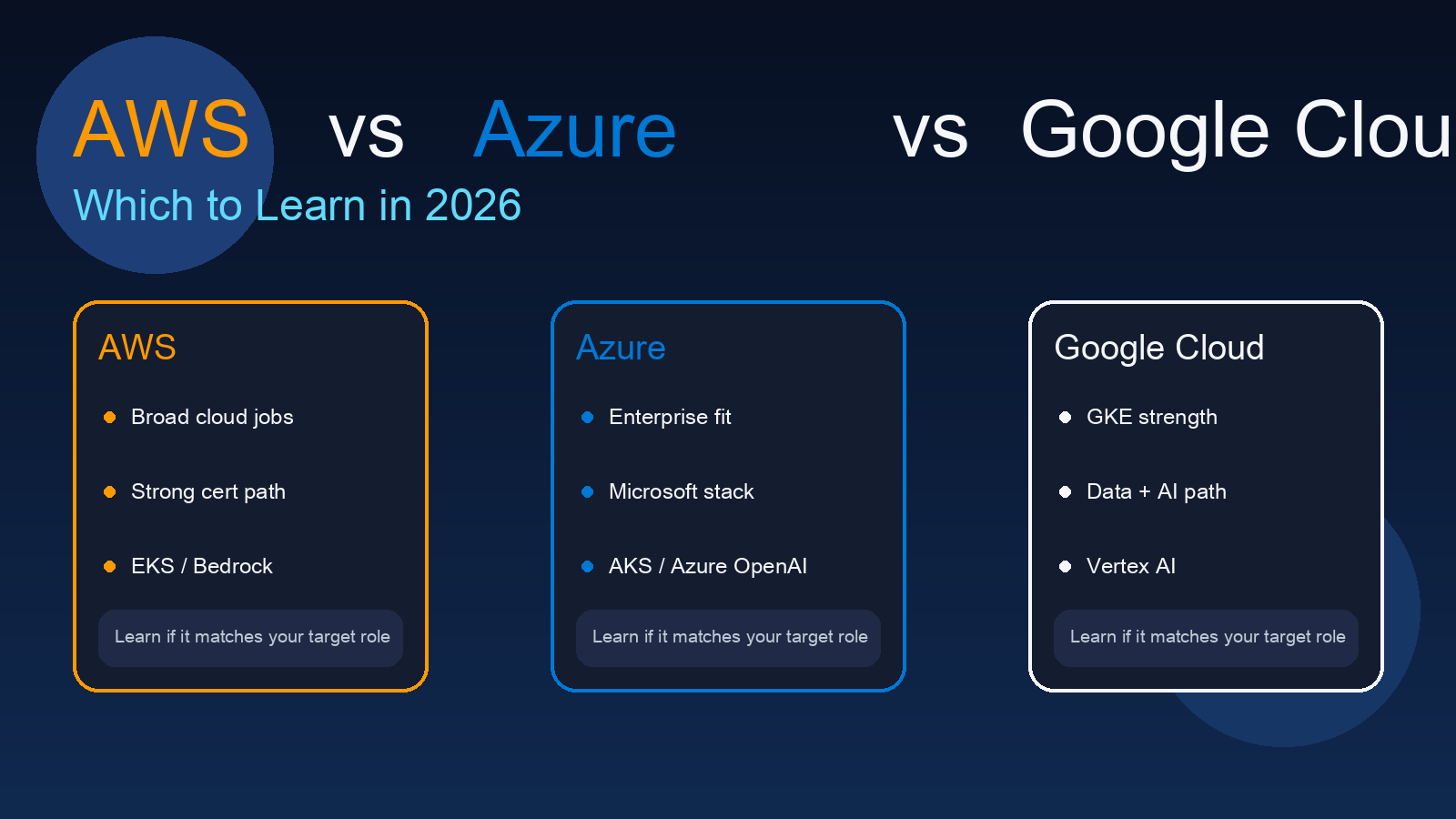
Quick Answer: In 2026, AWS is still the safest first choice for broad cloud employability, Azure is the strongest option if you want enterprise and Microsoft-heavy environments, and Google Cloud is the best focused bet for data, Kubernetes, and AI-centric engineering paths. The right platform to learn depends less on brand prestige and more on your target role, the companies you want to work for, and whether you care most about general cloud jobs, enterprise platform work, or modern data/AI systems.
AWS vs Azure vs Google Cloud in 2026: The Real Decision
Choosing a cloud platform is easier when you stop asking which provider is “best” and start asking which provider is best for the work you want to do. All three major clouds can run production applications, managed Kubernetes, CI/CD pipelines, databases, observability stacks, and AI workloads. The difference is usually in ecosystem fit, learning curve, enterprise adoption patterns, and how naturally each cloud matches your long-term path.
If you are starting from scratch in 2026, the most practical question is not whether AWS, Azure, or Google Cloud has more services. All of them have more services than most engineers will master. The practical question is where your learning effort will compound fastest. For some people that means starting with AWS because it appears in the widest range of job descriptions. For others it means Azure because their employer already runs Microsoft 365, Entra ID, Windows Server, and SQL Server. For others it means Google Cloud because they want stronger alignment with Kubernetes, data engineering, and AI-native platform work.
This guide is written for that practical decision. It is not a brand war. It is a field guide for students, junior engineers, DevOps practitioners, cloud engineers, and software developers deciding what to learn next.
| If your goal is… | Best first choice | Why |
|---|---|---|
| Maximum job-market flexibility | AWS | Broad service coverage, common in cloud job listings, large training ecosystem, strong general-purpose path. |
| Enterprise IT and Microsoft-heavy companies | Azure | Strong integration with Microsoft identity, productivity, governance, and hybrid enterprise environments. |
| Kubernetes, data, analytics, and AI-focused engineering | Google Cloud | Strong fit for GKE, data platforms, and modern AI/ML workflows around Google Cloud services. |
| One cloud to learn in 90 days | AWS or Azure | AWS for broad market value; Azure if your current employer already uses Microsoft tools. |
| Second cloud after you know one already | Google Cloud | Useful way to deepen Kubernetes, data, and platform thinking after the basics are established. |
The Short Verdict
- Learn AWS first if you want the broadest cloud foundation and you do not yet have a strong employer-specific reason to choose another platform.
- Learn Azure first if you work in, or want to work in, enterprises built around Microsoft identity, Windows, Microsoft 365, Power Platform, or .NET.
- Learn Google Cloud first only if you have a clear reason, such as a GKE-heavy platform team, a data engineering path, or an AI/ML role where Google Cloud is already part of the target environment.
If you are still undecided, the safest sequence for most beginners is AWS first, then Azure or Google Cloud second. That path gives you strong transfer learning because the core ideas of IAM, networking, compute, storage, observability, containers, and infrastructure as code carry across providers.
Why This Comparison Matters in 2026
In 2026, cloud learning is no longer just about virtual machines and object storage. Engineers are comparing cloud platforms through the lens of Kubernetes, platform engineering, FinOps, managed AI services, governance, and internal developer platforms. That changes the decision.
AWS continues to invest heavily across infrastructure and AI services, including Amazon Bedrock and the AWS certification and training ecosystem. Azure keeps its advantage in enterprise integration, hybrid governance, and Microsoft-aligned identity and productivity ecosystems. Google Cloud remains especially compelling for teams drawn to GKE, data engineering, and AI services around Vertex AI, now presented through Google Cloud’s evolving agent and model platform story.
Those platform directions matter because they change what “learning cloud” actually means. A strong 2026 cloud engineer needs to understand not just compute and storage, but also managed Kubernetes, cloud security boundaries, cost control, developer workflows, and how AI services fit into production systems.
AWS vs Azure vs Google Cloud: Comparison Table
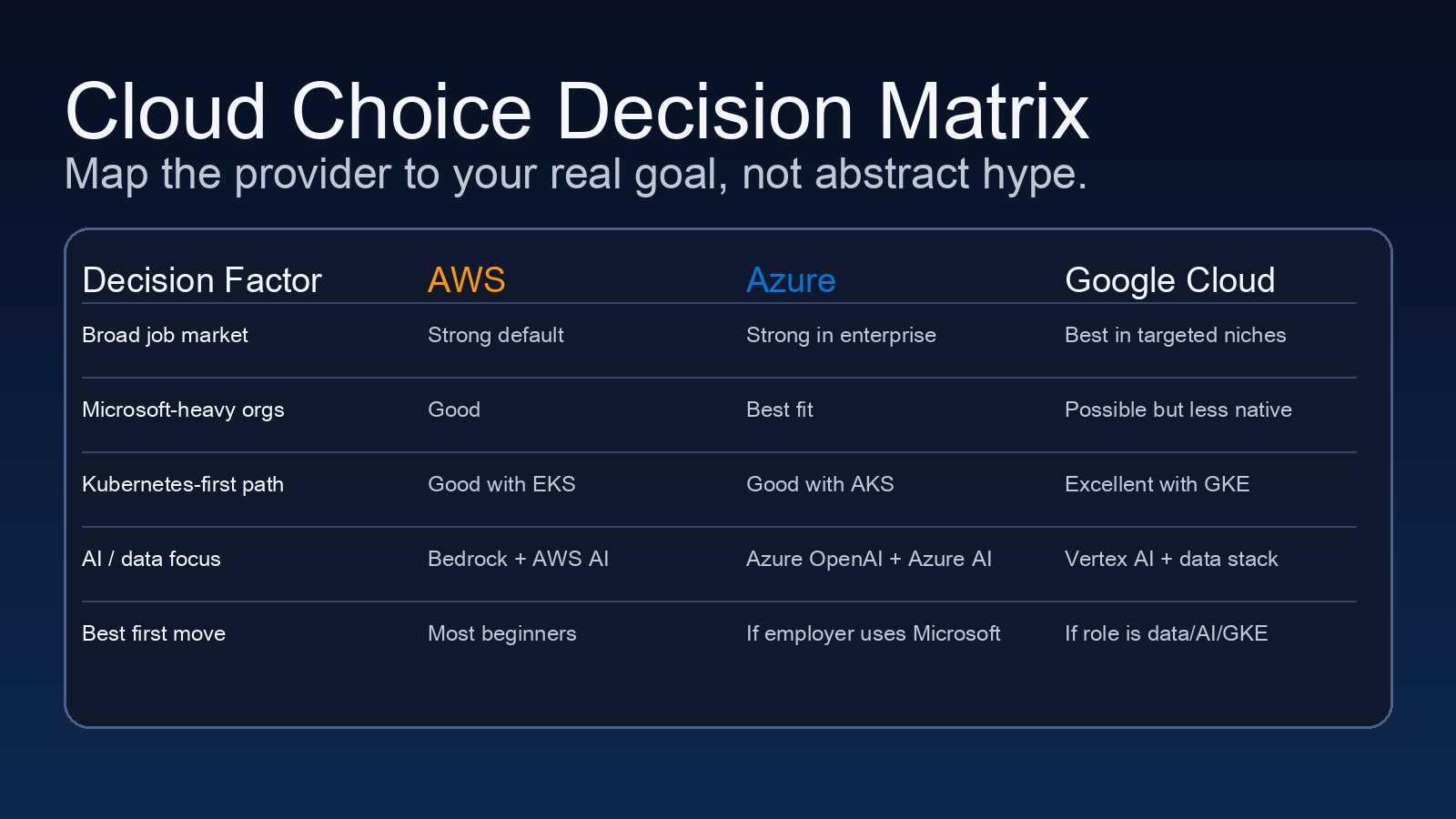
| Category | AWS | Azure | Google Cloud |
|---|---|---|---|
| Best for | General cloud careers, broad service exposure, startups to enterprises | Enterprise IT, Microsoft-centric organizations, hybrid governance | Data engineering, Kubernetes-heavy teams, AI and analytics-focused work |
| Beginner path | Cloud Practitioner to associate-level role paths | Azure Fundamentals then role-based Azure tracks | Cloud Digital Leader or role-specific Google Cloud paths |
| Kubernetes platform | Amazon EKS | Azure Kubernetes Service (AKS) | Google Kubernetes Engine (GKE) |
| Managed AI platform | Amazon Bedrock and broader AWS AI services | Azure OpenAI and Azure AI services | Vertex AI / Gemini Enterprise Agent Platform ecosystem |
| Enterprise identity fit | Good, but less native to Microsoft estates | Very strong with Entra ID and Microsoft stack | Good, but usually not the default enterprise identity center |
| Learning ecosystem | Very large official and third-party ecosystem | Strong Microsoft Learn ecosystem with enterprise-aligned paths | Solid and focused, especially for data and AI practitioners |
| Common first recommendation | Yes | Yes, if employer fit exists | Usually as a targeted choice, not default |
How to Choose the Right Cloud to Learn
A useful way to choose is to score each provider against five filters: target role, employer ecosystem, workload interest, learning speed, and local opportunity.
1. Target Role
If you want a broad cloud engineer or DevOps role, AWS is usually the most flexible first platform. If you want platform engineering in a Microsoft-centric enterprise, Azure deserves serious priority. If you want ML platform, analytics, or Kubernetes-specialized work, Google Cloud becomes much more attractive.
2. Employer Ecosystem
This is often the deciding factor that beginners ignore. If your company already runs Microsoft 365, Entra ID, Power BI, and .NET services, Azure skills can pay off faster than theoretical AWS breadth. If your target startup or SaaS employers mostly use AWS, the opposite is true. If the company cares deeply about GKE, BigQuery, or Vertex AI, Google Cloud may be the most strategic bet.
3. Workload Interest
Cloud learning becomes easier when you like the workloads. If you are energized by infrastructure, multi-account governance, and broad operations patterns, AWS is a strong fit. If you enjoy identity, enterprise integration, and hybrid control planes, Azure often feels more natural. If you like Kubernetes internals, modern data stacks, and AI experimentation, Google Cloud is often the most enjoyable platform to study.
4. Learning Speed
Choose the cloud where you can get the fastest repetition. If your current job gives you access to Azure subscriptions every day, that is worth more than watching AWS tutorials at night without real hands-on practice. Access and repetition beat abstract platform rankings.
5. Local Opportunity and Market Signal
Job markets vary by country, city, and industry. Even when AWS is the broad default, Azure may dominate in large enterprises and public-sector contexts, while Google Cloud may be concentrated in data-heavy companies, consulting teams, and modern digital-native organizations. Look at the employers you genuinely want, not generic internet advice.
AWS in 2026: Strengths, Weaknesses, and Best Fit
AWS remains the most common first recommendation because it gives you exposure to the widest general-purpose cloud vocabulary. IAM, VPC design, EC2, S3, RDS, Lambda, CloudWatch, EKS, and infrastructure automation patterns on AWS map well to the kinds of problems many cloud engineers see in real jobs.
The AWS learning ecosystem also stays strong. AWS still offers a broad certification catalog and large official training footprint through AWS Training and Certification and Skill Builder. That matters because beginners often need structured paths and abundant practice material.
Where AWS is strongest
- General cloud and DevOps employability
- Broad service coverage across compute, storage, networking, databases, and serverless
- Mature patterns for infrastructure automation and multi-account operations
- Strong alignment with modern backend, platform, and SaaS environments
- Large third-party content ecosystem for labs, tutorials, and interview preparation
Where AWS can feel harder
- Sheer service sprawl can overwhelm beginners
- Cost control mistakes are common when learning hands-on
- Naming and product overlap can make first-time navigation confusing
If you want the default answer for “Which cloud should I learn first?”, AWS still wins that slot for most self-directed learners.
Azure in 2026: Strengths, Weaknesses, and Best Fit
Azure is strongest when your cloud journey intersects with enterprise reality. Identity, governance, Windows and Linux estates, Microsoft 365, developer workflows tied to the Microsoft ecosystem, and enterprise procurement patterns often make Azure the most practical cloud in actual organizations.
Microsoft’s credential system also remains highly visible. Microsoft Learn continues to offer official certifications and applied learning paths, and the Azure Fundamentals certification page was updated in January 2026. That is a useful signal that Azure’s beginner path remains active and well-maintained.
Where Azure is strongest
- Enterprise organizations already invested in Microsoft tools
- Identity, governance, compliance, and hybrid scenarios
- .NET and Microsoft-centric application teams
- Organizations adopting Azure OpenAI and broader Azure AI services
Where Azure can feel harder
- Service naming and licensing boundaries can confuse newcomers
- Some learning paths make more sense once you already understand enterprise IT basics
- It is less natural than AWS for some startup-style self-learning environments
If your day job or target employers live inside the Microsoft ecosystem, Azure is often a smarter first choice than AWS, even if internet advice says otherwise.
Google Cloud in 2026: Strengths, Weaknesses, and Best Fit
Google Cloud is not usually the safest generic first pick, but it can be the best focused pick. It remains especially attractive for engineers drawn to Kubernetes, data platforms, analytics, and AI-oriented workflows. GKE continues to be a major reason engineers respect Google Cloud, and Google Cloud’s learning and certification pages still position role-based and foundational credential paths clearly.
Google Cloud’s AI platform story is also significant in 2026. Google Cloud has reframed Vertex AI into a broader Gemini Enterprise Agent Platform direction while still keeping the underlying model, MLOps, and application platform ideas central. For engineers who want to build with modern AI systems, that can make Google Cloud especially appealing.
Where Google Cloud is strongest
- Kubernetes and platform engineering teams using GKE
- Data engineering, analytics, and modern ML workflows
- AI and model platform experimentation with Google Cloud services
- Teams that want a clean path into cloud-native infrastructure patterns
Where Google Cloud can feel harder
- Fewer employers use it as their default cloud than AWS or Azure in many markets
- Some learners may struggle to find as many third-party beginner resources as they can for AWS
- It works best when you already know why you are choosing it
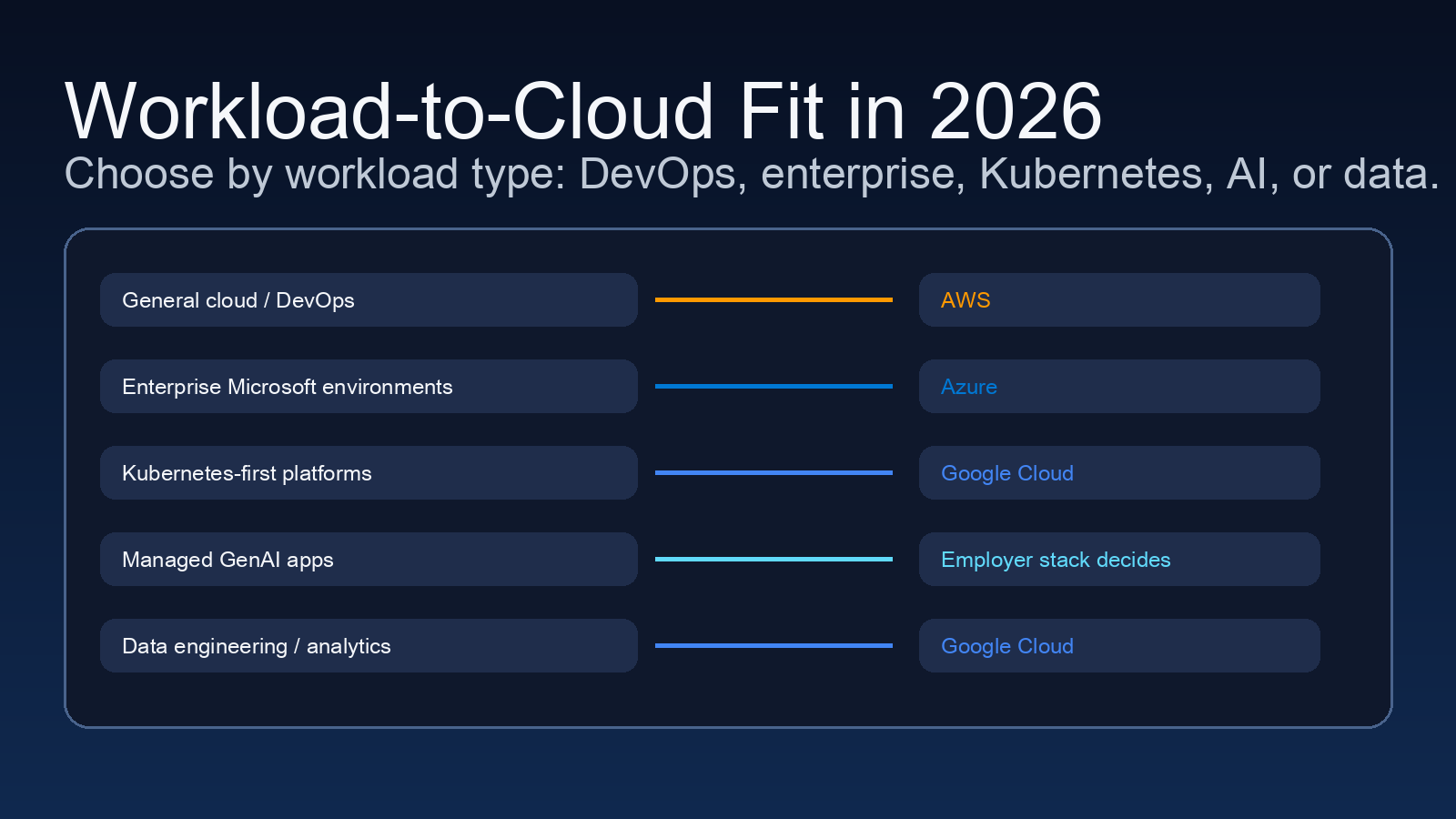
Which Cloud Is Best for AI, Kubernetes, and DevOps?
This is where the generic rankings start to break down, because the best cloud depends on workload style.
| Workload | Best default choice | Reason |
|---|---|---|
| General DevOps / platform foundations | AWS | Broad service set and strong transfer value across common cloud operations patterns. |
| Enterprise DevOps / Microsoft estates | Azure | Identity, governance, and enterprise integration often dominate the actual work. |
| Kubernetes-first platform engineering | Google Cloud | GKE remains a major strength and a natural fit for Kubernetes-heavy teams. |
| Managed GenAI application building | Depends on employer stack | Bedrock, Azure OpenAI, and Vertex AI all matter, but employer fit is more important than hype. |
| Data engineering and analytics | Google Cloud | Often favored for modern data platform paths and adjacent AI workflows. |
For Kubernetes specifically, all three clouds provide managed offerings: Amazon EKS, Azure Kubernetes Service, and Google Kubernetes Engine. If your cloud learning plan is Kubernetes-led, Google Cloud often feels the most natural, but that does not mean EKS or AKS are weak. It means GKE is often the platform people intentionally choose when Kubernetes itself is central to the role.
For AI, each provider has a credible managed platform story in 2026. AWS positions Amazon Bedrock as a managed layer for building AI applications and agents. Microsoft continues to tie Azure OpenAI and broader Azure AI services into enterprise deployments and AKS-based patterns. Google Cloud continues to emphasize Vertex AI and agent platform capabilities around Gemini models and model lifecycle tooling. None of these stacks should be chosen in isolation from the rest of your platform needs.
Certifications: Which Path Makes Sense?
Certifications do not replace hands-on work, but they are useful when they structure your learning and signal role intent. In 2026, each provider still maintains a credible certification path:
- AWS: AWS Certification and AWS Training still offer broad role-based and foundational pathways, including Cloud Practitioner and role-specific tracks.
- Azure: Microsoft Learn continues to offer Azure Fundamentals plus role-based certifications and applied skills across Azure services.
- Google Cloud: Google Cloud continues to offer Cloud Digital Leader and role-based certifications for cloud, data, and architecture paths.
If you are a beginner, do not collect certifications randomly. Pick one cloud, one role path, and one small portfolio project to prove you can actually use the services.
A 90-Day Learning Plan for Beginners
If you want a practical plan instead of endless comparison videos, use this sequence.
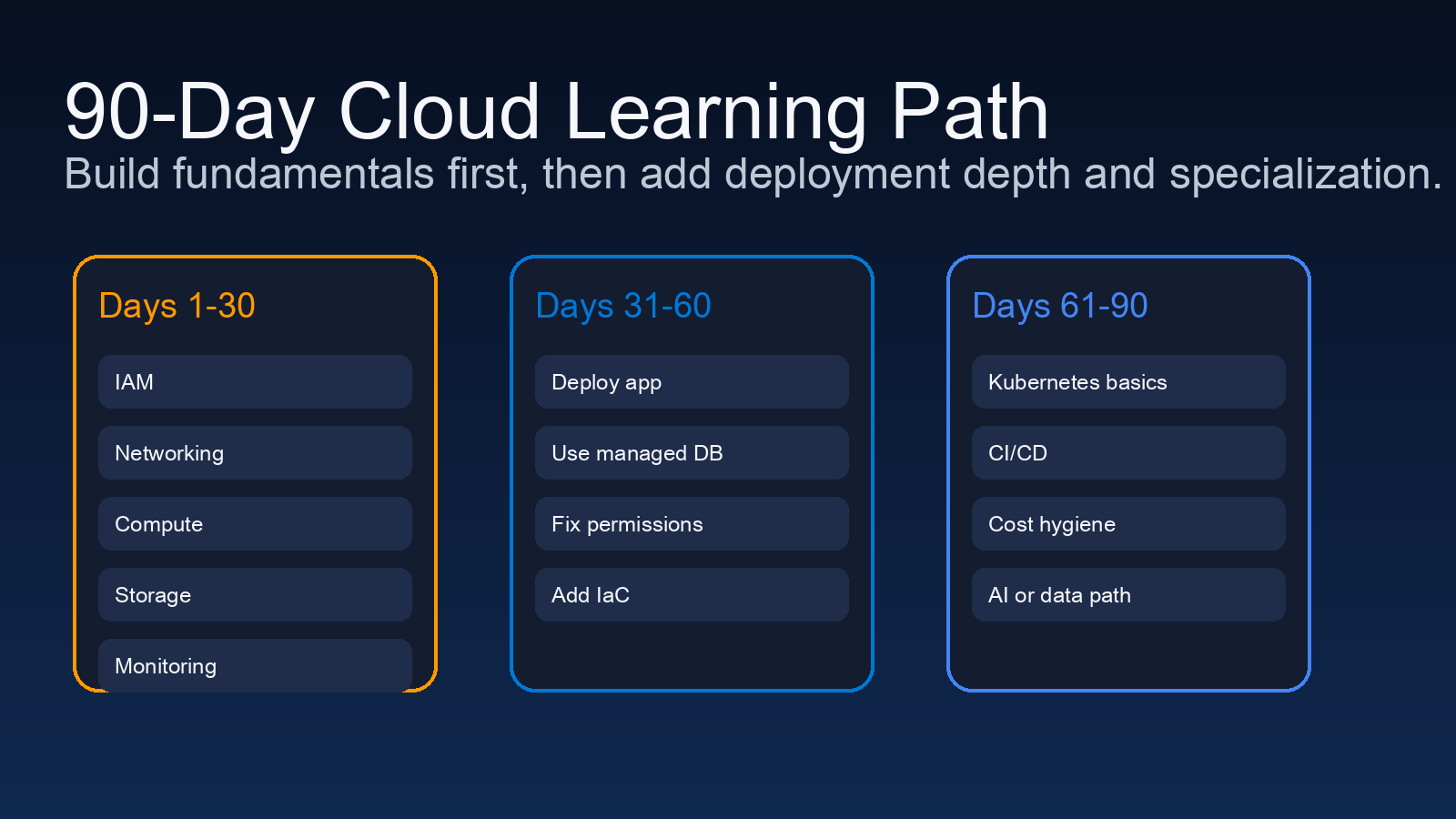
Days 1-30: Core Cloud Concepts
- Identity and access management
- Virtual networking basics
- Compute, storage, and managed database concepts
- Logging and monitoring basics
- Budget alerts and cost hygiene from day one
Days 31-60: Real Deployment Practice
- Deploy a static site or simple web app
- Add a managed database or object storage
- Configure IAM properly instead of using over-permissive defaults
- Set up infrastructure as code with Terraform or OpenTofu
Days 61-90: Career-Relevant Depth
- For DevOps: learn CI/CD, secrets handling, monitoring, and Kubernetes basics
- For cloud engineering: learn VPC/VNet design, IAM patterns, and cost awareness
- For AI/data: add managed AI services, vector search concepts, or analytics tooling
Document everything you build. A simple GitHub repository with diagrams, Terraform, deployment notes, and screenshots often matters more than a shallow certification badge alone.
Common Mistakes When Choosing a Cloud
- Choosing based only on social-media hype instead of target employers
- Trying to learn all three clouds at once
- Ignoring IAM, networking, and cost hygiene because AI or Kubernetes looks more exciting
- Collecting certifications without building anything real
- Assuming a cloud is “better” globally when the right answer is role-specific
Recommendation by Persona
| Persona | Recommendation |
|---|---|
| Student with no employer context | Start with AWS. |
| Windows / Microsoft admin moving into cloud | Start with Azure. |
| Data engineer or ML platform learner | Start with Google Cloud. |
| DevOps engineer at a Microsoft-heavy enterprise | Start with Azure, then add AWS later. |
| Startup-oriented backend engineer | Start with AWS. |
| Kubernetes-focused platform engineer | Start with Google Cloud or the cloud used by your target employer. |
Final Verdict: Which Cloud Should You Learn in 2026?
If you want one safe answer, learn AWS first. If you want the answer that is often best in real enterprise environments, learn Azure when Microsoft is already everywhere around you. If you want the answer that best fits data, Kubernetes, and AI-centric platform work, learn Google Cloud.
The strongest long-term strategy is not blind loyalty to one provider. It is learning one cloud deeply enough to understand IAM, networking, observability, automation, and production tradeoffs, then using that knowledge to learn a second cloud faster.
If you are building a cloud-and-AI career, use your first cloud to learn the fundamentals and your second cloud to build specialization.
FAQ
Is AWS still the best cloud to learn first in 2026?
For most self-directed learners, yes. AWS is still the safest first choice when you want broad cloud foundations and strong transfer value across many cloud roles. The main exception is when your employer or target employers are heavily aligned to Azure or Google Cloud.
Is Azure better than AWS for getting a job?
Not broadly, but it can be better for specific enterprise environments. If the employers you want use Microsoft identity, Azure governance, and Azure application services heavily, Azure can be the faster route to relevant interviews and hands-on experience.
Why do engineers choose Google Cloud over AWS or Azure?
Usually because of workload fit rather than brand preference. Google Cloud is especially attractive for GKE, data engineering, analytics, and AI/ML platform work. It is often chosen by teams that want strong alignment between cloud-native infrastructure and data/AI systems.
Should beginners learn certifications first or projects first?
Use both, but let projects anchor the learning. Certifications help structure study, but a small real project proves that you understand access control, networking, deployment, observability, and troubleshooting in practice.
Can I switch clouds later if I start with the wrong one?
Yes. Core cloud concepts transfer well. Once you understand IAM, networking, storage, compute, monitoring, and infrastructure as code on one cloud, your second cloud usually becomes much easier to learn.
Schema-Ready FAQ JSON-LD
{
  "@context": "https://schema.org",
  "@type": "FAQPage",
  "mainEntity": [
    {
      "@type": "Question",
      "name": "Is AWS still the best cloud to learn first in 2026?",
      "acceptedAnswer": {
        "@type": "Answer",
        "text": "For most self-directed learners, yes. AWS is still the safest first choice when you want broad cloud foundations and strong transfer value across many cloud roles. The main exception is when your employer or target employers are heavily aligned to Azure or Google Cloud."
      }
    },
    {
      "@type": "Question",
      "name": "Is Azure better than AWS for getting a job?",
      "acceptedAnswer": {
        "@type": "Answer",
        "text": "Not broadly, but it can be better for specific enterprise environments. If the employers you want use Microsoft identity, Azure governance, and Azure application services heavily, Azure can be the faster route to relevant interviews and hands-on experience."
      }
    },
    {
      "@type": "Question",
      "name": "Why do engineers choose Google Cloud over AWS or Azure?",
      "acceptedAnswer": {
        "@type": "Answer",
        "text": "Usually because of workload fit rather than brand preference. Google Cloud is especially attractive for GKE, data engineering, analytics, and AI/ML platform work."
      }
    },
    {
      "@type": "Question",
      "name": "Should beginners learn certifications first or projects first?",
      "acceptedAnswer": {
        "@type": "Answer",
        "text": "Use both, but let projects anchor the learning. Certifications help structure study, but a small real project proves practical understanding."
      }
    },
    {
      "@type": "Question",
      "name": "Can I switch clouds later if I start with the wrong one?",
      "acceptedAnswer": {
        "@type": "Answer",
        "text": "Yes. Core cloud concepts transfer well. Once you understand IAM, networking, storage, compute, monitoring, and infrastructure as code on one cloud, your second cloud becomes much easier to learn."
      }
    }
  ]
}
Internal Links to Add
- What Is Generative AI? A Beginner’s Guide for readers comparing cloud choices through the AI adoption lens.
- Best CI/CD Tools in 2026 Compared for readers evaluating the DevOps toolchain that sits on top of their chosen cloud.
- When published, link forward to the planned tutorials on Amazon EKS, Azure AKS, AWS S3, and AWS cost optimization.
- When published, link sideways to the planned comparison and revenue posts on cloud certifications, cloud engineer salaries, and infrastructure as code tools.
Sources used for current-platform verification: AWS Certification and Training pages, Microsoft Learn credentials pages, Google Cloud certification and learning pages, and official Kubernetes/AI platform documentation for EKS, AKS, GKE, Bedrock, Azure OpenAI, and Vertex AI / Gemini Enterprise Agent Platform.


