
NEW DELHI, September 16, 2026, 5:05 PM IST — Google, Nvidia and AI infrastructure startup Emerald AI have launched an industry coalition that wants data centers to become flexible power users, reducing electricity demand during grid stress instead of operating as an unchanging round-the-clock load.
The AI Energy Management Alliance, or AEMA, brings together 20 companies and organizations across the AI and energy sectors, according to Axios. Anthropic, National Grid, AES, Constellation, NRG and RWE are among the participants cited in the report. The alliance says it will advocate for regulatory and utility rules that recognize data-center demand flexibility as a grid resource.
The move matters because power access is becoming a gating factor for new AI capacity. It also turns an infrastructure concern into an operations question: which training, inference and data-processing jobs can be delayed, shifted or curtailed without breaking service-level objectives? For developers, cloud architects and platform teams, energy-aware scheduling could become another production constraint alongside accelerator availability, latency, cost and data residency.

What the alliance confirmed
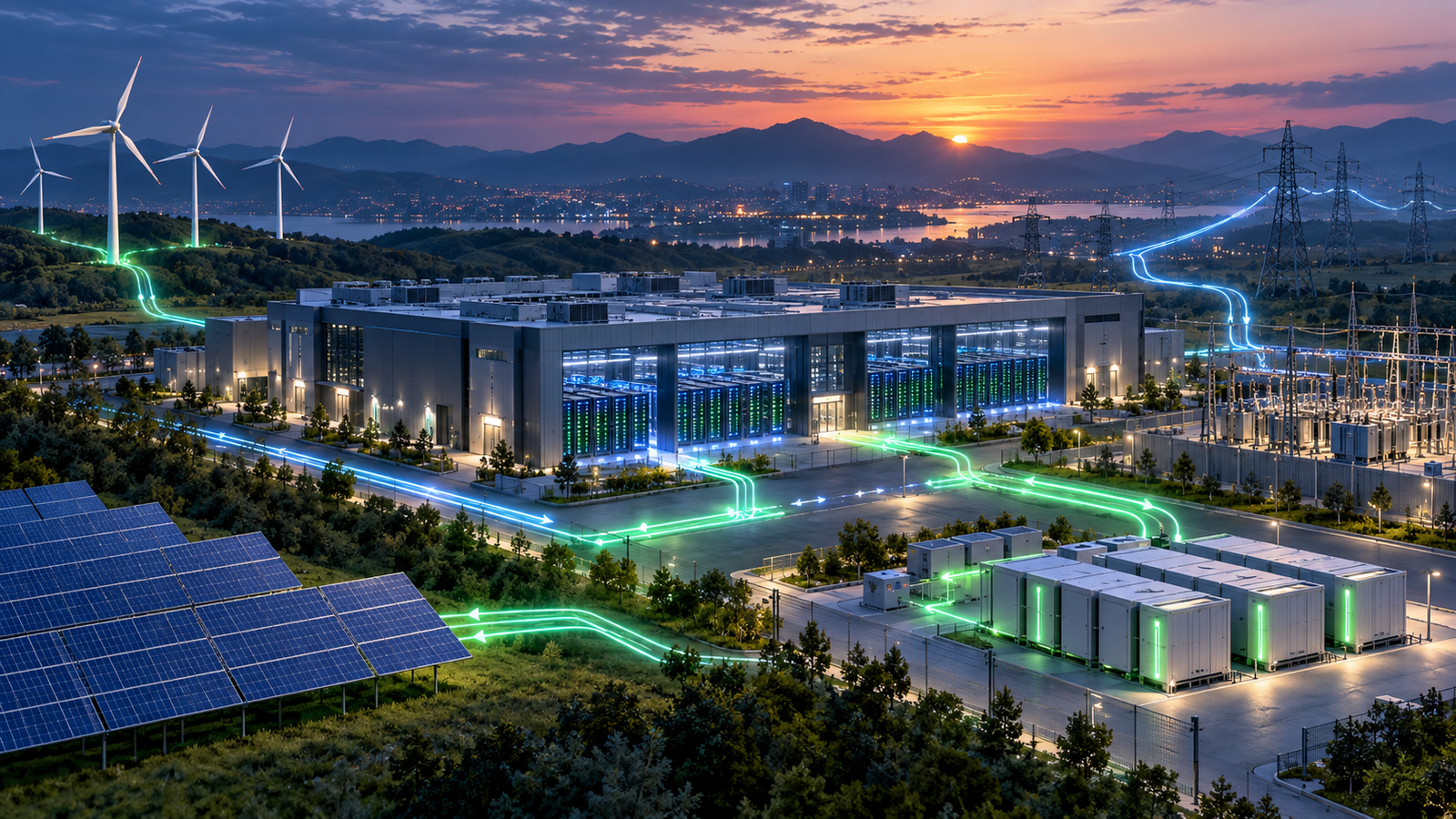
AEMA describes its goal as making AI data centers “good grid citizens” that can dynamically adjust their electricity draw when the power system needs relief. Its public plan lists several ways to do that: intelligent software that adjusts AI workloads, on-site energy storage and co-located generation.
Coalition leaders told Axios that the flexibility could involve pausing or shifting compute jobs, drawing on batteries or using nearby generation. The group plans to make its case to federal and state regulators, regional grid operators and utilities. AEMA is a relaunch of the Advanced Energy Management Alliance, an earlier demand-response trade group founded in 2014.
The alliance presents large estimates for what flexible demand could unlock, including 100 gigawatts of capacity on the existing US grid. Those figures are advocacy claims supported by linked studies, not guaranteed outcomes. Actual benefits will vary by region, tariff, interconnection rules, data-center design and the amount of computing that can safely move in time or location.
Why the timing matters
The launch comes as US regulators reconsider how very large electricity users connect to transmission networks. In June, the Federal Energy Regulatory Commission directed six regional grid operators to justify or revise their tariffs for data centers and other large loads. FERC specifically asked them to address new transmission services for flexible large loads, cost shifting, co-located generation and connection-study processes.
The public pressure is also rising. A new Associated Press-NORC survey found that 53% of US adults were extremely or very concerned about AI’s environmental effects, up from 41% last year. A majority were also highly concerned about the effect of data centers on local electricity prices or water supplies. The survey of 3,424 adults was conducted in July and reported a margin of sampling error of plus or minus 2.2 percentage points.
That context gives the coalition two related objectives: make power available sooner for AI infrastructure and convince regulators and communities that data centers can reduce, rather than simply add to, peak grid stress. Whether it succeeds will depend on enforceable operating commitments and measured performance, not only industry pledges.
Google has already tested the operating model
The underlying idea is not purely theoretical. Google said in an August 2025 infrastructure update that it had reduced electricity demand from machine-learning workloads during three grid events in a demonstration with Omaha Public Power District. The company also announced utility agreements with Indiana Michigan Power and the Tennessee Valley Authority to target ML workloads for demand response.
Google has long shifted non-urgent computing, such as some video processing, to periods when the grid is under less strain. Applying that model to accelerator-heavy AI workloads is harder. Training runs can span days, distributed jobs may be sensitive to interruption, checkpoint recovery consumes time and storage bandwidth, and real-time inference cannot simply stop during a heat wave.
Google acknowledged those limits in its update, noting that flexibility remains at an early stage and that essential services require high reliability. That caveat is central: demand response is a portfolio tool, not a substitute for new generation, transmission, efficient hardware and careful capacity planning.

What developers and platform teams should watch
For most software teams, no immediate cloud API or pricing change was announced. The practical effect will emerge through utility contracts, regional grid rules and the infrastructure controls adopted by hyperscalers and data-center operators.
Platform teams can prepare by separating workloads into operational classes. Latency-sensitive inference, control-plane services and stateful production systems should have explicit protection. Checkpoint-friendly training, evaluation suites, synthetic-data generation, indexing and other batch jobs are stronger candidates for interruption or relocation. Teams should also test restart behavior, checkpoint integrity and queue back-pressure before treating any workload as flexible.
Observability will need to cover both service and energy signals. Useful measures include time to checkpoint, recovery duration, deadline risk, accelerator utilization and the cost of moving data or work across regions. The same discipline used in LLMOps and CI/CD systems—policy gates, measured rollbacks and auditable changes—will be important when a power event can reschedule expensive compute.
Cloud customers should also scrutinize contractual language. A “flexible” capacity tier could lower cost or improve access, but only if interruption windows, notice periods, regional failover, data-transfer charges and service-level exclusions are clear. Teams running retrieval systems should understand how geographic movement affects data locality and the architecture described in retrieval-augmented generation.
What remains unresolved
AEMA has announced an advocacy agenda, not a binding technical standard. It has not yet published common telemetry requirements, workload orchestration interfaces, verification rules or compensation models. Regulators will also have to decide how much flexibility qualifies for faster interconnection and how to verify that promised reductions are available during actual grid emergencies.
There is also a risk that demand flexibility is credited twice—once as a reason to connect a project sooner and again as an operating benefit—without sufficient accountability. Independent measurement, transparent baselines and penalties for non-performance will be essential if utilities rely on data centers as grid resources.
The confirmed development today is the formation of a broad AI-and-energy coalition around flexible data-center demand. The bigger claim—that software-controlled AI workloads can unlock large amounts of reliable capacity while protecting household bills—now has to be proven across real grids, seasons and production workloads.
Sources
This report draws on the AI Energy Management Alliance, Axios reporting on the launch, FERC’s large-load proceedings, Google’s demand-response update and the AP-NORC polling report.


