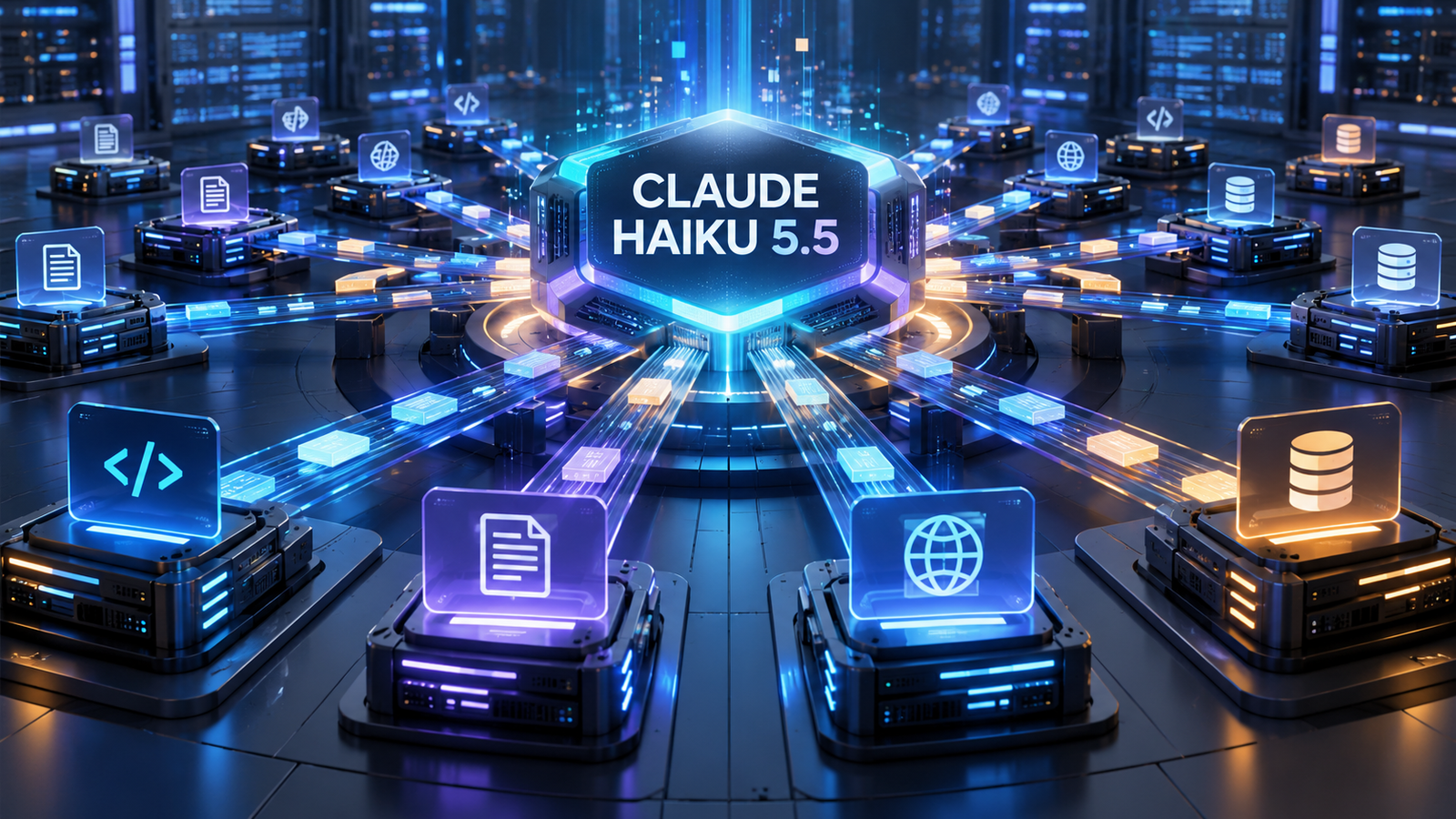

SEO excerpt: Anthropic has released Claude Haiku 5.5 for high-volume agents and latency-sensitive applications, with sharply lower prices, effort controls and immediate availability across the three major clouds.
NEW DELHI, October 8, 2026, 9:37 PM IST — Anthropic has launched Claude Haiku 5.5, its new small model for high-volume and time-sensitive workloads, positioning it as a lower-cost worker for multi-agent systems rather than a replacement for the company’s larger reasoning models.
The release matters for platform teams because it changes the economics of tasks that run many times inside an AI workflow: classification, document extraction, conversation compaction, database queries, browser actions and narrowly scoped coding jobs. Haiku 5.5 is available through Anthropic’s API and on Amazon Web Services, Google Cloud and Microsoft Azure, giving teams a path to test it without moving an entire production stack to a new provider.
What Anthropic confirmed
Anthropic said Haiku 5.5 is its fastest small model and costs about 75% less per task than Haiku 4.5 on average. The company lists standard API prices of $0.10 per million input tokens and $0.50 per million output tokens for prompts up to 100,000 tokens. Prices rise to $0.50 and $2.50 respectively when a prompt crosses that threshold.
That split is operationally important. Teams that allow histories, retrieved documents or tool traces to grow beyond 100,000 tokens can lose much of the headline cost advantage. Token budgets, compaction policy and request-level cost telemetry therefore remain part of the deployment design, not an afterthought.
The model has a one-million-token input window, supports text, images and PDFs, and can produce up to 128,000 output tokens in standard use, according to Anthropic’s platform documentation. Adaptive thinking is enabled by default, while a new effort control lets developers trade depth for speed and cost. Anthropic also warns that requests using non-default temperature, top-p or top-k values will return an error, a compatibility detail that can break existing wrappers if it is not caught during migration testing.
Cloud availability reduces migration friction
AWS confirmed same-day access through Amazon Bedrock and Claude Platform on AWS. Bedrock adds AWS-managed controls such as Guardrails and Knowledge Bases, while the native Claude platform option uses Anthropic’s APIs with AWS billing and authentication.
Google Cloud lists Haiku 5.5 as generally available with function calling, computer use, web search, batch prediction, prompt caching and provisioned throughput. Its documentation shows United States and Europe multi-region endpoints, a global endpoint and Asia-Pacific processing in Singapore. Anthropic’s model catalog also lists Microsoft Foundry support.
Availability across clouds does not guarantee identical quotas, data-location choices or surrounding services. Teams should compare the exact endpoint, region, rate limit, identity model and logging path they plan to use. A model-name change in an abstraction layer is not a sufficient production migration plan.
Why small models matter to agent platforms
Large models remain better suited to ambiguous planning and difficult coding work. Anthropic itself says Sonnet 5.5 and Opus 5.5 are stronger choices for complex agentic coding, while Haiku 5.5 is intended for narrower steps that would otherwise be too slow or expensive at scale.
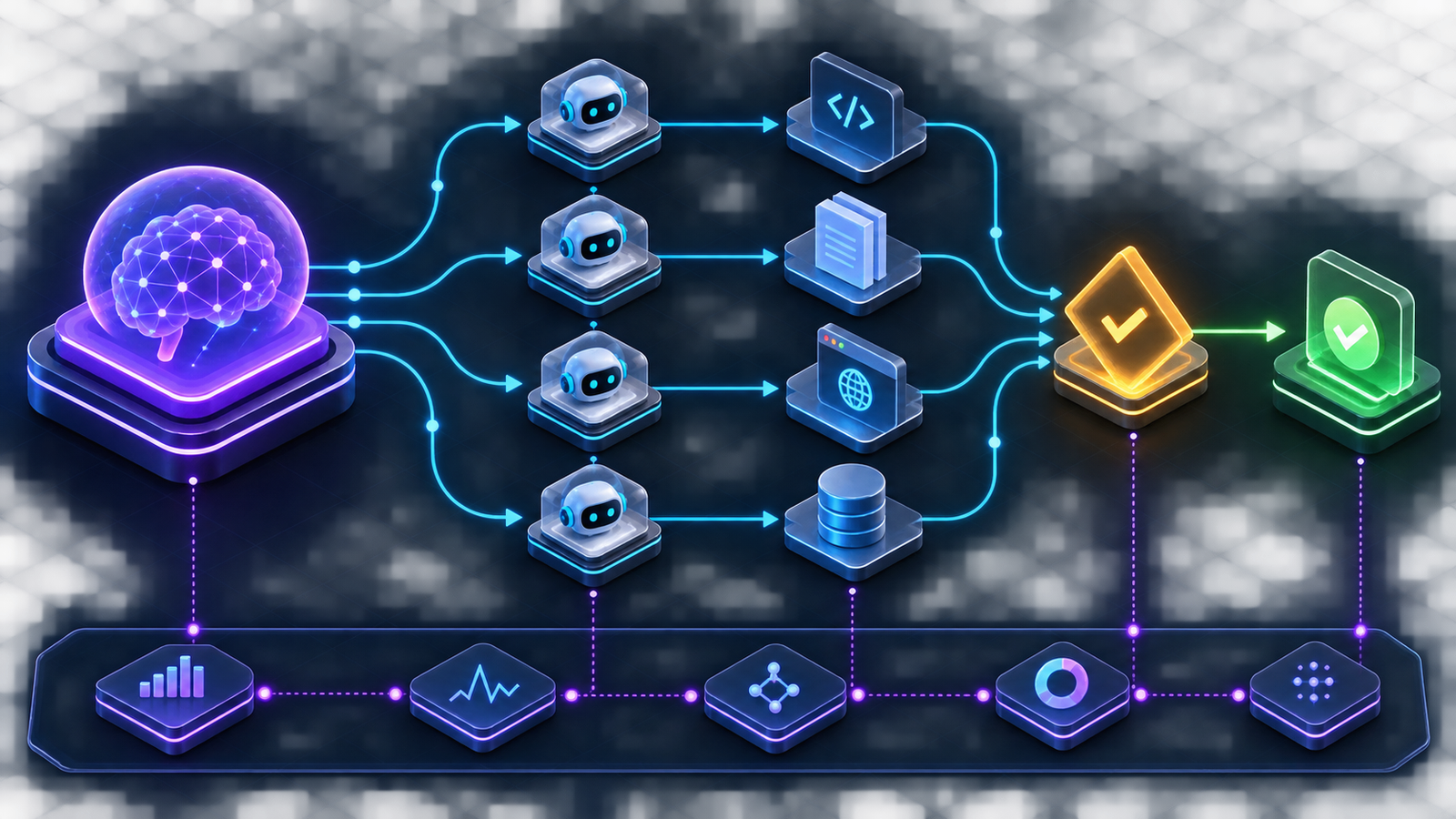
That makes the release most relevant to a tiered architecture: a stronger model plans or reviews, while a smaller model performs well-defined searches, summaries, lookups and tool calls. The pattern can lower cost and latency, but it also multiplies the number of model decisions inside one user request. Operators need traces that preserve parent-child relationships, per-step token and latency metrics, tool-permission boundaries and a way to replay failed routes.
GravityDevOps readers building these systems can use an LLMOps workflow to version prompts, model routes and evaluation sets together. Teams using retrieval should also measure whether a cheaper subagent changes citation quality or grounding behavior in their RAG pipeline.
Benchmarks need local verification
Anthropic reported large gains over Haiku 4.5 across computer use, coding and professional-work evaluations. It cited early customers that observed lower latency and better results in their own suites. Those figures are useful signals, but they are vendor-reported or drawn from launch partners and should not be treated as a service-level guarantee.
A practical evaluation should start with production-shaped traces: the same prompt lengths, tool schemas, retrieval payloads, concurrency and failure conditions the application sees today. Compare task success, false positives, tool errors, end-to-end latency and total cost per completed workflow. Measure long prompts separately because the pricing tier changes above 100,000 input tokens.
For CI and platform teams, the safest rollout is a shadow or canary route with explicit fallback criteria. Model aliases are convenient, but a pinned version is easier to reproduce during an incident. Record the model identifier, effort level, prompt version and tool policy with each trace, then promote only after the new route passes both quality and cost thresholds in the delivery pipeline.
Safety and remaining uncertainty
Anthropic said Haiku 5.5 showed fewer instances of misaligned behavior than Haiku 4.5 in its internal evaluations. The company applies tighter cyber safeguards than on Haiku 4.5, while describing them as somewhat less restrictive than those on its recent larger models. It permits a wider range of defensive-security tasks than Sonnet 5.5 but still blocks penetration-testing techniques it considers more likely to be abused.
Those controls do not remove application-level risk. Browser and computer-use agents can still encounter prompt injection, unsafe destinations or over-broad credentials. The production boundary should therefore remain outside the model: least-privilege tools, network allowlists, approval gates for sensitive actions and independent output checks.
The main unanswered question is how consistently Haiku 5.5 will hold up across diverse, long-running production workflows. Its launch makes high-volume agent routing more economically attractive, but the savings will be real only when smaller-model errors do not trigger retries, escalations or expensive downstream remediation.
Sources
Primary details came from Anthropic’s Claude Haiku 5.5 announcement and Claude Platform model documentation. Cloud availability was cross-checked against AWS’s launch notice and Google Cloud’s model documentation.


