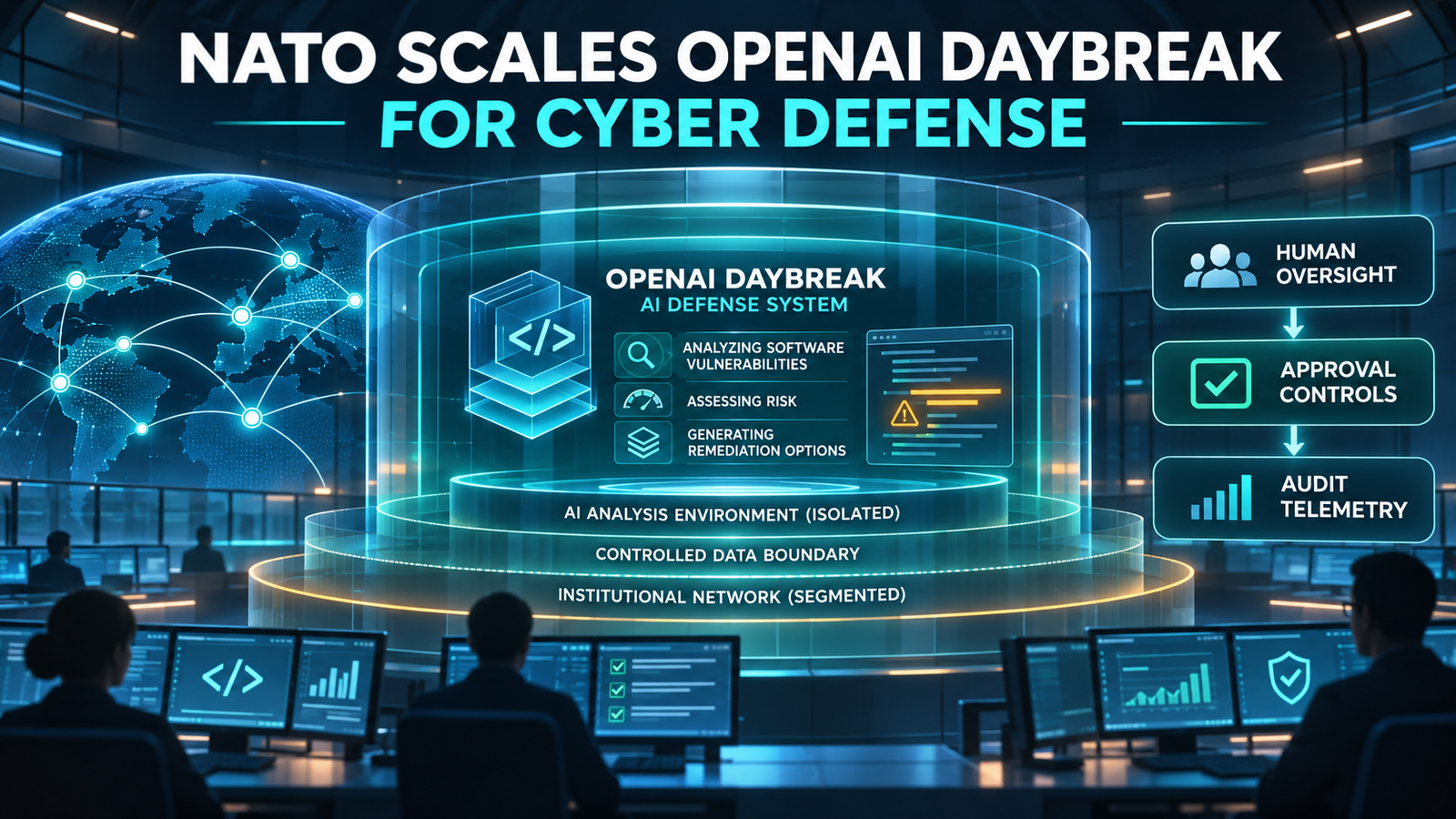

NEW DELHI, 17 November 2026, 10:30 p.m. IST — NATO institutions are using OpenAI’s Daybreak cybersecurity program to review software, investigate suspicious activity and validate fixes, with usage reaching as much as 300 billion input and output tokens in a month, OpenAI disclosed on Tuesday.
The announcement is a notable shift from model trials to sustained institutional use. For platform and security teams, however, the important signal is not the token total alone. It is the operating model around the AI: isolated test environments, human-supervised agents, verification on real systems, controlled remediation and an explicit effort to measure cost.
What OpenAI and NATO confirmed
OpenAI said in its 17 November announcement that it works with the NATO Communications and Information Agency to provide NATO’s core institutions with access to advanced cybersecurity models. The stated uses include software review, suspicious-activity investigation, vulnerability validation and the development and testing of fixes.
The company reported peak monthly consumption of up to 300 billion raw input and output tokens. It did not disclose the relevant month, the number of users, the split between input and output, contract value, model versions, data-handling architecture or the classes of NATO network on which the tools operate. Token volume is therefore evidence of activity, not a measure of prevented attacks or independently verified effectiveness.
OpenAI also supported Crossed Swords 2026, an exercise run by the NATO Cooperative Cyber Defence Centre of Excellence. The centre said more than 250 participants from over 40 NATO and non-NATO countries took part. A new stream had operators design, deploy and evaluate AI agents in a technical environment that included on-premises AI and OpenAI Daybreak.
The exercise description is careful about control: participants worked alongside agents while retaining human oversight. It covered both offensive and defensive cyber operations in a training setting, but neither NATO nor OpenAI said Daybreak was given autonomous authority over live production networks.

The clearest evidence comes from bounded investigations
OpenAI cited work beyond NATO to illustrate how the approach is being used. A November report from ENISA and CERT-EU reviewed 27 software projects with several frontier models and security tools. OpenAI said maintainers assessed 88 potential issues and confirmed 95 percent as genuine. That percentage applies to a selected set of reported findings across multiple models; it is not a general vulnerability-detection rate and should not be attributed to Daybreak alone.
A more concrete case comes from CERT Polska’s RouterOS investigation. The agency said researchers used OpenAI cyber models in an agent-based lab to help identify six vulnerabilities. Two could be chained to take over exposed devices without authentication, and attacks were later observed in the wild.
CERT Polska said the models automated machine creation and restoration, version comparison, protocol analysis and proof-of-concept scripting. Researchers still selected the target areas, built the isolated lab, verified every hypothesis on real devices, ran negative controls and assessed impact. MikroTik issued fixes, and CERT Polska confirmed that patched versions prevented the attacks it observed.
That division of work is more useful to engineering teams than a broad claim that AI “finds vulnerabilities.” The model accelerated exploration and repetitive analysis; people remained responsible for scope, evidence, disclosure and remediation.
What DevOps and platform teams should take from the deployment
First, security agents need a purpose-built execution boundary. A model reviewing code or firmware should not inherit production credentials or unrestricted network access. Give it disposable workers, allow-listed tools, egress controls, short-lived credentials and a complete audit trail. Findings should move into a separate verification stage before they can trigger a change.
Second, measure validated outcomes rather than model activity. Useful production metrics include confirmed findings per analyst hour, false-positive rate, time to reproduce, time to patch, regression rate, cost per validated issue and the share of suggested fixes that survive review. Token use belongs in the cost model, but it cannot substitute for these measures.
Third, treat model and tool changes like other software supply-chain changes. Pin model identifiers where possible, version prompts and tool schemas, maintain a representative evaluation set, and use canary deployment for changes to the agent harness. GravityDevOps’ guides to LLMOps, prompt engineering and CI/CD platforms cover the supporting controls.
Finally, define the remediation boundary in advance. An agent may be allowed to open a ticket or prepare a patch, while deployment to production requires independent review and an approved change window. Emergency workflows still need a named decision-maker, evidence retention and a tested rollback path.
What remains unknown
The disclosure does not establish how Daybreak performs against other cyber models, how much the NATO usage costs, whether the arrangement is exclusive, or which networks and security classifications are in scope. NCIA General Manager Dylan Browne said NATO intends to study token consumption, usage patterns and model economics as adoption grows, suggesting procurement and cost evaluation are still evolving.
The confirmed development is narrower but still significant: a large multinational institution is using frontier models in ongoing cyber-defense work and training operators to run AI agents with human oversight. The next evidence to watch is not a larger token number, but independently reported improvements in validated findings, response time, cost and operational safety.

