
SEO excerpt: Reflection AI has released Beam’s Apache-2.0 model weights for coding agents, giving platform teams new self-hosting options alongside substantial infrastructure and safety responsibilities.
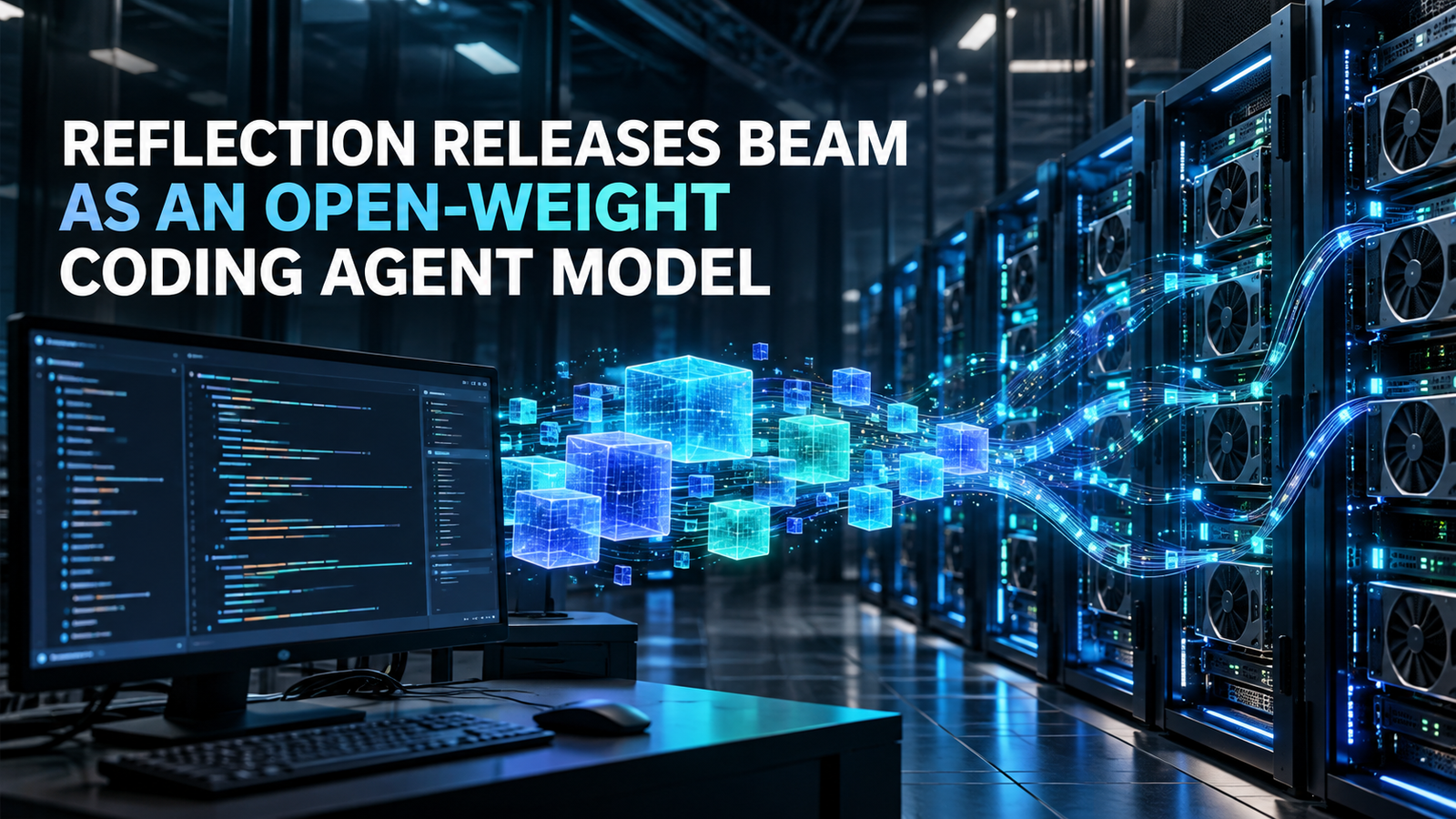
NEW DELHI, October 18, 2026, 5:00 PM IST — Reflection AI has released the model weights for Beam, a large open-weight system designed for coding, reasoning and long-running agent workflows, moving the model from an early-access preview into a release that developers can download, self-host and customize.
The October 16 release includes BF16, FP8 and NVFP4 checkpoints under the Apache 2.0 license, a model card and a separate safety report. Reflection says more than 40 cloud, infrastructure and developer-tool partners support the model at launch, including Amazon Web Services, Google Cloud, Microsoft Foundry, Nvidia, Cloudflare, CoreWeave, Ollama and several hosted inference providers.
Why it matters now: open weights give engineering teams more control over where an AI coding agent runs, how its serving stack is configured and whether the model is adapted to private repositories. They do not make the system operationally simple. Beam has 501 billion total parameters, even though its sparse mixture-of-experts architecture activates about 23 billion for each token. Storage, memory, sharding, long-context caching, tool permissions and safety controls remain production concerns.
What Reflection released
Reflection’s release announcement says Beam is intended for software engineering, command-line work, tool use and other multi-step tasks. Developers can obtain the weights from Hugging Face, use Reflection’s API or deploy through partner platforms. The company is also publishing integrations and customization workflows around the model.
The accompanying model card describes Beam as a text-only system developed predominantly for English, with a one-million-token context window and a June 30, 2026 knowledge cutoff. The release includes instruction-tuned checkpoints in three numerical formats. The lower-precision FP8 and NVFP4 variants can reduce weight-memory pressure, but production sizing still depends on checkpoint storage, KV cache, batch size, concurrency, runtime overhead and parallelism.
Reflection reports strong results on coding, terminal, tool-use and reasoning evaluations. Those figures should be treated as vendor-reported results rather than a guarantee for a particular repository or workflow. The company’s own earlier announcement showed Beam behind several competing open models on some agentic coding tests, while presenting inference efficiency as its main advantage.
Cloud support arrives with the weights
AWS said Beam is available through SageMaker JumpStart in the US East regions in Northern Virginia and Ohio. Its deployment guidance offers a managed real-time endpoint as the simpler path and SageMaker HyperPod Inference with SGLang or vLLM for teams that need Kubernetes-level control over the serving image, quantization and distributed execution.
Google Cloud also published day-zero deployment recipes for Beam using llm-d with vLLM or Nvidia Dynamo with SGLang. Google emphasizes prefix-aware routing, separate prefill and decode resources, speculative decoding and tiered KV-cache storage. Its stated throughput and latency gains are based on customer benchmarking and should not be generalized without workload-specific testing.
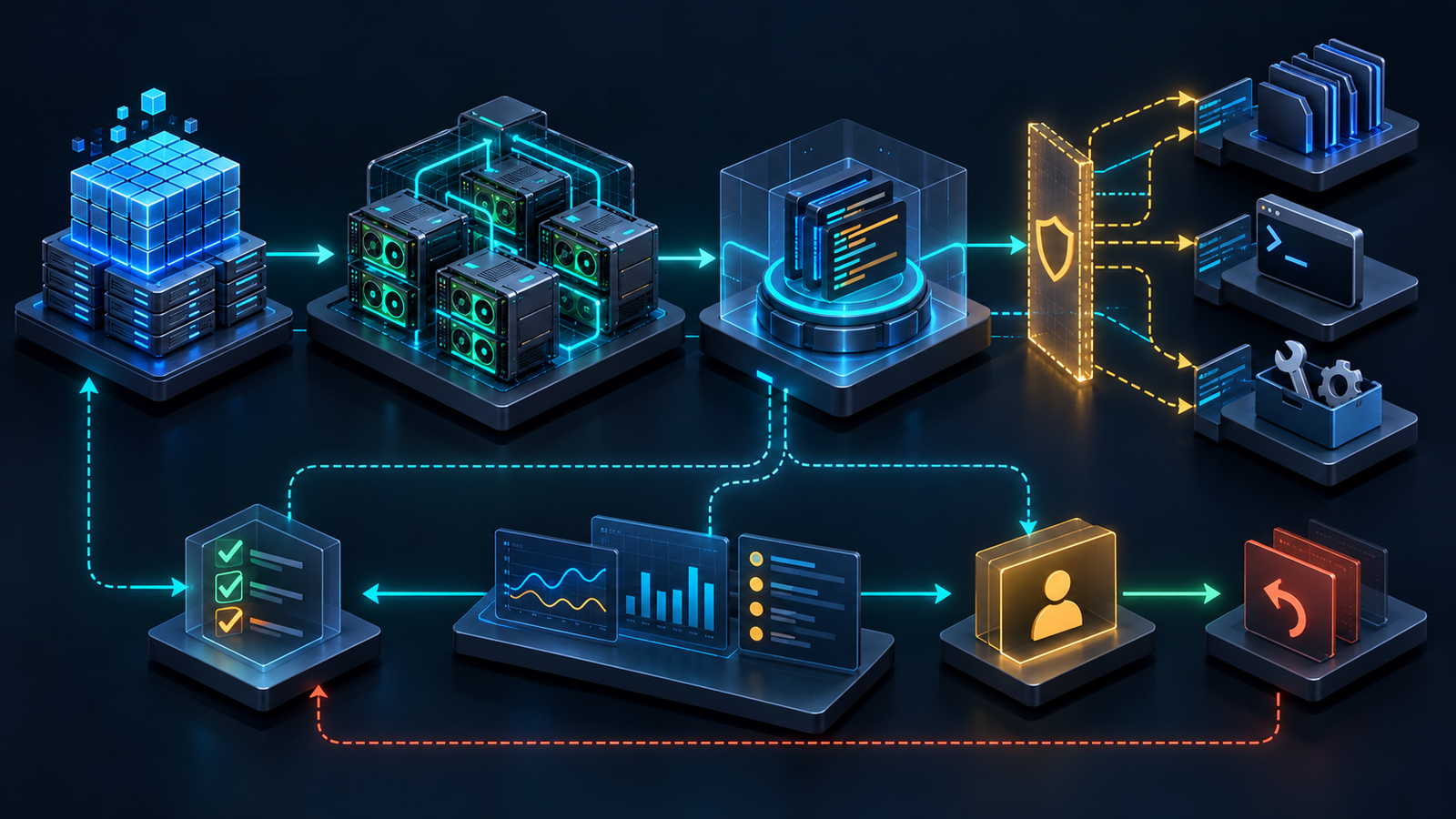
The cloud guidance exposes the central operations problem. Coding agents repeatedly append file reads, patches, compiler output and tool responses to their working context. If each turn lands on a different replica, the serving layer may recompute a large prompt instead of reusing a warm prefix. Long sessions can also exhaust GPU memory with cached attention state. Model-level token efficiency does not remove those cluster-level bottlenecks.
What platform teams should test
The practical decision is not simply whether Beam can run. Teams should compare task completion, regression rate, time to first useful action, total GPU time, generated tokens, tool calls and recovery behavior against the models they already operate. A smaller number of active parameters can lower per-token compute, but it does not by itself establish lower cost per successfully completed engineering task.
A controlled pilot should use representative repositories and versioned issue sets. Keep the model, quantization, serving runtime, harness, system prompt and tool permissions fixed for each comparison. Record full traces and evaluate the final repository state with tests, security checks and human review rather than relying only on benchmark scores or an agent’s claim that the task is complete.
Self-hosting also moves more responsibility onto the operator. Coding agents should receive short-lived, least-privilege credentials, run in isolated workspaces and require approval for production changes or sensitive network actions. GravityDevOps’ guide to AI agent security covers prompt injection, tool permissions and sandboxing, while its LLMOps overview explains the versioning, evaluation and monitoring layer needed around production models.
Safety evidence is useful but not a deployment control
Reflection’s safety report assesses Beam as having a limited effect across biological weapons, chemical weapons, loss-of-control and cyber-offense risk categories under the company’s Open Safety Framework. Reflection also reports that the BF16 model refused or redirected 88.9% of harmful requests in its combined Iris evaluations while complying with 81.5% of harmless requests.
Those results describe tested model behavior, not the security of an agent deployment. Open weights can be fine-tuned, merged or run with different prompts and tools, and Reflection’s model card explicitly permits broad customization. Organizations still need their own abuse testing, prompt-injection defenses, network controls, secret isolation, human escalation paths and incident logging.
A meaningful release with a high operating bar
Beam’s public weights, permissive license and simultaneous support across major infrastructure providers make this a substantive release rather than a model announcement with access deferred to an unspecified date. It expands the set of coding-agent models that teams can inspect and operate within their own control boundary.
The tradeoff is equally concrete. A 501-billion-parameter checkpoint remains a distributed-systems project, and the longest agent sessions magnify caching, routing and observability problems. For DevOps and platform teams, Beam is best viewed as a new candidate for a measured evaluation pipeline, not a reason to bypass one.

