
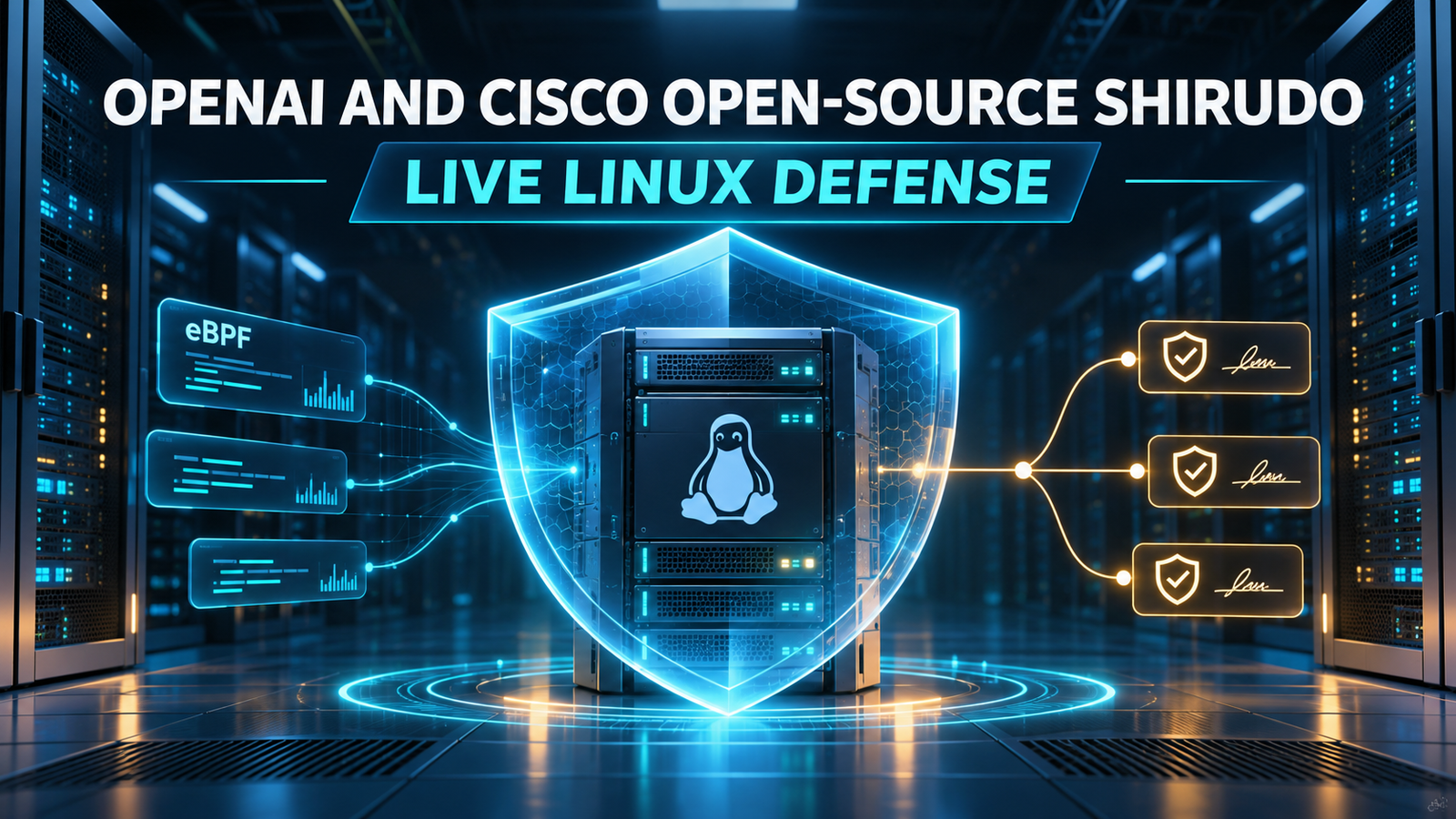

NEW DELHI, November 24, 2026, 5:00 PM IST — OpenAI and Cisco have released Shirudo, an open-source security runtime designed to let operators place temporary, signed protections on running Linux systems while permanent patches are tested and deployed.
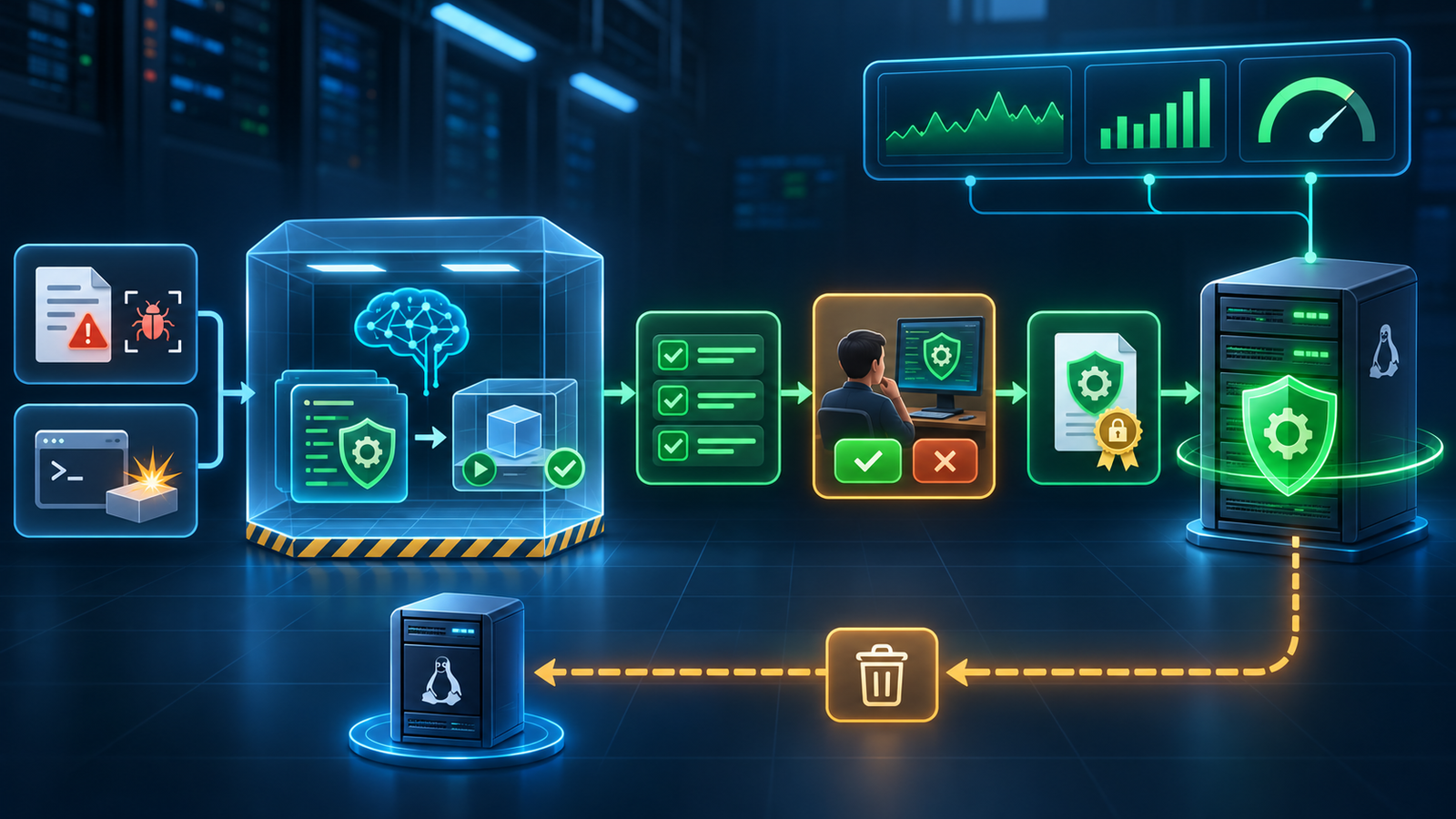
The project uses eBPF programs, which Shirudo calls shields or upatches, to observe or block a vulnerable path without rebooting the host. OpenAI and Cisco say AI agents can help investigate a flaw and generate a narrowly targeted mitigation, but an operator must approve what is deployed.
For DevOps, platform engineering and security teams, the immediate significance is not that patch management has been automated away. It is that a new, agent-oriented layer is being proposed for the dangerous interval between disclosure and a fully tested patch. Shirudo is still pre-release software, requires non-standard production prerequisites and has not yet been independently validated at broad production scale.
What OpenAI and Cisco confirmed
OpenAI and Cisco announced Shirudo on November 23. The OpenAI release describes four intended capabilities: live protection, agent-assisted investigation and shield development, cryptographically verified deployment, and hardware-backed evidence through a Trusted Platform Module.
A proposed shield can first run in an observation mode so teams can measure its effect on legitimate workloads. The shield is signed before loading, the Linux eBPF verifier applies its normal safety checks, and Shirudo records changes to the active shield set in a TPM-backed measurement that operators can verify.
The companies also published a controlled demonstration involving Java4Shell. According to OpenAI, Codex generated a shield that added an input check to Java’s Base64 decoder and attached it to a running Elasticsearch process. The malicious input was rejected while the service continued running. Cisco separately said Shirudo generated detection and blocking code for both Java4Shell and a recent PHP vulnerability.
Shirudo is a mitigation layer, not a replacement for patches
The distinction matters operationally. A temporary eBPF shield can reduce exposure to a known exploit path, but it does not remove the underlying vulnerable code. Teams still need to inventory affected assets, apply the vendor fix, test it, deploy it through their normal change process and retire the temporary control.
Cisco’s Isovalent team says Shirudo has its roots in Tetragon, the open-source eBPF security platform, but has been rewritten around code-generating agents. The runtime can deliver BPF upatches for kernel-level hooks and Java upatches for application code. It can also export telemetry to configured OpenTelemetry collectors and pull signed packages from OCI registries.
That architecture creates a useful automation surface, but also a high-impact one. A false positive in an enforcement program can disrupt production traffic; a performance regression at a kernel hook can affect every workload on a host; and a compromised signing workflow can turn a defensive delivery channel into a privileged attack path. Linux’s eBPF verifier checks program safety properties, but it does not prove that a mitigation expresses the correct business or security intent.
Production readiness remains limited
The project’s own GitHub repository labels Shirudo as pre-release. Its current production targets require a Linux kernel that includes the signed-loader interface and Shirudo’s kernel patches, as well as TPM 2.0. The repository reports continuous-integration coverage for x86-64, host tests on Arm64 and pending target validation for RISC-V.
Those requirements mean the release is better treated as an evaluation target than a drop-in control for ordinary Kubernetes fleets today. OpenAI provides a virtual-machine quickstart, and Cisco is asking kernel developers, infrastructure operators, security researchers and vendors to test shields against their own builds and report both missed attacks and broken legitimate traffic.
What platform teams should evaluate now
Teams exploring Shirudo should begin in an isolated lab with representative traffic, not on a production node. A useful evaluation should measure exploit coverage, false positives, CPU and latency overhead, restart and rollback behavior, and compatibility with the kernels and container runtimes already in service.
The signing authority also needs to sit outside the agent’s unrestricted reach. Platform owners should require human approval for enforcement, short-lived credentials for the build and delivery pipeline, separate roles for authors and approvers, immutable audit logs, staged rollout and an automatic removal condition when the permanent patch lands.
Existing operational disciplines still apply. Teams should connect shield state to asset inventory and vulnerability management, expose health and enforcement metrics through their observability stack, and test failure paths in the same way they test deployment rollbacks. GravityDevOps’ guides to LLMOps, retrieval-augmented generation and CI/CD tooling provide background on the adjacent model, data and delivery controls.
What remains uncertain
OpenAI and Cisco have demonstrated selected vulnerabilities, not a general guarantee that agents can safely produce mitigations for arbitrary flaws. The companies have not published broad independent measurements for exploit blocking, false-positive rates or performance overhead across production kernels and workloads.
The more important near-term result may therefore be the open technical boundary Shirudo establishes: agent-generated defenses must be signed, observable, reviewable and disposable. Whether that approach becomes a practical part of incident response will depend on community testing, upstream kernel support and evidence that shields fail safely under real traffic.
Sources: OpenAI’s Shirudo announcement, Cisco’s launch release, Cisco Isovalent’s technical overview, and the Shirudo source repository and README.


