
Meta’s public preview of the Meta Model API gives U.S. developers access to Muse Spark 1.1, adding another paid agentic coding model for teams weighing cost, routing, safety, and production governance.
NEW DELHI, July 10, 2026, 6:20 p.m. IST – Meta has opened developer access to Muse Spark 1.1 through the new Meta Model API, moving its latest agentic model from a consumer assistant feature into a paid API that developers can test inside coding and automation workflows.
The release matters because model choice is no longer just an application-team decision. For DevOps, platform engineering and AI teams, a new coding-focused API introduces fresh questions about provider routing, token budgets, safety review, data handling and how much agentic work should be allowed inside delivery pipelines.
What Is Confirmed
Meta’s own Muse Spark 1.1 announcement says the model is a significant upgrade from the first Muse Spark release and points developers to the new Meta Model API. The Meta Model API product page describes direct, self-serve access to Muse Spark with free credits, web search grounding, OpenAI SDK compatibility and pay-as-you-go pricing.
Meta’s developer guide frames the release around first API calls, coding primitives and agentic patterns. Axios reported that Meta is charging $1.25 per million input tokens and $4.25 per million output tokens, while noting the company’s emphasis on coding and longer tasks. The Verge reported that Muse Spark 1.1 is available to U.S. developers through a public API preview and that new API accounts include $20 in free credits.
Why It Matters Now
The immediate news is not simply that Meta has another model. It is that Meta is placing a model designed for coding, tool use, multimodal inputs and agentic workflows behind a developer-facing API at a time when engineering teams are already comparing OpenAI, Anthropic, Google and open-source options for different classes of work.
For teams building internal copilots, code-review assistants or deployment agents, the operational question becomes whether a model can be routed safely and economically. OpenAI SDK compatibility may lower integration friction, but it does not remove the need for provider-specific testing. Prompt behavior, tool-call behavior, refusal behavior, latency and output quality still need to be measured inside a team’s own repositories and runbooks.
That puts the release squarely in the territory of LLMOps. Teams need model evaluation, observability, cost controls and change management in the same way they already manage build systems, cloud services and CI/CD tooling.
Technical Background
Muse Spark is Meta’s in-house model family for reasoning and multimodal tasks. The new API preview gives developers a route to use Muse Spark 1.1 outside Meta’s own apps, including workflows where agents inspect code, call tools, reason over documents or coordinate longer tasks.
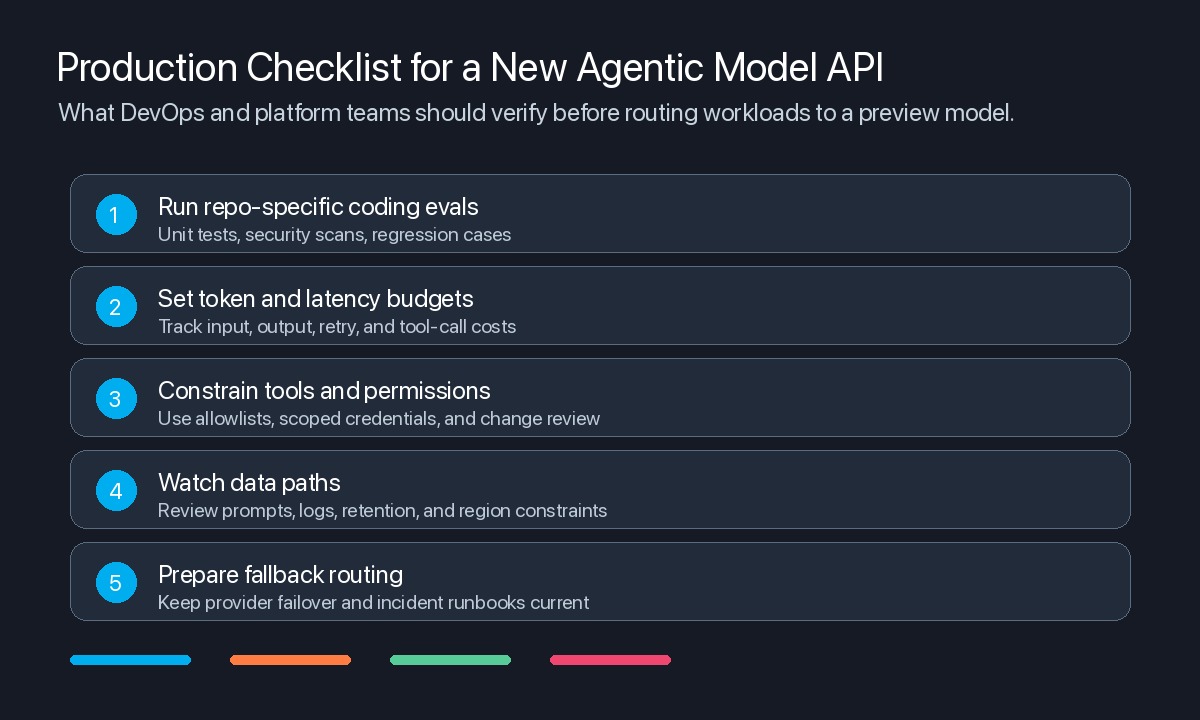
Meta also points readers to a Muse Spark 1.1 evaluation report for its safety posture. That matters for enterprise buyers, but it should be treated as a starting point rather than a substitute for local review. Teams still need to evaluate what data leaves their environment, how logs are retained, which regions are supported, and what controls exist around high-impact tool use.
Impact For Developers And DevOps Teams
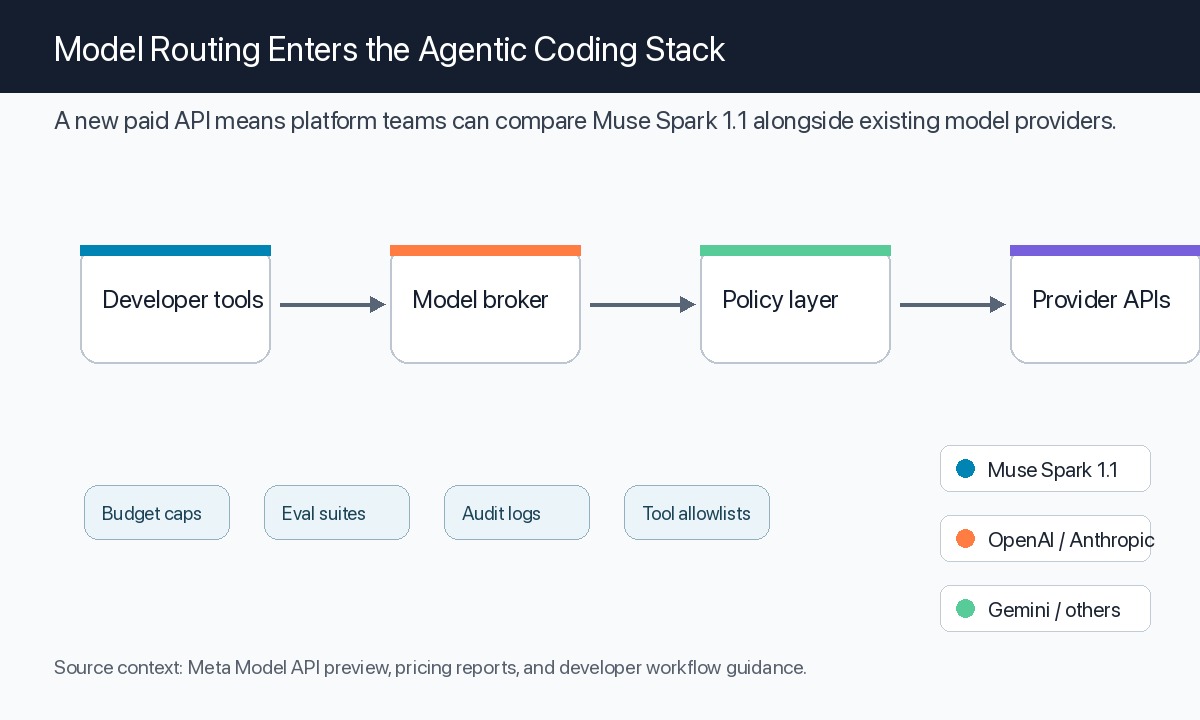
For developers, the practical change is another model endpoint to benchmark for coding help, bug fixing, multi-step automation and document-heavy tasks. For platform teams, the change is broader: model selection should move behind a broker or gateway where policies can enforce which provider is used for which workload.
A reasonable first test is not a generic benchmark. It is a repo-specific evaluation set: real pull requests, failing tests, security lint findings, migration tasks and incident runbooks. Teams should compare output quality, latency, token usage and failure modes before sending production work to a preview model.
Cost also deserves attention. Lower headline token pricing can help experimentation, but agentic systems often spend tokens in retries, planning steps, tool calls and context loading. That is why prompt design, retrieval boundaries and context strategy still matter. Teams using prompt engineering and RAG patterns should track total workflow cost, not just per-token prices.
Balanced View
Meta’s announcement increases competition in developer AI infrastructure, but public preview access is not the same thing as a mature enterprise rollout. The important unknowns include reliability under production load, enterprise support depth, data-governance terms, regional availability and how the model behaves in constrained tool-use environments.
The strongest read for technical decision-makers is cautious experimentation. Add Muse Spark 1.1 to evaluation pipelines if the API is available to your team, but keep provider abstraction, audit logs, budget caps and fallback routing in place. The teams that benefit most will be the ones that can compare models with evidence rather than switching providers on launch-day claims.
Sources
This article is based on Meta’s Muse Spark 1.1 announcement, the Meta Model API product page, Meta’s developer guide, Meta’s Muse Spark 1.1 evaluation report, and reporting from Axios and The Verge. GravityDevOps also checked recent site posts and found no existing Muse Spark 1.1 article before publication.


