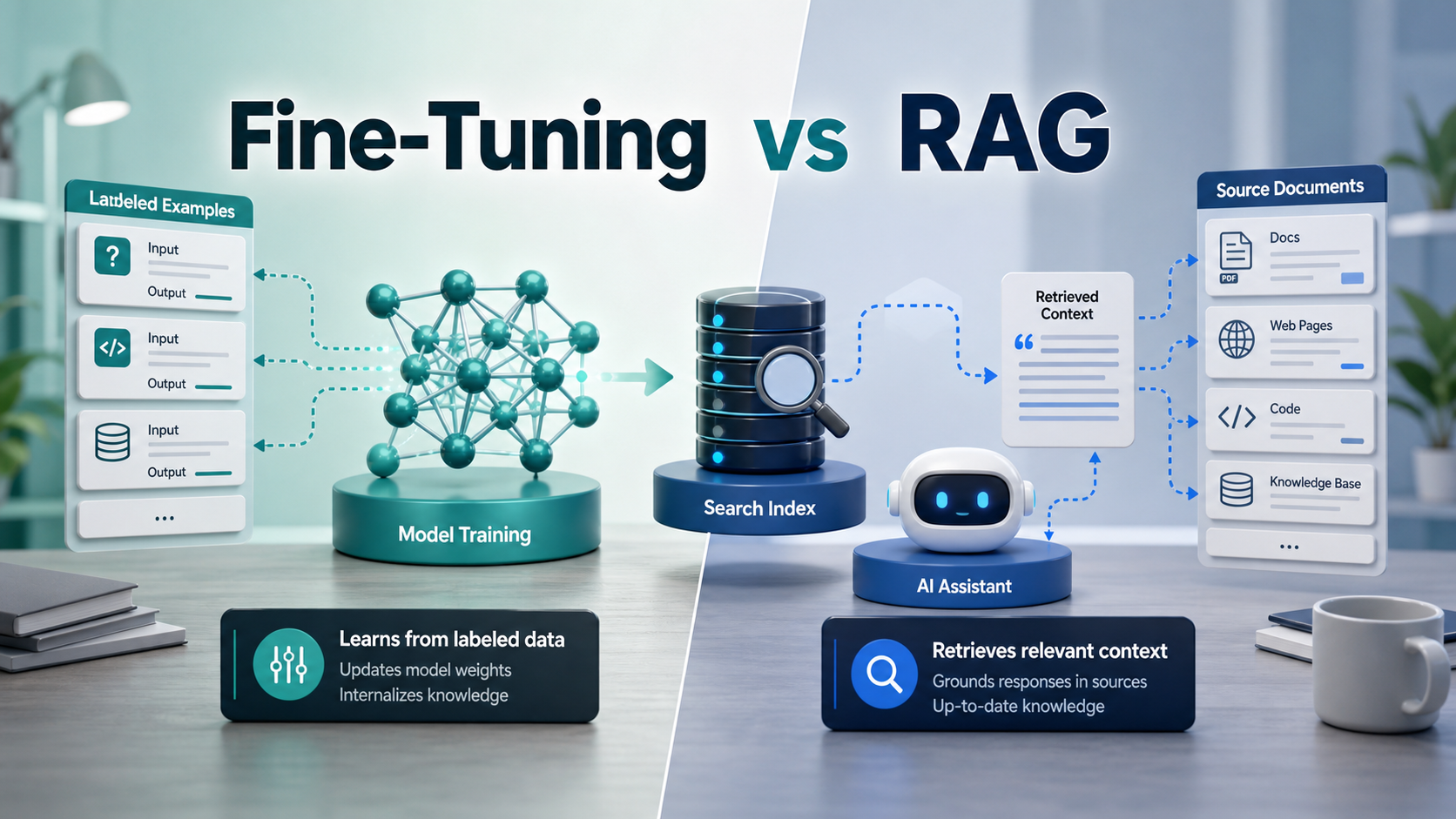

SEO excerpt: Fine-tuning vs RAG is not a choice between two ways to “add knowledge” to an AI app. RAG is usually best for fresh facts and private documents, while fine-tuning is best for behavior, format, tone, and task performance. This guide explains when to use each, when to combine them, and how to decide without wasting budget.
Quick Answer: Use RAG when the model needs to answer from current, private, or frequently changing knowledge such as product docs, policies, tickets, runbooks, PDFs, or database records. Use fine-tuning when the model already has enough knowledge but must behave differently: follow a strict output format, classify better, use a consistent domain style, apply examples more reliably, or perform a repeated task with less prompting. Use both when the app needs grounded knowledge from retrieval and a model that is trained to use that context in a specific way.
Fine-Tuning vs RAG: The Core Difference
Fine-tuning and retrieval-augmented generation, usually shortened to RAG, both customize large language model applications. They solve different problems.
RAG changes the context. It retrieves relevant information from an external source and gives that information to the model at request time. The base model is not changed. Your application might retrieve chunks from a vector database, a keyword search index, a SQL result, a ticketing system, or a documentation site, then ask the model to answer using that retrieved context.
Fine-tuning changes the model behavior. It trains a model on examples so the model becomes better at a task, style, format, or decision pattern. The fine-tuned model may become more consistent, cheaper to prompt, or better aligned with a repeated workflow. But fine-tuning is not the best way to keep a model updated with facts that change every week.
A simple rule helps: if your problem is missing or changing knowledge, start with RAG. If your problem is repeated behavior, consider fine-tuning. If your problem is both, use a hybrid architecture.
What Is RAG?
RAG is an application pattern where the model receives retrieved knowledge before generating an answer. A typical RAG flow looks like this:
- Ingest documents such as Markdown files, PDFs, wiki pages, tickets, or database exports.
- Split the content into useful chunks with metadata such as source, URL, date, product, team, or access group.
- Create embeddings for those chunks and store them in a vector database or search service.
- At query time, retrieve the most relevant chunks using vector search, keyword search, filters, reranking, or a hybrid approach.
- Pass the retrieved context into the model with instructions to answer from the evidence.
- Return an answer with citations, source links, or confidence notes where appropriate.
Modern RAG systems are not only vector search plus a prompt. Strong implementations often include query rewriting, metadata filters, permission checks, reranking, chunk quality evaluation, observability, and fallback behavior when retrieval is weak.
If you are new to the concept, read the GravityDevOps primer on what RAG is and how retrieval-augmented generation works before going deeper into this comparison.
What Is Fine-Tuning?
Fine-tuning trains a model using examples. Each example shows the model what kind of input it will receive and what kind of output it should produce. Depending on the platform and model family, fine-tuning can target chat behavior, structured outputs, classification, extraction, tool-use style, domain tone, or repeated decision patterns.
For example, a company might fine-tune a model so it always transforms noisy support tickets into a strict JSON schema, labels cloud incidents using the company’s incident taxonomy, or rewrites raw engineering notes into a consistent release-note style.
Fine-tuning can reduce prompt length because examples that were previously stuffed into every prompt become part of the trained behavior. It can also improve consistency for tasks where prompting works sometimes but fails too often at scale.
The important caveat: fine-tuning should not be treated as a document upload feature. If you want the model to answer from today’s policy, this week’s pricing, or an internal runbook that changes often, retrieval is usually the better foundation.
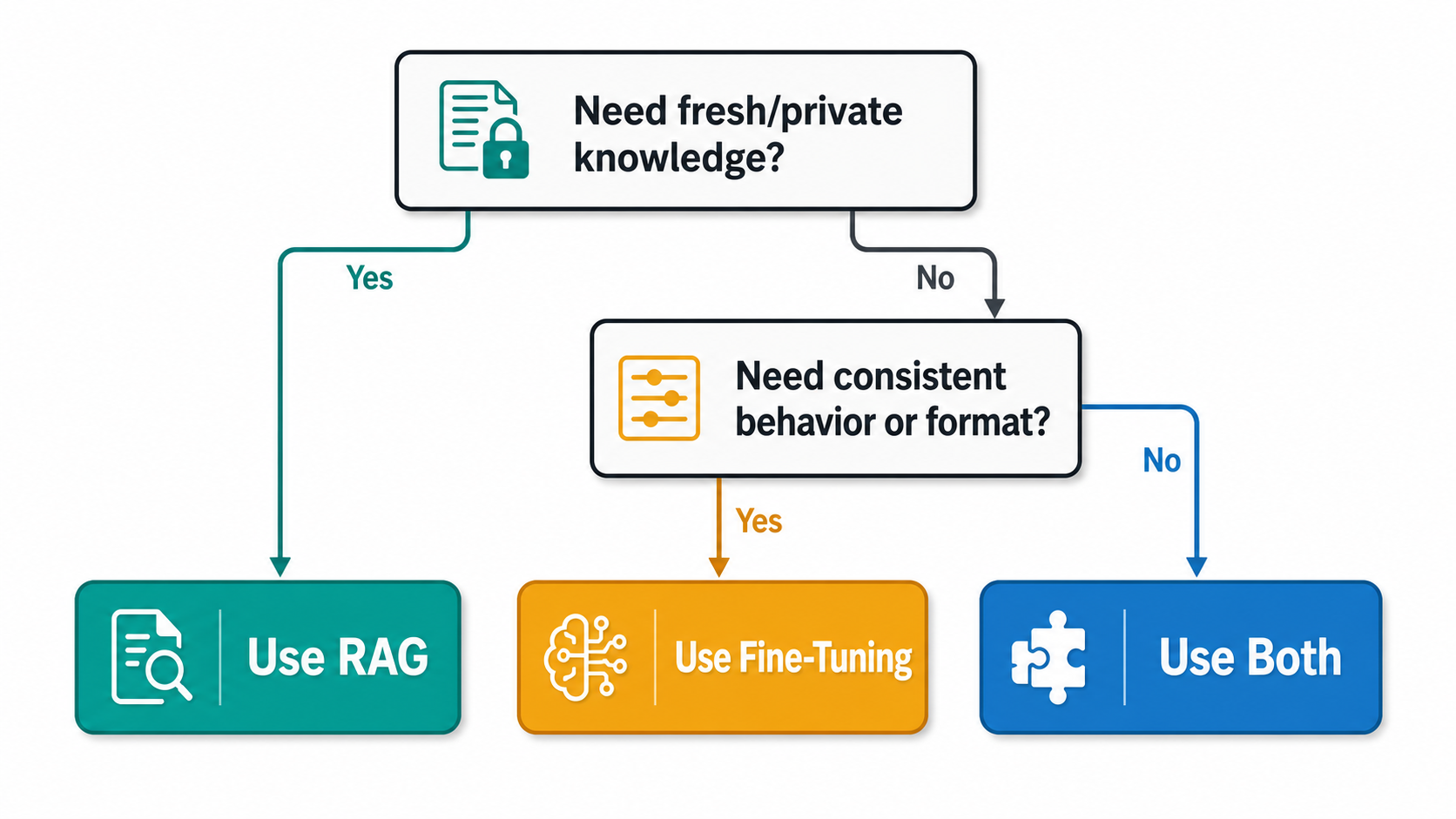
Decision Table: When to Use RAG, Fine-Tuning, or Both
| Need | Best Starting Point | Why |
|---|---|---|
| Answer questions from private documents | RAG | The knowledge lives outside the model and may require citations or access controls. |
| Use fresh or frequently changing facts | RAG | You can update documents or indexes without retraining a model. |
| Follow a strict response format every time | Fine-tuning | Training examples can improve consistency when prompting alone is not enough. |
| Classify, route, or transform repeated inputs | Fine-tuning | The task pattern is stable and can be learned from examples. |
| Summarize company documents with citations | RAG | The model must ground answers in source material. |
| Make the model use retrieved context in a specialized way | Both | RAG supplies knowledge; fine-tuning teaches the model how to apply it. |
| Reduce long prompt templates for a stable workflow | Fine-tuning | Repeated examples can replace some instruction-heavy prompts. |
| Build a customer support assistant over docs and tickets | RAG first, then possibly fine-tuning | Grounding matters first; fine-tuning can later improve tone, escalation, and output structure. |
Use RAG When Knowledge Must Stay Current
RAG is usually the right answer when your AI app needs information that changes faster than a model can be retrained, evaluated, and redeployed. Examples include:
- Product documentation and release notes
- Security policies and compliance guidance
- Cloud architecture standards
- Runbooks, incident records, and postmortems
- Support tickets and customer-specific knowledge
- Pricing pages, plan limits, and contract terms
- HR policies and internal wiki content
In these cases, the model should not “remember” the answer from training. It should retrieve the current source and answer based on that source. This is also easier to audit. When someone asks why the assistant gave a recommendation, you can inspect the retrieved chunks and trace the answer back to source documents.
Practical RAG Example: Internal DevOps Assistant
Imagine a DevOps team wants an assistant that answers questions like:
- “How do we rotate production database credentials?”
- “What is our EKS upgrade checklist?”
- “Which Grafana dashboard should I check for API latency?”
- “What changed in the last incident review?”
Fine-tuning a model on old runbooks would be risky because procedures change. A RAG system can index the latest runbooks, pull the relevant pages at query time, and include links to the exact sources. If the team updates the Kubernetes upgrade checklist, the assistant can use the new version as soon as ingestion runs.
This fits naturally with platform and DevOps workflows. If your team already works with observability, deployment pipelines, and Kubernetes, connect this guide with the GravityDevOps articles on CI/CD tools and LLMOps to think about AI features as production systems, not demos.
Use Fine-Tuning When Behavior Must Be Consistent
Fine-tuning becomes more attractive when the input-output pattern is stable and you can collect high-quality examples. Good use cases include:
- Classifying support tickets into a company-specific taxonomy
- Converting messy text into a strict JSON schema
- Producing responses in a specific brand or compliance-approved style
- Extracting structured fields from recurring document types
- Generating code comments, summaries, or review notes in a consistent format
- Improving tool-calling decisions for repeated workflows
For example, suppose a platform team receives thousands of incident notes per month. The team wants each note converted into this schema:
{
  "service": "payments-api",
  "severity": "sev2",
  "customer_impact": "checkout latency above SLO for 17 minutes",
  "suspected_cause": "connection pool exhaustion",
  "next_action": "review database pool settings and alert thresholds"
}
A prompt with examples may work at first. But if the model keeps drifting from the schema, misclassifying severity, or adding prose outside JSON, fine-tuning can help. The training data should contain realistic inputs and ideal outputs, including edge cases where the correct answer is “unknown” or “needs human review.”
Do Not Use Fine-Tuning as a Knowledge Base
A common mistake is trying to fine-tune a model with a pile of PDFs so it can answer questions about those PDFs. That usually creates three problems:
- Updates are slow. Every document change may require a new training run, evaluation, and deployment.
- Sources are opaque. The model may not provide reliable citations because the knowledge is buried in weights rather than retrieved as evidence.
- Facts can blur. Fine-tuning can improve behavior, but it is not a precise database lookup mechanism.
If your users ask factual questions and expect current answers with source links, use RAG first. If the assistant then struggles with a specific behavior after retrieval works well, consider fine-tuning as a second step.
Architecture Pattern: RAG First, Fine-Tune Later
For most teams building their first serious AI application, the pragmatic path is:
- Start with prompting. Write clear instructions and test them on realistic examples.
- Add RAG if the model needs external knowledge. Build a small retrieval pipeline over trusted sources.
- Measure retrieval quality. Check whether the right chunks are retrieved before blaming the model.
- Improve chunking and metadata. Many RAG failures come from poor ingestion, not model weakness.
- Fine-tune only after patterns are proven. Use production examples to improve stable behavior.
- Evaluate before and after. Compare accuracy, hallucination rate, format compliance, latency, and cost.
This order avoids premature training. It also gives you better data. Once real users interact with the app, you can identify the failures that fine-tuning can actually fix.
RAG Implementation Checklist for Beginners
If you are building a RAG prototype, use this checklist:
- Choose trusted sources. Start with a small set of documents that are accurate and useful.
- Chunk intentionally. Split by headings and semantic sections where possible. Avoid random fixed-length chunks when document structure matters.
- Attach metadata. Store source URL, document title, owner, last updated date, product, and permission group.
- Use hybrid retrieval where useful. Vector search is strong for meaning; keyword search can be better for exact service names, error codes, and product IDs.
- Rerank results. A reranker can improve the top context that reaches the model.
- Ask the model to cite sources. Citations force better grounding and improve user trust.
- Handle weak retrieval. If sources are missing, the assistant should say so instead of guessing.
- Log retrieval and answer quality. Store enough metadata to debug why an answer was good or bad.
Beginner mistake: focusing only on the model. In RAG, the retrieval system is often the product. Bad chunks, stale indexes, missing permissions, and weak metadata can make even a strong model look unreliable.
Fine-Tuning Implementation Checklist for Beginners
If you are preparing a fine-tuning project, use this checklist:
- Define one task. Fine-tuning works best when examples target a clear, repeatable behavior.
- Create high-quality examples. A smaller set of clean examples is often better than a large set of inconsistent ones.
- Include edge cases. Add examples for missing data, ambiguous inputs, refusal conditions, and escalation paths.
- Keep the output stable. If the desired schema changes every week, postpone fine-tuning.
- Hold out test examples. Do not evaluate only on the same examples used for training.
- Compare against prompting. Fine-tuning should beat a strong prompt baseline.
- Track cost and latency. A fine-tuned smaller model may be cheaper than a larger model with long prompts, but verify it with real traffic.
Fine-tuning is not a shortcut around product design. You still need clear evaluation data, useful examples, and a deployment process. Treat a fine-tuned model like any other production artifact: version it, test it, monitor it, and roll it back if quality drops.
Common Mistakes
1. Fine-Tuning Before You Have Evaluation Data
If you cannot describe what “better” means, you are not ready to fine-tune. Create a test set first. Measure exact-match accuracy for structured outputs, human preference for style, citation accuracy for grounded answers, and escalation correctness for sensitive workflows.
2. Building RAG Without Access Control
Internal search is only useful if users see the documents they are allowed to see. RAG applications must respect permissions during retrieval, not just after generation. A model should never receive context the user is not authorized to access.
3. Ignoring Source Freshness
RAG can answer from current knowledge only if the index is current. Add ingestion schedules, document versioning, and last-updated metadata. For important content, show the source date in the answer.
4. Using Fine-Tuning to Hide Bad Prompts
If a simple prompt is confusing, fine-tuning may encode that confusion at scale. Improve the prompt and examples first. Fine-tune after the target behavior is clear.
5. Blaming the Generator for Retrieval Failures
When a RAG answer is wrong, inspect the retrieved chunks. If the right evidence never reached the model, the fix is retrieval quality, not fine-tuning.
Cost, Latency, and Operations
RAG and fine-tuning have different cost profiles.
RAG costs include ingestion, embeddings, vector storage, search requests, reranking, and additional tokens for retrieved context. Latency can increase because the app must search before generating. However, RAG avoids repeated model training when documents change.
Fine-tuning costs include training runs, dataset preparation, evaluation, and ongoing use of the fine-tuned model. It can reduce inference cost when it lets you use shorter prompts or a smaller model, but those savings depend on traffic volume and task stability.
Operationally, RAG looks like a search and data pipeline problem. Fine-tuning looks like a model lifecycle problem. Many production systems need both disciplines, which is why LLMOps matters: versioned prompts, datasets, retrieval indexes, evaluations, and model deployments all need ownership.
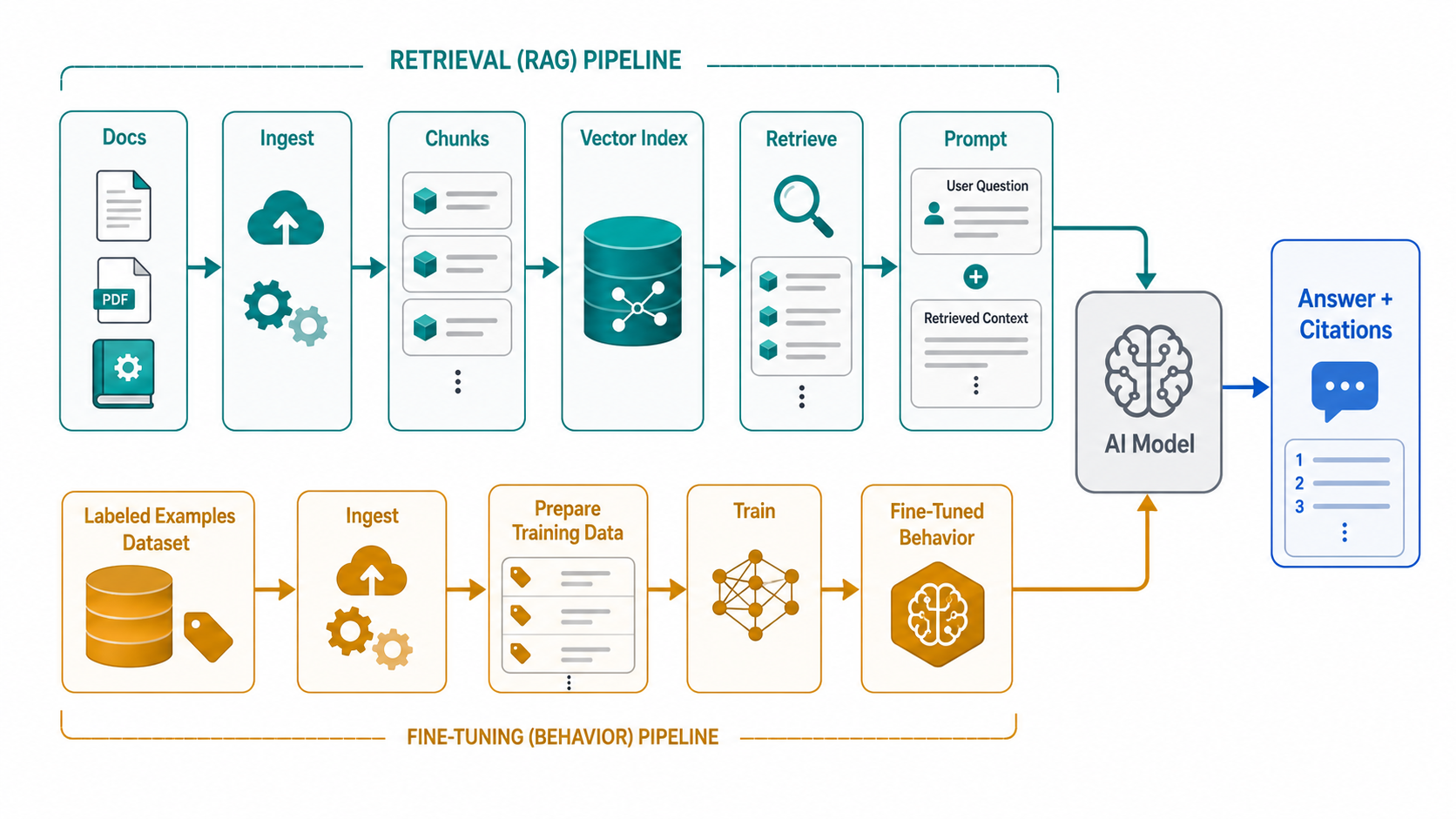
Hybrid Pattern: RAG Plus Fine-Tuning
Some of the strongest AI applications combine both approaches.
Consider a security assistant for a cloud platform team. RAG retrieves the latest internal standards, CIS benchmark notes, Terraform modules, and incident postmortems. Fine-tuning teaches the model to produce a company-specific risk assessment format with severity, evidence, remediation, owner, and escalation path.
In that design:
- RAG handles changing knowledge.
- Fine-tuning handles consistent behavior.
- Evaluation checks both retrieval relevance and answer quality.
- Monitoring catches stale documents, weak citations, and format drift.
A hybrid design is powerful, but do not start there by default. Build the simplest system that proves value, then add complexity where measurements show it is needed.
A Practical Decision Framework
Use these questions before choosing an approach:
| Question | If Yes | If No |
|---|---|---|
| Does the answer depend on private or current documents? | Start with RAG. | Prompting or fine-tuning may be enough. |
| Do users need citations or source links? | Use RAG. | Fine-tuning may still help behavior. |
| Is the desired output format stable? | Fine-tuning may help. | Keep improving prompts and product requirements. |
| Do you have high-quality examples? | You can evaluate fine-tuning. | Collect examples before training. |
| Is retrieval returning the right evidence? | Then tune generation behavior if needed. | Fix ingestion, chunking, metadata, and search first. |
Recommended Path for Most Teams
For a new AI feature in 2026, the practical order is:
- Prompt the base model well. Use clear instructions, examples, and output constraints.
- Add RAG for factual grounding. Connect trusted knowledge sources and evaluate retrieval quality.
- Instrument the workflow. Log queries, retrieved chunks, answer quality, refusal cases, and user feedback.
- Fine-tune for stable high-volume behavior. Use real examples once the target behavior is proven.
- Re-evaluate continuously. AI systems change as documents, users, models, and business rules change.
If your team is still early, do not over-optimize. A clean RAG prototype with strong source control and evaluation will teach you more than a premature fine-tuning project. If your team already has stable examples and high traffic, fine-tuning can be the step that makes the system more consistent and efficient.
FAQ
Is RAG better than fine-tuning?
RAG is better for current, private, or source-grounded knowledge. Fine-tuning is better for consistent behavior, format, tone, classification, or repeated task performance. Neither is universally better.
Can fine-tuning replace RAG?
Usually no. Fine-tuning should not replace retrieval when the application needs fresh facts, citations, or access-controlled documents. It can improve how a model uses retrieved context after RAG is working.
Can RAG replace fine-tuning?
Sometimes. If the model behaves well with a good prompt and retrieved context, you may not need fine-tuning. But if output consistency remains poor across many examples, fine-tuning can help.
Should I fine-tune on my company documents?
If the goal is question answering over company documents, use RAG first. If the goal is teaching a stable response style or structured transformation based on examples, fine-tuning may be useful.
When should I use both RAG and fine-tuning?
Use both when the application needs external knowledge and specialized behavior. RAG provides the evidence; fine-tuning teaches the model a reliable way to transform or apply that evidence.
What should I measure before deciding?
Measure retrieval relevance, answer accuracy, citation correctness, format compliance, refusal behavior, latency, and cost. Without evaluation data, the choice becomes guesswork.
Schema-Ready FAQ Structure
{
  "@context": "https://schema.org",
  "@type": "FAQPage",
  "mainEntity": [
    {
      "@type": "Question",
      "name": "Is RAG better than fine-tuning?",
      "acceptedAnswer": {
        "@type": "Answer",
        "text": "RAG is better for current, private, or source-grounded knowledge. Fine-tuning is better for consistent behavior, format, tone, classification, or repeated task performance."
      }
    },
    {
      "@type": "Question",
      "name": "Can fine-tuning replace RAG?",
      "acceptedAnswer": {
        "@type": "Answer",
        "text": "Usually no. Fine-tuning should not replace retrieval when the application needs fresh facts, citations, or access-controlled documents."
      }
    },
    {
      "@type": "Question",
      "name": "When should I use both RAG and fine-tuning?",
      "acceptedAnswer": {
        "@type": "Answer",
        "text": "Use both when the application needs external knowledge and specialized behavior. RAG provides the evidence, while fine-tuning teaches the model a reliable way to transform or apply that evidence."
      }
    }
  ]
}
Internal Link Suggestions
- What is RAG (Retrieval-Augmented Generation)?
- What is LLMOps?
- Prompt Engineering for Developers
- What is Generative AI? A Beginner’s Guide
- Best CI/CD Tools 2026 Compared


