

NEW DELHI, August 13, 2026, 2:06 PM IST — Google has launched its Pixel 11 phones around a new Tensor G6 processor that the company says substantially increases on-device AI throughput while cutting energy use, making the handset lineup an early reference point for how agentic workloads may be split between edge hardware and cloud models.
The announcement is a consumer-device launch, but the engineering signal reaches beyond smartphones. Google is pairing the latest Gemini Nano model with 50% more TPU compute, a new Titan M3 security chip and Gemini Intelligence features that can act across apps. For developers and platform teams, the package shows the controls that increasingly matter when an AI agent runs close to private data: explicit permissions, execution visibility, activity history and hardware-backed isolation.
What Google confirmed
Google said the Pixel 11, Pixel 11 Pro and Pixel 11 Pro XL use Tensor G6, its fastest Pixel processor so far. The company claims the chip processes on-device AI tasks up to 3.5 times faster and uses up to 3.5 times less energy than Tensor G5. Those numbers come from Google’s internal testing on pre-production devices and should not be read as independent benchmarks or as a guarantee for every workload.
Tensor G6 also delivers 50% more TPU compute, according to Google, and runs the latest Gemini Nano model. Google says Gemini Intelligence requires capable devices with at least 12 GB of memory and a qualified system-on-chip, giving developers a clearer view of the hardware floor for its newest local AI experiences.
The launch also introduces the Titan M3 security chip. Google says Titan M3 and Tensor G6 bring post-quantum cryptography to secure boot, while the phones will receive seven years of operating-system, security and Pixel Drop updates. The company did not publish independent performance or security validation with the launch, so those claims remain vendor assertions pending broader testing.
From assistant prompts to actions across apps
Pixel 11 is designed for Gemini Intelligence, Google’s broader effort to let Gemini automate multi-step work across Android applications. Google has described examples such as building a shopping cart from a list, finding information in connected apps and completing forms. The system is intended to show progress while it works and to stop before a final confirmation.
That operating model is more consequential than the individual phone features. Once an assistant can navigate interfaces and move information between applications, it begins to resemble an execution platform. The same security questions facing enterprise agents then appear on the device: which tools the agent may use, what data it can read, which actions require approval and how operators reconstruct what happened.
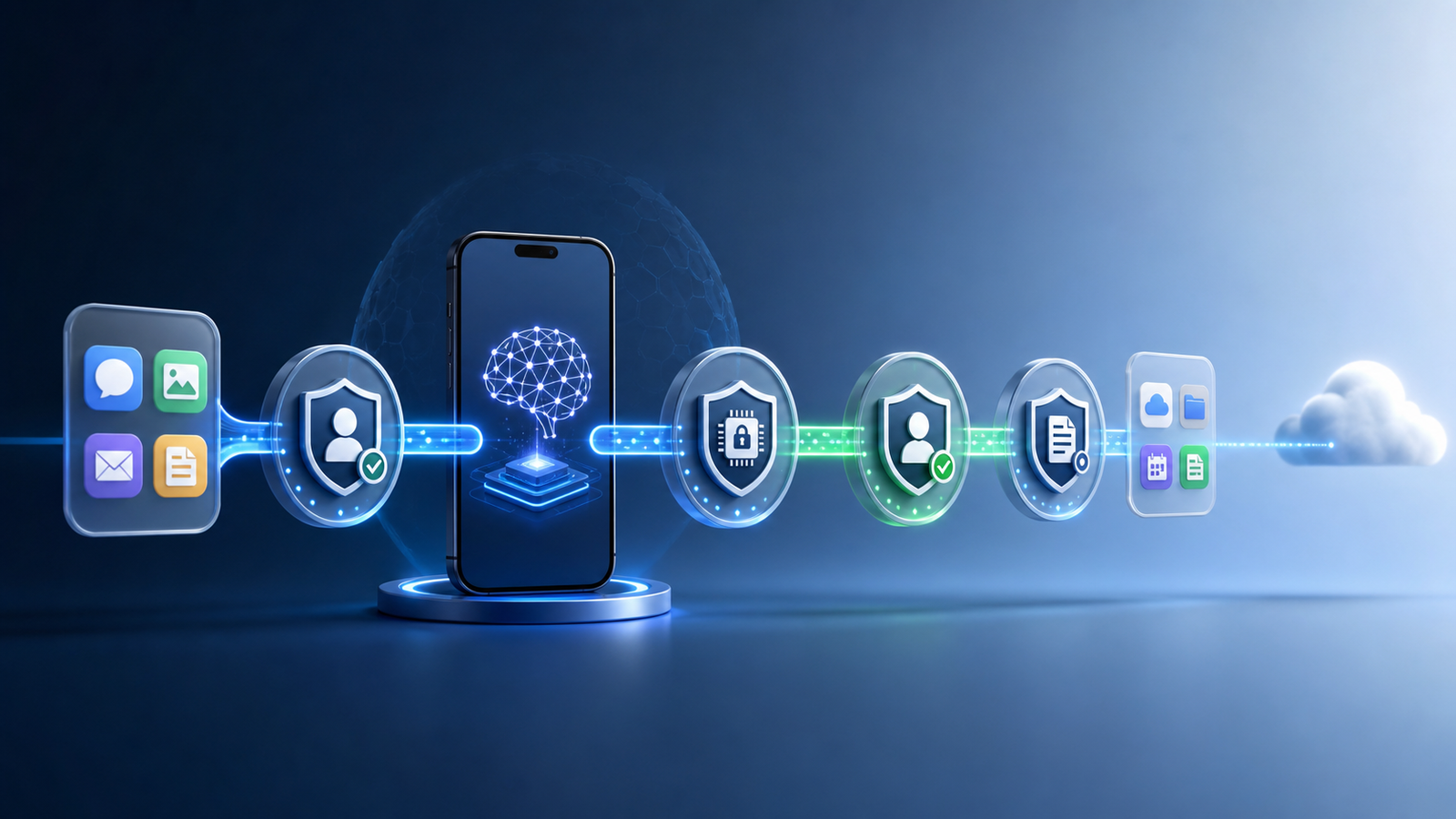
Android’s control model offers a useful checklist
In its security documentation for Gemini Intelligence, Google says users will be able to enable app automation for individual applications. Purchases require confirmation, and proactive features rely on explicit settings or user actions before sharing data. Google also says task progress remains visible through an interface and a persistent notification indicator.
Google plans to add AI-assistant activity history to Android’s Privacy Dashboard, showing which assistants were active and which apps they used during the previous 24 hours. Sensitive processing may use Private Compute Core, Private AI Compute or protected KVM, depending on the feature. Google also says it is building defenses against prompt injection when Gemini acts on a user’s behalf.
These are design commitments rather than proof that every failure mode has been solved. Prompt injection, confused-deputy behavior and excessive permissions remain active risks for agents that consume untrusted content. Still, the combination of least-privilege access, visible execution, confirmation gates and retrospective logs is a practical baseline for any team deploying agents in CI/CD, cloud operations or internal business systems.
What developers and platform teams should take from the launch
First, edge and cloud inference should be treated as a workload-placement decision, not a binary ideology. Small local models can handle latency-sensitive or private steps, while larger cloud models can be reserved for tasks that need broader reasoning. Teams should measure end-to-end latency, energy use, memory pressure, network dependency and accuracy on their own workload rather than extrapolating from a vendor headline.
Second, hardware capability is becoming part of the AI application contract. If advanced features require at least 12 GB of memory and a qualified accelerator, product teams need capability detection, graceful fallback paths and telemetry that distinguishes device inference from cloud inference. That mirrors the discipline already used for heterogeneous Kubernetes nodes and accelerator-aware scheduling.
Third, agent observability must include actions, not just prompts and tokens. A useful production record should capture the requested goal, permissions granted, tools invoked, approvals received, output produced and rollback status. GravityDevOps’ guide to LLMOps explains the lifecycle controls around model-backed systems, while its overview of retrieval-augmented generation covers another common boundary between private data and model execution.
For delivery teams, the lesson is to keep agents behind the same change controls used for other automation. Test tool permissions in isolated environments, require review for production-impacting actions and connect agent changes to established CI/CD approval and rollback mechanisms.
Availability and what remains uncertain
Google opened pre-orders for the Pixel 11 series and said retail availability begins August 20 in announced markets. Feature availability varies by country, language, device and subscription, and some Gemini Intelligence capabilities are rolling out in waves rather than arriving everywhere at launch.
Independent testing will be needed to determine whether Google’s claimed speed and efficiency improvements hold across sustained workloads, and whether its app-level controls resist adversarial content in everyday use. The immediate news is not that smartphones have replaced cloud AI. It is that local inference, agent permissions and hardware security are being shipped as one product surface — a pattern enterprise AI platforms are likely to face as well.
Sources
Google’s Pixel 11 launch announcement; Google’s Gemini Intelligence product overview; Google’s Android agent security and privacy architecture; and Associated Press coverage of the launch.


