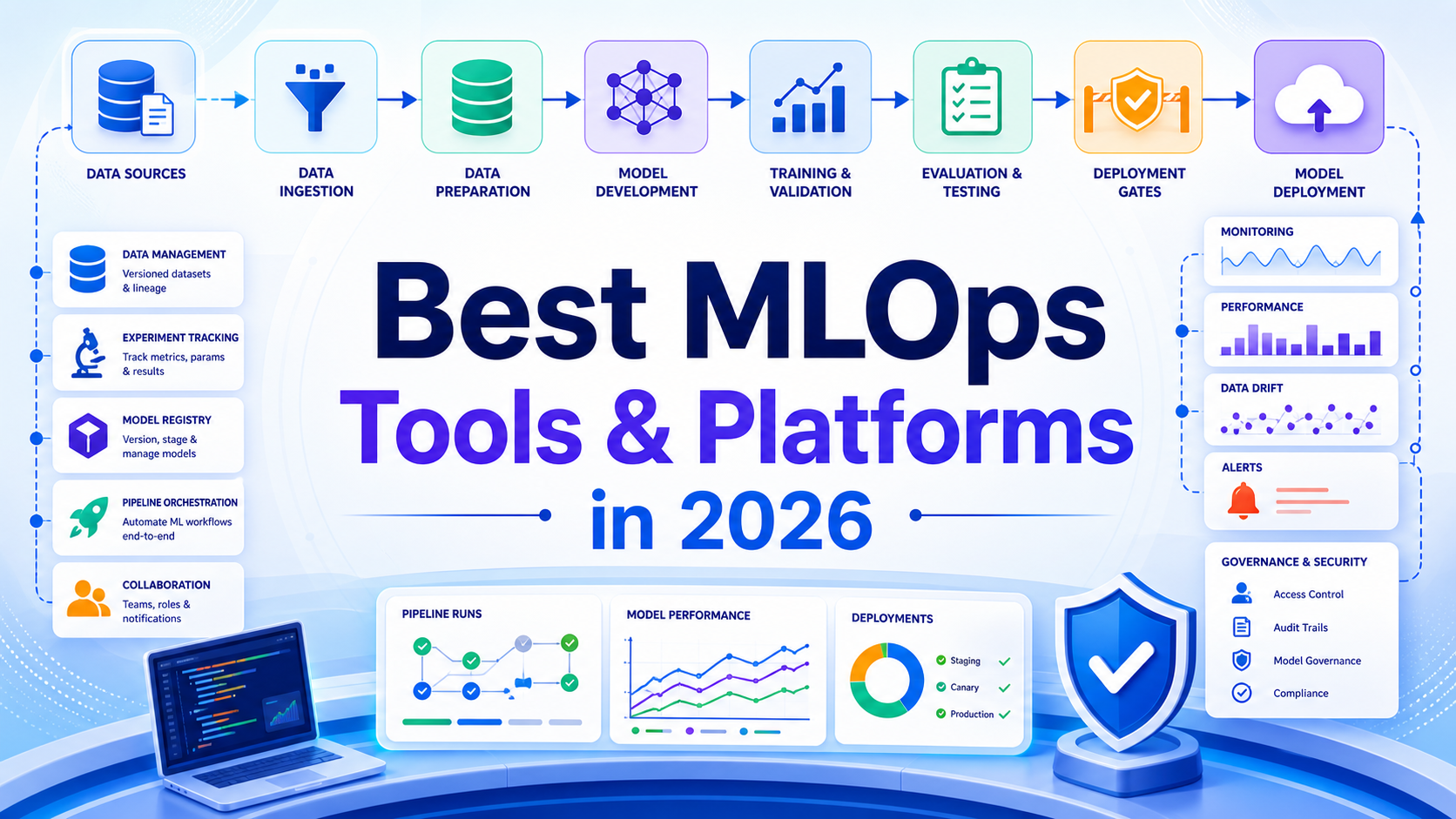

Quick Answer: The best MLOps platform in 2026 depends on where your models, data, and engineers already live. Choose Databricks Mosaic AI if your ML work is tightly connected to lakehouse data and MLflow. Choose Amazon SageMaker AI, Google Vertex AI, or Azure Machine Learning when your organization is standardized on AWS, Google Cloud, or Microsoft Azure. Choose MLflow or Kubeflow if you want an open-source foundation and can operate the infrastructure. Choose Weights & Biases, Neptune, Arize, or Evidently when you need best-of-breed experiment tracking or model observability around an existing stack.
Teams operating foundation models, retrieval systems, or agents should also review the distinct production controls in our LLMOps guide; prompt, retrieval, evaluation, and inference observability add requirements beyond conventional model operations.
MLOps tools are no longer just experiment trackers. In 2026, a serious platform must help teams move models from notebooks to production with reproducible pipelines, a model registry, deployment automation, monitoring, evaluation, lineage, access control, and cost governance. The right choice is not always the most feature-rich tool. It is the tool your team can operate reliably, afford at production scale, and trust when a model drifts or fails.
What Counts as an MLOps Platform in 2026?
MLOps is the operating model for machine learning systems. It borrows from DevOps, but adds model-specific concerns: datasets change, features drift, training code is only part of the artifact, model quality is statistical, and production behavior can degrade even when the application code has not changed.
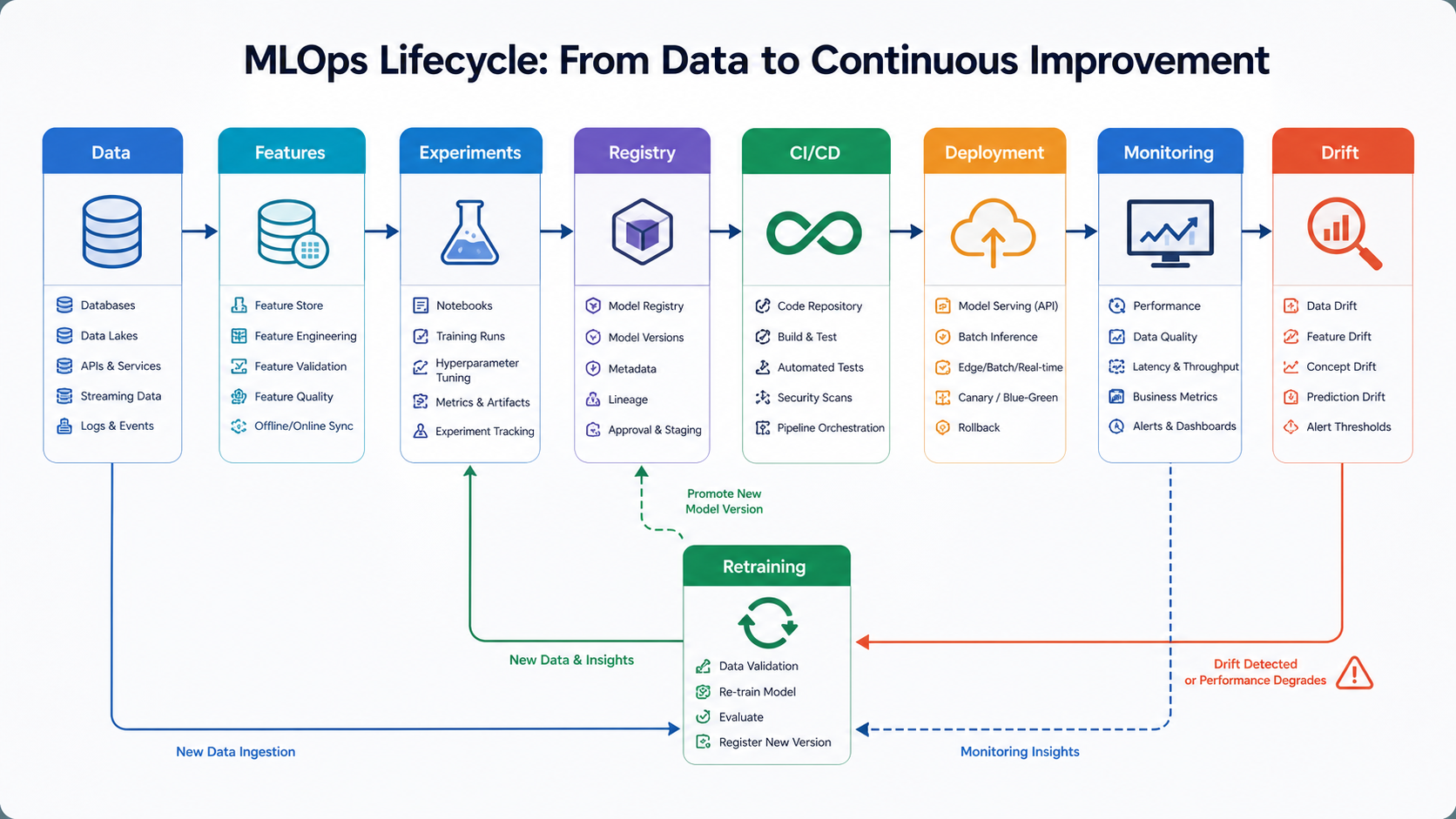
A complete MLOps platform usually covers these areas:
- Experiment tracking: parameters, metrics, artifacts, source code, notebooks, prompts, and evaluation results.
- Data and feature management: dataset versioning, feature stores, feature quality, lineage, and offline/online consistency.
- Model registry: model versions, aliases, approvals, metadata, stage transitions, lineage, and rollback paths.
- Pipeline orchestration: repeatable training, validation, packaging, deployment, and retraining workflows.
- Deployment: batch inference, real-time endpoints, canary releases, shadow deployments, autoscaling, and rollback.
- Monitoring: model performance, data drift, feature drift, latency, throughput, errors, cost, and business metrics.
- Governance: access control, audit logs, model cards, approval workflows, data residency, and compliance evidence.
- AI application support: tracing, prompt evaluation, RAG evaluation, agent observability, and LLM cost monitoring where relevant.
The key buyer mistake is comparing tools as if every platform solves the same problem. MLflow is excellent for tracking and registry workflows, but it is not the same kind of product as SageMaker AI or Vertex AI. Kubeflow is powerful on Kubernetes, but it requires platform engineering maturity. W&B can be the best choice for research-heavy teams even if another platform handles deployment. Arize or Evidently may be the missing production monitoring layer rather than the entire MLOps stack.
Best MLOps Tools and Platforms: 2026 Comparison Table
| Tool or platform | Best fit | Strengths | Watch-outs | Pricing/licensing caveat |
|---|---|---|---|---|
| Databricks Mosaic AI + MLflow | Lakehouse teams, enterprise ML, governed data + AI | MLflow-native workflows, model registry, feature engineering, model serving, Unity Catalog governance, strong data proximity | Best value when Databricks is already strategic; can be expensive if used only for light MLOps | Usage-based Databricks compute/serving costs; confirm DBU, serverless, storage, and workspace commitments |
| Amazon SageMaker AI | AWS-first ML teams | Training, pipelines, model registry, endpoints, batch inference, feature store, monitoring, AWS IAM integration | Many service pieces; cost can surprise teams that leave notebooks/endpoints running | AWS usage-based pricing across Studio resources, training jobs, storage, endpoints, serverless inference, and related services |
| Google Vertex AI | Google Cloud, BigQuery, data/AI teams, Gemini-era apps | Managed training, pipelines, model registry, prediction, feature store, model monitoring, tight GCP integration | Best when data and IAM are already in Google Cloud; multi-cloud teams may face portability tradeoffs | Usage-based charges for training, prediction, pipelines, storage, monitoring, and connected services |
| Azure Machine Learning | Microsoft enterprise, Azure, Purview/Fabric/Entra ecosystems | Workspaces, registries, managed endpoints, pipelines, prompt flows, security and enterprise identity integration | Operational clarity depends on Azure cost governance and resource tagging discipline | Compute, endpoints, storage, networking, and managed resources can all contribute to cost |
| MLflow | Open-source tracking and model registry foundation | Experiment tracking, model packaging, registry, evaluation, deployment integrations, broad adoption | Self-hosting requires decisions about storage, auth, backups, governance, and deployment targets | Open source core; managed costs depend on where you host it, with Databricks offering managed MLflow integration |
| Kubeflow | Kubernetes-native platform teams | Portable ML workflows, notebooks, pipelines, training operators, model registry ecosystem, K8s-native control | Powerful but operationally heavy; not ideal for teams without Kubernetes platform ownership | Open source, but real cost is cluster operations, platform engineering, upgrades, and support |
| Weights & Biases | Research, experimentation, collaboration, model evaluation | Excellent experiment tracking, artifacts, reports, sweeps, evaluation, collaborative workflows | Usually complements deployment platforms rather than replacing them fully | Free/personal and team/enterprise plans exist; storage, seats, self-hosting, and enterprise limits matter |
| Neptune | Experiment tracking and model metadata at scale | Strong metadata tracking, comparison, collaboration, and reproducibility | Deployment and production serving still need separate tooling | Typically SaaS or self-hosted plans; check seats, projects, metadata volume, and retention |
| Arize AI / Phoenix | Model and LLM observability | Drift, performance monitoring, tracing, evaluation, troubleshooting, Phoenix open-source path | Not a full training/deployment platform; strongest after models or AI apps are live | Phoenix is open source/local-first; managed Arize pricing depends on scale and plan |
| Evidently AI | Open-source model monitoring and data quality | Data drift, quality reports, test suites, monitoring workflows, useful for custom stacks | Requires integration work for alerting, deployment, and governance | Open-source and cloud/enterprise options; compare hosted monitoring volume and support terms |
| Dataiku | Enterprise analytics, governed data science, business collaboration | Visual workflows, governance, automation, model operations, broad user personas | May feel heavy for small engineering-first teams; procurement is enterprise oriented | Commercial licensing; validate user roles, environments, automation nodes, and deployment terms |
| Domino Data Lab | Regulated enterprise data science platforms | Governance, reproducibility, workbench, deployment, collaboration, compliance-friendly controls | Enterprise platform investment; not a lightweight startup tool | Commercial enterprise licensing; evaluate infra, user, support, and compliance needs |
How to Choose: The Practical Decision Framework
Start with your operating constraints, not the vendor feature grid. A tool can look perfect in a demo and still fail because your data lives elsewhere, your platform team cannot support Kubernetes, your security team rejects the data path, or your cost model explodes after the first production endpoint.
1. Match the platform to data gravity
If training data is already in S3 and AWS IAM controls the business, SageMaker AI is a natural candidate. If your data platform is BigQuery, Vertex AI will usually reduce friction. If your organization has standardized on Azure, Azure Machine Learning fits the identity, networking, and governance model. If most feature engineering and analytics run in Databricks, Mosaic AI and MLflow integration are hard to ignore.
Moving data just to satisfy an MLOps tool is often a hidden tax. It adds storage duplication, egress cost, governance reviews, data freshness problems, and new failure modes.
2. Decide whether you need a platform or a best-of-breed layer
A startup with two ML engineers may not need a full enterprise platform. MLflow for tracking, GitHub Actions for CI, Docker for packaging, a managed cloud endpoint for serving, and Evidently or Arize Phoenix for monitoring may be enough. A bank deploying dozens of regulated models needs approvals, audit logs, lineage, segregation of duties, reproducibility, and production support. Those are different buying motions.
3. Test the actual production workflow
Do not evaluate MLOps tools only by training a toy model. Run a proof of concept that includes model registration, approval, batch or online deployment, rollback, drift detection, alert routing, retraining, and a cost estimate using realistic data volume. The uncomfortable parts of MLOps usually appear after the notebook is done.
Best Overall: Databricks Mosaic AI with MLflow
Best for: teams that want production ML close to governed lakehouse data.
Databricks is a strong default for organizations that already use the lakehouse pattern. Its advantage is not just that it includes MLflow. It connects model development with data engineering, feature engineering, governance, lineage, model registry workflows, and serving in one environment. Databricks documentation describes model serving as a unified interface for deploying, governing, and querying AI models, with tight MLflow Model Registry integration.
Pros: strong MLflow adoption, excellent data proximity, Unity Catalog governance, scalable notebooks/jobs, model serving, good fit for mixed data engineering and ML teams.
Cons: cost discipline matters; not ideal if you only need a lightweight tracker; best value appears when Databricks is already part of the data platform strategy.
Neutral recommendation: choose Databricks when the team needs both governed data and production ML workflows. Avoid buying it only because you need an experiment tracker.
Best for AWS Teams: Amazon SageMaker AI
Best for: teams already standardized on AWS accounts, IAM, VPC networking, S3, ECR, CloudWatch, and EventBridge.
SageMaker AI gives AWS teams a broad managed toolbox: notebooks, training, pipelines, model registry, deployment endpoints, serverless inference, batch inference, feature store, and monitoring integrations. It is especially attractive when infrastructure, security, and platform teams already understand AWS controls.
The main caution is cost visibility. AWS documentation notes that the Studio UI itself has no additional charge, but storage volumes, launched jobs, applications, notebooks, and endpoints do incur costs. SageMaker Serverless Inference can scale to zero for unpredictable traffic, while persistent endpoints and training jobs need active cost governance.
Pros: deep AWS integration, mature managed services, flexible deployment patterns, strong IAM and event automation, good path for regulated AWS workloads.
Cons: service surface area can be complex; teams must tag, monitor, and shut down resources; portability outside AWS is limited.
Best for Google Cloud and BigQuery Teams: Vertex AI
Best for: teams using BigQuery, Google Cloud data services, managed training, and Google-native AI services.
Vertex AI is Google Cloud’s managed machine learning platform for training, pipelines, prediction, model registry, feature management, and model monitoring. It is a strong choice when data science and analytics already happen in Google Cloud, especially for teams that want managed infrastructure rather than self-operated Kubernetes.
Pros: natural fit with BigQuery and GCP IAM, managed training/prediction, model monitoring features, good support for modern AI application workflows.
Cons: cloud lock-in tradeoffs; pricing spans multiple services; teams should test monitoring and deployment behavior with their real models, not only quickstarts.
Best for Microsoft Enterprise: Azure Machine Learning
Best for: enterprises that already use Azure, Microsoft Entra ID, Azure networking, Microsoft security tooling, and Microsoft data platforms.
Azure Machine Learning provides workspaces, registries, managed endpoints, batch endpoints, pipelines, prompt flows, and enterprise controls. Microsoft documentation emphasizes cost planning, budgets, cost analysis, and endpoint cost visibility. That matters because endpoint, compute, storage, and networking choices can all affect the final bill.
Pros: strong enterprise identity integration, familiar Azure operations model, useful managed endpoints and registries, good fit for Microsoft-heavy organizations.
Cons: cost governance requires Azure discipline; architecture can become fragmented if teams mix too many Azure services without a platform standard.
Best Open-Source Foundation: MLflow
Best for: teams that need a portable, widely adopted foundation for experiment tracking, model registry, packaging, and evaluation.
MLflow remains one of the most important MLOps tools because it solves everyday workflow problems without forcing a single cloud. The MLflow Model Registry provides a centralized model store with APIs and a UI for lifecycle management, including lineage, versioning, aliases, metadata, and annotations. MLflow 3 also expands relevance for agents and LLM applications with tracing, evaluation, prompt management, and AI gateway capabilities.
Pros: open source, broadly supported, easy to start, strong tracking and registry workflows, good ecosystem integration.
Cons: production-grade hosting requires decisions about authentication, artifact storage, database backups, access control, monitoring, and deployment integration.
Best Kubernetes-Native Option: Kubeflow
Best for: teams with strong Kubernetes platform engineering and a need for portable ML workflows.
Kubeflow is not a beginner shortcut. It is a Kubernetes-native ML platform that can be very powerful when a team already runs production Kubernetes well. Kubeflow Pipelines focuses on building and deploying portable, scalable ML workflows using containers on Kubernetes-based systems. The Kubeflow ecosystem also includes notebooks, training operators, and a model registry path.
Pros: open-source control, Kubernetes-native workflows, portability, strong fit for platform teams, useful for custom infrastructure and hybrid environments.
Cons: operationally heavy; upgrades, security, multi-tenancy, storage, identity, and observability become your responsibility.
Best Experiment Tracking and Collaboration: Weights & Biases
Best for: research teams, applied AI teams, and model builders who need excellent tracking, comparison, reports, sweeps, artifacts, and collaborative evaluation.
Weights & Biases is often the tool data scientists actually enjoy using. It is especially useful when a team is running many experiments, comparing runs, tracking artifacts, writing reports, or collaborating across research and engineering. It may still need to sit alongside SageMaker, Vertex AI, Azure ML, Kubernetes, or custom serving infrastructure.
Pros: polished UI, excellent tracking, strong team collaboration, good fit for deep learning and GenAI evaluation workflows.
Cons: not always the deployment platform; pricing depends on plan, seats, storage, self-hosting needs, and enterprise controls.
Best for Model Observability: Arize, Phoenix, and Evidently
Best for: teams that already have training and deployment solved but need better production visibility.
Model observability is where many MLOps programs become real. After deployment, teams need to know whether input distributions changed, output quality dropped, latency increased, costs rose, or business KPIs moved. Arize is strong for managed AI observability and evaluation. Phoenix offers an open-source, local-first route for tracing, evaluation, experimentation, and prompt iteration. Evidently is useful for data quality, drift reports, and monitoring in custom stacks.
Pros: practical production focus, strong monitoring/evaluation workflows, useful around existing platforms.
Cons: these tools usually do not replace your training, registry, deployment, and CI/CD foundation.
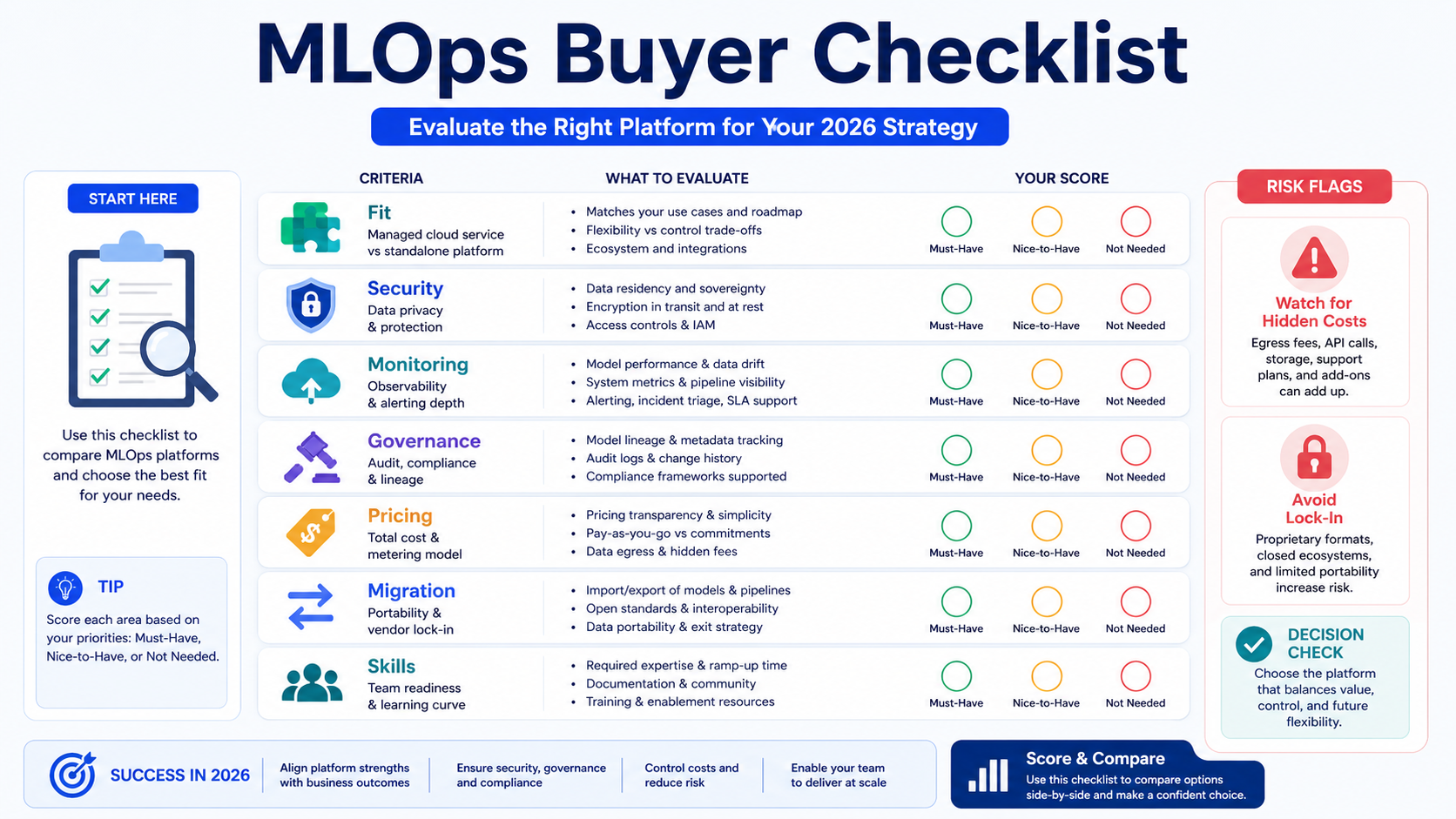
Pricing and Licensing Caveats Buyers Should Check
MLOps pricing is hard because the line item is rarely just “MLOps.” You may pay for compute, GPUs, CPUs, storage, artifacts, managed endpoints, batch jobs, notebook instances, feature store storage, logs, observability events, users, projects, model versions, support, private networking, and data egress.
Before signing a contract or standardizing on a managed cloud service, ask these questions:
- What is billed by seat, by compute hour, by endpoint uptime, by request, by token, by storage, by artifact, or by event?
- Do idle notebooks, persistent endpoints, attached disks, load balancers, logs, or monitoring jobs keep charging?
- Can batch workloads scale to zero?
- How much will staging, dev, test, and production environments cost separately?
- Are model registry, lineage, governance, SSO, audit logs, and private networking included or enterprise-only?
- How easy is it to export experiments, artifacts, model metadata, and monitoring history?
- What happens if the team doubles the number of models or moves from daily batch inference to real-time endpoints?
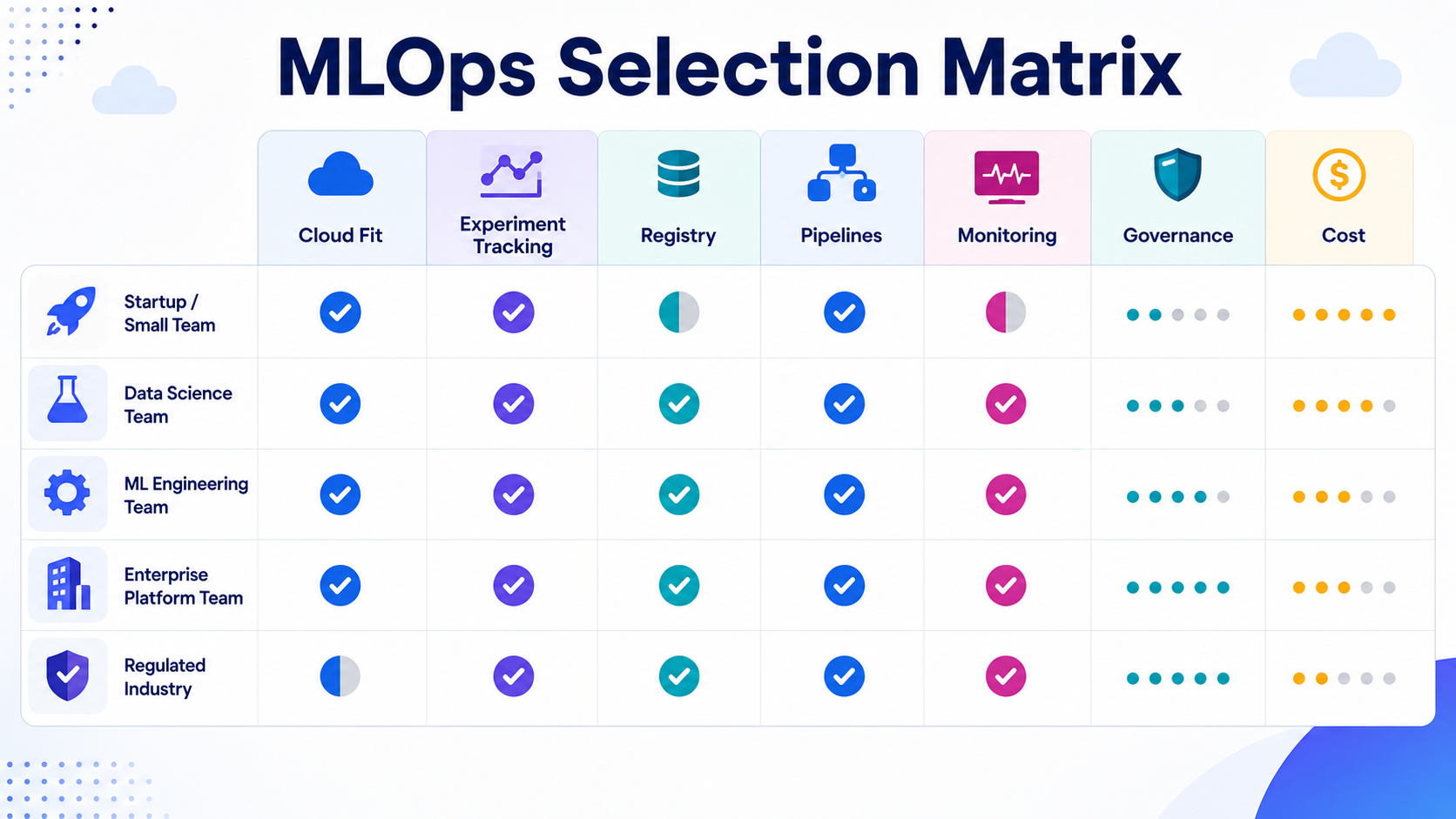
Recommended MLOps Stack by Team Type
| Team type | Recommended starting stack | Why |
|---|---|---|
| Solo learner or small startup | MLflow + GitHub Actions + Docker + cloud batch/endpoint + Evidently or Phoenix | Low commitment, useful fundamentals, portable learning path. |
| AWS-first product team | SageMaker AI + S3 + ECR + CloudWatch + EventBridge + optional W&B or MLflow | Works with AWS IAM, networking, and operations standards. |
| Google Cloud data team | Vertex AI + BigQuery + Artifact Registry + Cloud Build + Model Monitoring | Reduces data movement and fits GCP-native workflows. |
| Microsoft enterprise | Azure Machine Learning + Azure DevOps/GitHub + Entra ID + Azure Monitor | Fits enterprise identity, governance, and procurement patterns. |
| Lakehouse ML team | Databricks Mosaic AI + MLflow + Unity Catalog + Model Serving | Strong alignment between governed data, features, experiments, and serving. |
| Kubernetes platform team | Kubeflow + MLflow + Argo Workflows or Tekton + Prometheus/Grafana + custom serving | Maximum control when the organization can operate the platform. |
| Regulated enterprise | Databricks, Azure ML, SageMaker, Dataiku, or Domino with formal governance review | Auditability, access control, lineage, approvals, and support matter more than raw flexibility. |
Common MLOps Mistakes
- Buying before standardizing: if datasets, repositories, environments, and ownership are chaotic, a platform will expose the chaos rather than fix it.
- Ignoring monitoring: deployment is not the finish line. Models need quality, drift, latency, and business-metric monitoring.
- Skipping cost tests: a cheap proof of concept can become expensive when endpoints, GPUs, logs, artifacts, and observability scale.
- Treating LLM apps like classic ML only: RAG, agents, prompts, traces, evaluations, and token costs need additional observability.
- Choosing Kubernetes without platform ownership: Kubeflow can be excellent, but only when someone owns cluster reliability, upgrades, security, and user experience.
- Forgetting rollback: every production model needs a clear path to revert, disable, route traffic, or fall back safely.
Practical Proof-of-Concept Checklist
Use this simple proof-of-concept plan before committing to a platform:
- Pick one real model with real data, not a sample notebook.
- Track at least five runs with parameters, metrics, artifacts, and source version.
- Register a candidate model with metadata, owner, approval state, and rollback notes.
- Deploy it to the same target pattern you expect in production: batch, real-time, serverless, or Kubernetes.
- Add monitoring for input quality, drift, prediction distribution, latency, errors, and one business metric.
- Trigger a retraining or rollback workflow from a simulated drift event.
- Estimate monthly cost at 10x the proof-of-concept usage.
- Ask security to review data movement, identity, audit logs, secrets, and retention.
- Ask the engineers who will operate it whether they would trust it during an incident.
Internal Links and Next Reading
For readers building the AI and DevOps foundation around MLOps, these related GravityDevOps guides are useful next steps:
- What Is Generative AI? A Beginner’s Guide for the AI concepts behind modern model platforms.
- What Is RAG? for teams adding retrieval workflows and evaluation to AI applications.
- Fine-Tuning vs RAG for deciding how model customization affects your MLOps stack.
- Best CI/CD Tools in 2026 because model delivery still needs disciplined build, test, and release automation.
- Kubeflow Tutorial: ML Pipelines on Kubernetes if your team wants a Kubernetes-native MLOps path.
Sources Checked for 2026 Accuracy
- Databricks MLflow documentation and Databricks Model Serving documentation.
- Amazon SageMaker Studio cost documentation and SageMaker Serverless Inference documentation.
- Google Vertex AI SLA and Vertex AI documentation for model monitoring and pipelines.
- Azure Machine Learning cost planning documentation and managed endpoint cost guidance.
- MLflow Model Registry documentation and MLflow 3 release information.
- Kubeflow Pipelines documentation and Kubeflow model registry documentation.
- Weights & Biases pricing information and Arize pricing/Phoenix information.
MLOps Questions Practitioners Are Asking
Tool lists are useful, but the harder decisions show up in practitioner discussions. Two recurring questions in a recent r/mlops discussion about managed versus self-built platforms and a discussion about moving from DevOps into MLOps are worth answering directly.
Should we build an MLOps platform or use managed services?
For most teams, the practical answer is a hybrid stack. Use a managed platform for expensive operational foundations such as identity integration, elastic training compute, endpoint management, audit logs, and support. Keep portable components for the parts where flexibility matters, such as MLflow tracking, OpenTelemetry collection, model evaluation code, container images, and CI/CD workflows.
Building from scratch makes sense only when a real constraint justifies the platform team: unusual hardware scheduling, strict data-residency rules, very large and predictable workloads, a required multi-cloud control plane, or workflows that managed products cannot support. “Avoiding lock-in” by operating Kubernetes, object storage, metadata databases, registries, secrets, upgrades, backups, and observability yourself can cost more than the vendor premium.
Run a 60- to 90-day proof of concept with one representative model. Measure time to first deployment, engineer hours spent on platform work, training and serving cost, rollback time, lineage coverage, and how easily the setup can be reproduced. Choose the option that leaves the team owning model quality and business outcomes rather than maintaining undifferentiated infrastructure.
Is MLOps just DevOps with machine learning tools?
No, although DevOps provides much of the foundation. MLOps still needs Git, CI/CD, containers, infrastructure as code, observability, access control, and reliable deployment patterns. It also adds versioned data and features, reproducible training, statistical evaluation gates, model lineage, drift detection, bias and safety checks, and retraining decisions.
The operational difference is important: an API can return HTTP 200 while its model produces a poor prediction. Traditional uptime monitoring will miss that failure. Production MLOps therefore connects system metrics such as latency and errors with model metrics such as accuracy, drift, calibration, retrieval quality, or business conversion.
A DevOps engineer moving into MLOps should keep the existing delivery skills and learn the model lifecycle well enough to design the right gates. Start with one training pipeline, record its data and code versions, register the model, deploy it behind a controlled release, and monitor both service health and model quality. That small end-to-end system teaches more than installing a large platform without a real workload.
FAQ: Best MLOps Tools and Platforms in 2026
What is the best MLOps tool in 2026?
There is no single best MLOps tool for every team. Databricks Mosaic AI is strong for lakehouse teams, SageMaker AI for AWS teams, Vertex AI for Google Cloud teams, Azure Machine Learning for Microsoft enterprises, MLflow for open-source tracking and registry workflows, Kubeflow for Kubernetes-native teams, and Arize or Evidently for model observability.
Is MLflow enough for MLOps?
MLflow can be enough for experiment tracking, model packaging, model registry, and evaluation workflows, especially for small or custom stacks. It is not automatically a complete production platform. You still need CI/CD, infrastructure, serving, monitoring, security, artifact storage, backups, and governance.
Should I choose Kubeflow or MLflow?
Choose MLflow when your main need is tracking, model registry, and portable model lifecycle metadata. Choose Kubeflow when your organization wants Kubernetes-native pipelines and can operate the platform. Many teams use both: MLflow for tracking and registry, Kubeflow for pipeline orchestration.
Are cloud MLOps platforms better than open source?
Managed cloud platforms are often better for teams that want integrated identity, networking, compute, and support. Open-source tools are better for portability, customization, learning, and avoiding early platform lock-in. The better choice depends on team maturity, compliance needs, existing cloud strategy, and operational capacity.
What should a beginner learn first for MLOps?
Beginners should learn Git, Docker, Python packaging, model training basics, MLflow experiment tracking, simple CI/CD, cloud storage, container deployment, and monitoring fundamentals. After that, learn one managed platform such as SageMaker AI, Vertex AI, Azure ML, or Databricks, depending on the cloud used by your target employers.
How do MLOps tools differ from LLMOps tools?
MLOps tools focus on the lifecycle of machine learning models: data, features, training, registry, deployment, monitoring, and retraining. LLMOps adds prompt management, RAG evaluation, tracing, token cost tracking, safety evaluations, agent observability, and human feedback workflows. In 2026, the categories overlap because many platforms support both classic ML and GenAI applications.


