


AI tools for unit testing are best used to propose test cases, scaffolding and edge conditions—not to decide whether software is correct. The reliable workflow starts with a behavior contract, asks AI for a small set of candidate tests, runs them in isolation, checks whether they can detect a seeded fault, and sends the final diff through human review and CI. A passing generated test proves only that the implementation and assertion agree; both can be wrong.
This guide compares five practical approaches for developers in the United States, explains where each fits, and provides a verification method that works across languages. Product access, quotas and pricing were checked against official vendor pages on November 10, 2026, but buyers should confirm the current plan before purchasing.
AI unit-testing tools: quick comparison
| Option | Best fit | Where it works | Access model checked | Watch closely |
|---|---|---|---|---|
| GitHub Copilot | General, prompt-driven unit and integration tests | VS Code, Visual Studio, JetBrains and GitHub workflows | Free limited tier; individual and organization plans use AI-credit allowances | Framework conventions, agent permissions and usage accounting |
| JetBrains AI Assistant | IDE-native generation for JVM, Python, JavaScript, .NET and other JetBrains projects | JetBrains IDEs and ReSharper workflows | Trial and free quotas; paid AI plans or supported own/local models | Model/data path, IDE version and test-runner selection |
| Amazon Q Developer | Repository-aware test generation in AWS-centered teams | VS Code, JetBrains, Visual Studio, CLI and supported integrations | Perpetual limited free tier; Pro listed at $19 per user/month | Identity mode, monthly limits and IDE-plugin lifecycle |
| Qodo | Test generation tied to code changes, review and coverage gaps | IDE, pull-request, CLI and CI-oriented workflows | Product tiers and enterprise access vary; verify the current quote and limits | Do not confuse the current platform with the retired open-source Cover Agent repository |
| Diffblue Cover | Automated Java/Kotlin regression-test generation at scale | IntelliJ, CLI and CI integrations for supported builds | Free trial documented; commercial terms require current vendor confirmation | Supported JDK/build versions and behavior-capture versus requirements testing |
These are not interchangeable. The first three are broad coding assistants that can generate tests as one task. Qodo connects generation more directly to change and coverage workflows. Diffblue is specialized for creating Java-family regression suites. If your only need is a few tests beside a function, start inside the IDE you already use. If you need repeatable generation across a large Java estate, evaluate a specialized system.
What AI can and cannot test
AI can inspect a function, nearby tests, type information and repository conventions to draft fixtures, mocks, assertions and edge cases. Repository agents can also create files, run the test command and revise failures. That makes AI useful for repetitive setup, missing boundary cases and unfamiliar frameworks.
AI does not know the true requirement unless the requirement exists in reliable context. When it derives expected output from the implementation, it may simply preserve a bug. It may over-mock dependencies, assert private implementation details, replace meaningful values with snapshots, or weaken an assertion until a test passes. Coverage can rise while defect detection stays flat.
The correct mental model is candidate generation. Requirements, examples, contracts and known incidents define expected behavior. The test runner reports execution. Static checks, coverage and mutation testing provide independent signals. Reviewers decide whether the test protects behavior that matters.
Five unit-testing options
GitHub Copilot
GitHub documents both conversational test generation and a reusable unit-test prompt file for VS Code, Visual Studio and JetBrains IDEs. It is a sensible default for teams already using Copilot because the same assistant can inspect code, propose focused cases and work with existing repository instructions. GitHub’s own testing tutorial notes that complex scenarios need more detailed prompts. The current plans page lists a limited free tier and paid individual and organization plans with AI-credit accounting.
JetBrains AI Assistant
JetBrains provides a dedicated Generate Unit Tests action that places proposed tests in an AI Diff before acceptance and follows the configured runner in products such as PyCharm. This is a strong fit when the IDE already understands the project model and test locations. JetBrains supports a service subscription, selected own-provider keys and local models, but feature/model availability differs. Its plan documentation lists trial, free and paid credit tiers; teams should also verify supported territories and which provider processes code.
Amazon Q Developer
AWS documents automatic unit-test generation that can analyze a project, add tests after consent and work in supported IDEs. The pricing page currently lists a limited free tier and a $19-per-user monthly Pro tier with higher limits and organization controls. It is attractive for teams already managing access through AWS identities, but the test output still needs independent review. Also confirm the current IDE path: AWS has announced an April 30, 2027 end-of-support transition for its standalone IDE plugins, so an adoption plan should use the vendor’s supported successor workflow rather than assume today’s extension remains permanent.
Qodo
Qodo’s current testing platform describes context collection from existing tests, preferences for frameworks and mocks, test execution, failure repair and pull-request coverage workflows. That makes it more testing-focused than a generic chat prompt. Buyers should distinguish the commercial platform from the public Qodo Cover Agent repository: the repository itself says it has not been maintained since June 2025. Verify current supported languages, repository indexing, retention, CI permissions, consumption limits and enterprise controls directly with Qodo.
Diffblue Cover
Diffblue Cover is narrower: it targets Java and Kotlin projects and generates regression tests from compiled behavior. The official getting-started documentation provides IDE and CLI trial paths, while its trial requirements list supported Java versions, Maven or Gradle builds, and JUnit or TestNG. It can be useful for characterization coverage before modernization, but generated regression tests do not replace product requirements, security tests or integration tests. Confirm version compatibility and commercial terms for the exact deployment.
A safe AI test-generation workflow
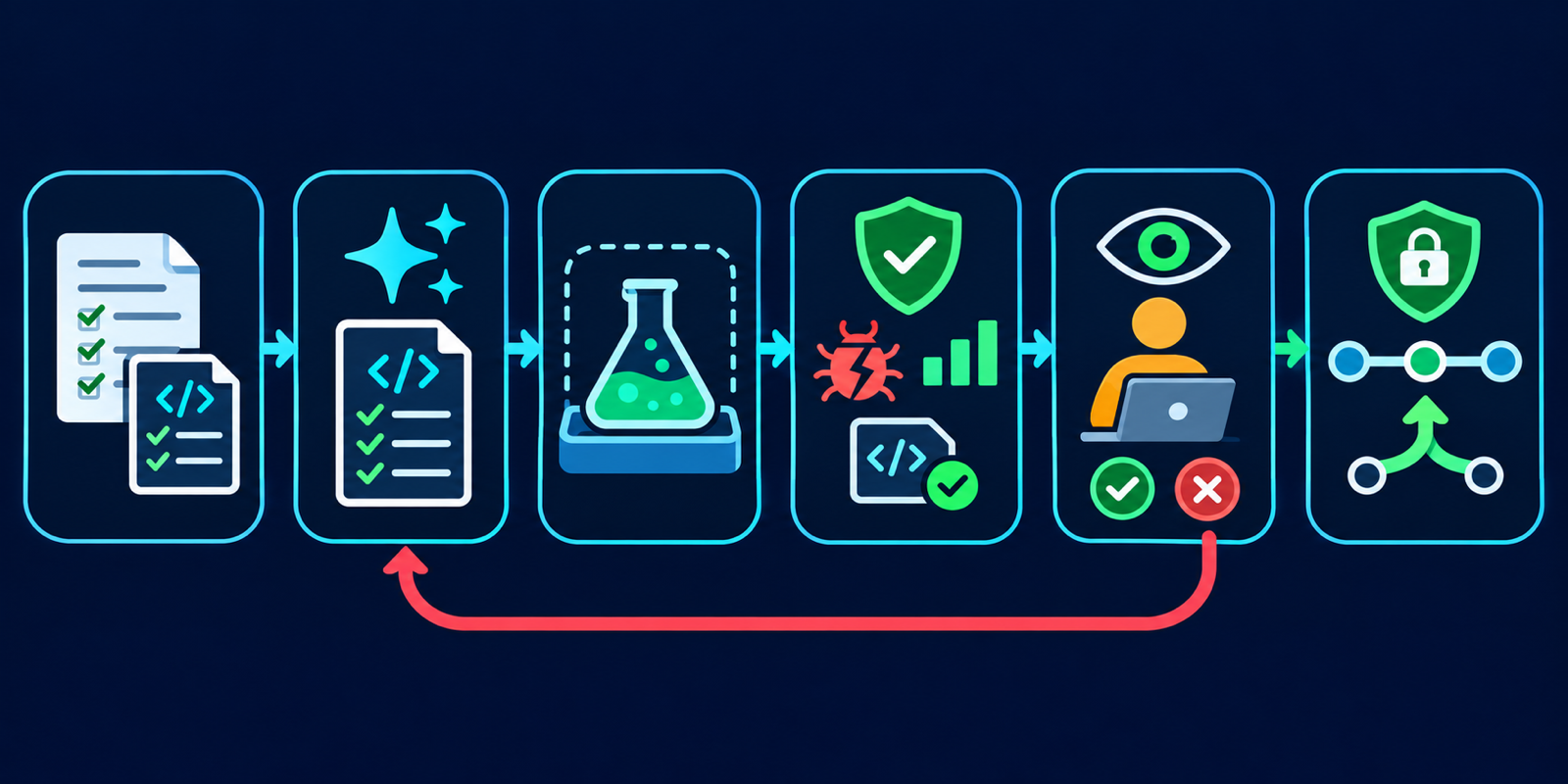
- Write the behavior contract. Name normal inputs, boundaries, invalid states, side effects, error semantics and invariants. Link tickets or API specifications. Do not ask the model to infer everything from code.
- Preserve the baseline. Run the existing suite and record known failures, runtime and flaky tests. A generator should not “repair” the baseline by deleting or relaxing assertions.
- Limit context and authority. Give the tool only the relevant module, existing tests and approved commands. Keep secrets, production data and unrelated repositories out of context. Start in proposal mode when available.
- Generate a small batch. Request behavior-focused cases for one function or change. Specify the framework, naming style, fixture rules, network/database boundaries and files that must not change.
- Run in isolation. Use a disposable branch or worktree, sandboxed commands and test credentials with no production access. Block external network calls unless the test explicitly requires an approved fake service.
- Challenge the tests. Temporarily introduce a small fault or use mutation testing. If changing a comparison, return value or branch condition does not fail the generated test, the assertion may not protect useful behavior. Coverage alone is insufficient.
- Inspect every assertion and fixture. Check that expected values come from requirements, not from copying the implementation. Reject over-mocking, hidden sleeps, nondeterministic time or randomness, broad snapshots and real secrets.
- Merge through normal CI. Compile, lint, run unit and integration tests, scan dependencies and code, and require human approval. Keep the change reversible; remove a generated test if later evidence shows it encodes the wrong behavior.
This workflow complements our production-ready AI code checklist. When generated tests fail, use the evidence-first approach in the AI debugging tools guide rather than automatically changing production code or assertions until the suite turns green.
A prompt that produces more useful tests
Analyze
calculateRenewalPriceand the existing tests without editing first. Use Vitest and the repository’s current fixture style. Propose tests for documented behavior, boundary dates, invalid discounts, currency rounding and dependency failure. Cite the requirement or existing example that supports each expected value. Do not call the network, change production code, add packages or weaken existing assertions. After I approve the cases, write only the test file, run the targeted test command, and report any uncertainty. Stop if the baseline already fails.
The important clauses are evidence, scope and stop conditions. “Write comprehensive tests” invites the model to invent behavior. A bounded request makes review faster and exposes missing requirements before code is merged.
Risks and required controls
- Oracle problem: the model may derive the expected result from flawed code. Anchor assertions in requirements, examples, invariants and independent calculations.
- False confidence: high line coverage may execute code without checking the important outcome. Use branch coverage, mutation checks and defect-oriented review.
- Brittle tests: assertions on private methods, call order or exact formatting can block safe refactoring. Prefer observable behavior and stable contracts.
- Prompt injection: repository comments and fixtures may contain hostile instructions. Treat repository text as untrusted, use least privilege and require approval before commands or writes.
- Secret exposure: never paste production tokens, customer records or sensitive logs into a cloud assistant. Review retention, model-training, region and enterprise-control terms before enabling repository indexing.
- Dependency risk: prevent the agent from adding an unapproved test library just to make its output compile. Scan lockfiles, licenses and packages.
- Flakiness and cost: block real network calls, control clocks and random seeds, and watch test duration. More generated tests are not automatically better tests.
The OWASP prompt-injection guidance is particularly relevant when an agent can read repository content and invoke tools. For pull-request controls, see our comparison of AI code review tools. AI review can provide a second signal, but it should not approve tests written by the same model without independent checks.
How to choose the right option
Start with your test-generation job. Choose an IDE assistant when developers need occasional tests beside active code. Choose a change-aware testing platform when coverage gaps and pull requests should trigger generation. Choose a specialized Java tool when the goal is scalable characterization or regression coverage across an established JVM estate.
Run a two-week pilot on representative code and use the same acceptance method for every candidate. Measure the percentage of suggestions retained after review, mutation score or seeded-fault detection, flaky-test rate, review time, test runtime and escaped defects. Also record repository access, data path, command permissions, audit logs and cost per accepted test—not merely the number of tests created.
Check supported languages, IDEs, frameworks, monorepos and repository limits against official documentation. Confirm whether “free” means a lasting tier or a trial, whether an account or cloud identity is required, and whether organization controls apply to the plan you are buying. The broader AI coding tools guide provides the same context, permission, privacy and total-cost framework for a full developer-tool stack.
Frequently asked questions
Can AI write good unit tests automatically?
It can draft useful tests for clear, bounded behavior, especially when existing examples and conventions are available. It cannot independently know the correct requirement, so every assertion and fixture still needs evidence and review.
Which AI unit-testing tool is best?
For occasional generation, the best starting point is usually the assistant already integrated with your IDE and governance. Qodo is worth evaluating for change-aware test workflows, while Diffblue is a specialized candidate for Java/Kotlin regression generation. Pilot on your code instead of selecting from feature claims.
Do AI-generated tests improve code coverage?
They can raise coverage, but coverage measures execution rather than fault detection. Pair coverage with mutation testing, meaningful assertions and review of boundary and failure paths.
Should a coding agent be allowed to fix failing tests?
It may propose a diagnosis or patch, but do not let it silently change production code and tests in the same loop. Review which side is wrong, preserve the original failure, and require normal CI and human approval.
Are generated unit tests safe for proprietary code?
Safety depends on what code is sent, where it is processed, retention and training terms, identity and access controls, and agent permissions. Use an approved enterprise or local configuration, exclude secrets and production data, and document the data path before adoption.


