
Quick answer: LangGraph is the strongest choice for explicit, durable workflows; OpenAI Agents SDK is the simplest fit for teams already building on OpenAI; Google ADK fits Gemini and Google Cloud deployments; Microsoft Agent Framework suits .NET and Foundry environments; Strands Agents is attractive when model-provider flexibility matters; and CrewAI is approachable for role-based multi-agent flows. All six frameworks are open source, but models, managed hosting, traces, databases and external tools can still create usage costs.
This 2027 edition was checked on November 14, 2026. It reflects currently documented access and capabilities, not future launches. The findings below come from official documentation and repositories; GravityDevOps did not run a universal hands-on benchmark, so “best” means best fit for a stated operating model—not fastest or most accurate in every workload.
Best AI agent frameworks: quick comparison
| Framework | Best fit | Languages highlighted by current docs | License / cost boundary | Main trade-off |
|---|---|---|---|---|
| LangGraph | Durable, stateful workflows with explicit control | Python, JavaScript/TypeScript | MIT; infrastructure and optional services cost extra | More orchestration design work |
| OpenAI Agents SDK | Small-to-medium agent apps on the OpenAI stack | Python | MIT; model and hosted-service usage is separate | Most natural with OpenAI APIs |
| Google ADK | Gemini, Google Cloud and multi-agent applications | Python, JavaScript, Go, Java, Kotlin | Apache 2.0; cloud/model usage is separate | Broad surface area to learn |
| Microsoft Agent Framework | .NET/Python teams and Foundry deployment | Python, .NET, Go | MIT; managed hosting/providers cost extra | Some hosting paths have different maturity |
| Strands Agents | Provider-flexible agents, especially on AWS | Python, TypeScript | Apache 2.0; providers and deployment cost extra | You assemble more of the operating stack |
| CrewAI | Role-based crews and structured flows | Python | MIT core; models and optional enterprise services are separate | Role metaphors can hide unnecessary complexity |
“Free” here describes the framework source code, not an unrestricted production service. A real agent may pay for model tokens, search, embeddings, vector storage, sandboxes, telemetry, queues and egress. Review each dependency’s terms, retention settings and regional availability before using sensitive data.
How we compared the frameworks
We evaluated what the maintainers document today: tool calling, workflow control, persistence, human approval, multi-agent patterns, model/provider choice, tracing, evaluation, deployment options, language support and open-source license. We also looked for a safe path from local prototype to an observable service. Repository popularity was not treated as proof of reliability, and vendor examples were not treated as independent performance tests.
This article focuses on selection. For concepts and architecture, start with AI Agents Explained. If your question is whether you need an agent at all, the guide to agents vs assistants vs chatbots separates these patterns.
Six AI agent frameworks compared
1. LangGraph: best for durable, explicit workflows
LangGraph is a low-level orchestration framework for long-running, stateful agents. Its graph model makes steps, branches and shared state visible. Official guidance emphasizes durable execution, checkpoints, interrupts for human input, retries and inspection between nodes. That makes it a strong fit for incident triage, research pipelines, regulated review flows and other processes where “resume safely” matters more than a tiny quickstart.
The advantage is control: deterministic code can own routing while a model handles judgment inside selected nodes. The cost is design effort. Teams must define state, idempotency, retry behavior and compensation instead of relying on a single open-ended loop. LangGraph’s Python and JavaScript packages are MIT licensed; optional hosted LangSmith capabilities are a separate commercial decision. See the official LangGraph overview and repository.
2. OpenAI Agents SDK: best lightweight OpenAI-first framework
OpenAI Agents SDK deliberately uses a small set of primitives: agents, tools, handoffs or agents-as-tools, guardrails, sessions and tracing. The runner handles turns and tool execution, while handoffs support specialist ownership and manager-style orchestration keeps one agent in control. Current documentation also covers human approval and deterministic, provider-neutral tests for SDK-owned orchestration.
This is a practical choice when a team already uses the Responses API and wants less custom loop code. Built-in tracing records model generations, tool calls, handoffs and guardrails, but the docs note that default trace export can include sensitive inputs and outputs; teams should configure or disable that behavior as their data policy requires. The Python package is MIT licensed. Read the official SDK overview, testing guide and tracing controls.
3. Google ADK: best for Gemini and Google Cloud deployment paths
Google’s Agent Development Kit spans agent definitions, tools, multi-agent orchestration, sessions, memory, callbacks, evaluation and deployment. Its documentation now covers Python, JavaScript, Go, Java and Kotlin, although capabilities can vary by language. The surrounding Agents CLI can scaffold projects, generate and grade evaluation traces, and target Agent Runtime, Cloud Run or GKE.
ADK is compelling when Gemini, Google identity, Cloud Trace or a Google deployment target already shapes the architecture. It is not limited to a single model conceptually, but teams should verify the exact provider adapter and language before committing. The Python package is Apache 2.0 licensed, and current package metadata requires Python 3.11 or newer. Start with the official ADK documentation and Agents CLI guide.
4. Microsoft Agent Framework: best for .NET and Foundry teams
Microsoft Agent Framework combines individual agents, graph and functional workflows, provider integrations, middleware and hosting patterns. Current documentation supports Python and .NET as primary paths and points Go users to a separate SDK. It can use Microsoft Foundry, Azure OpenAI, OpenAI, Anthropic, Ollama and other integrations, so it is broader than an Azure-only abstraction.
The hosting decision deserves attention. Foundry Hosted Agents can manage containers, scaling and session lifecycle; self-hosting leaves identity, authorization, storage, routes and scaling with your team. Microsoft’s documentation marks Foundry hosting as generally available while some Python self-hosting packages remain prerelease. The framework is MIT licensed. Consult the official overview and hosting comparison.
5. Strands Agents: best for provider flexibility with an AWS-friendly path
Strands Agents provides a model interface, tools, structured output, hooks, multi-agent patterns and a separate harness for more assembled workflows. Its provider documentation lists Bedrock, Anthropic, OpenAI, Google, Ollama, LiteLLM, Mistral, SageMaker and others; capability details such as prompt caching vary by provider. Python and TypeScript are documented, and the SDK is Apache 2.0 licensed.
Choose Strands when you want to keep model selection flexible or already operate on AWS. Do not assume provider portability makes data handling identical: authentication, retention, regions, tool behavior and caching still depend on the underlying service. Review the official provider matrix and multi-agent pattern.
6. CrewAI: best for role-based crews and flows
CrewAI offers two useful mental models: crews coordinate specialized role-based agents, while flows structure events and control paths around that work. This can make delegation examples easy to explain to product and operations teams. The Python core is MIT licensed, while model calls, infrastructure and optional enterprise services remain separate.
The risk is over-modeling a simple workflow as a “team” of agents. Each extra agent adds prompts, context boundaries, failure paths and cost. Use one agent plus deterministic steps unless independent roles genuinely improve evaluation or permissions. Check the official CrewAI repository and its versioned documentation before implementation.
How to choose an AI agent framework
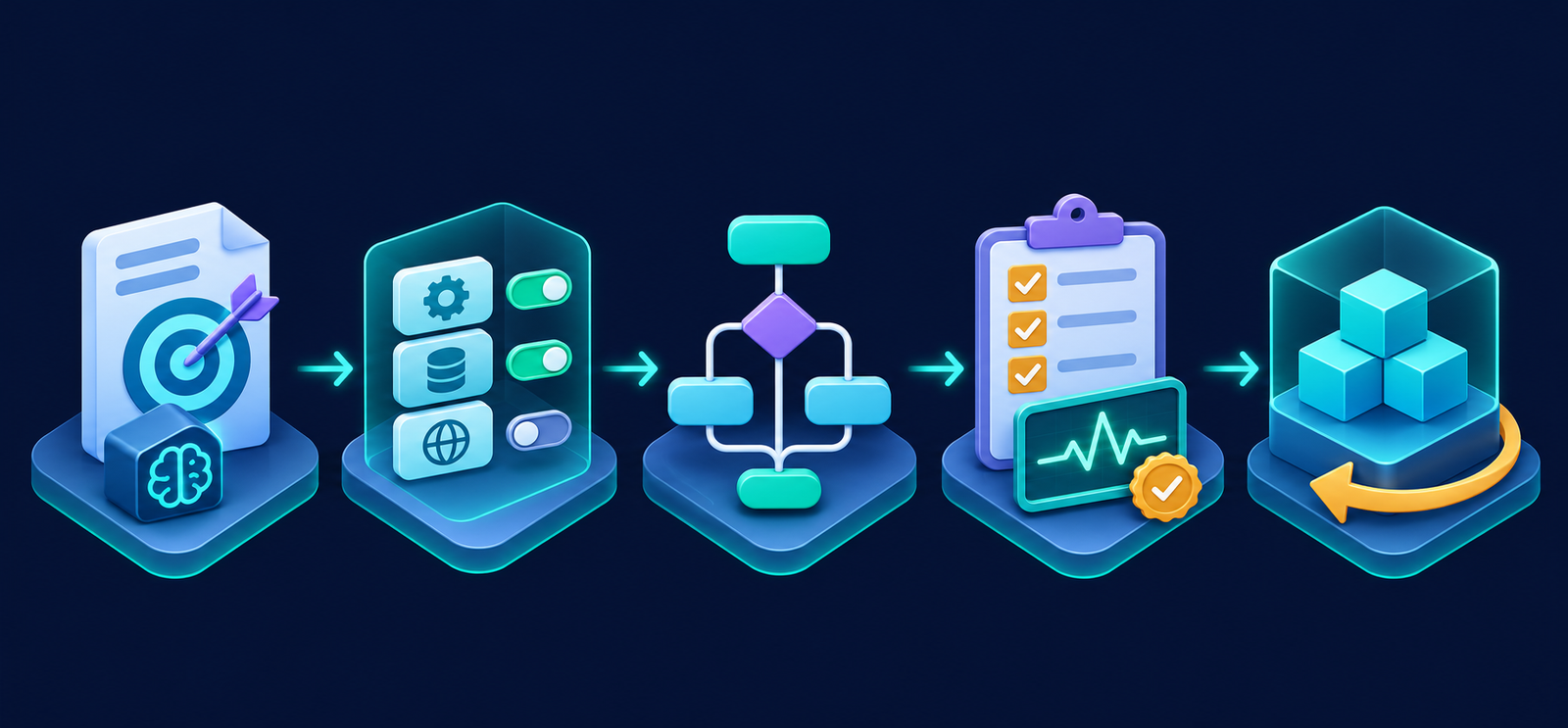
- Start with the failure model. If a run must survive restarts and resume at a known step, prioritize durable checkpoints and idempotent nodes.
- Choose the permission boundary. List every tool, credential, filesystem path, network destination and write action. Prefer read-only access first.
- Separate framework from provider. The orchestration library may be free while the model, tracing backend, sandbox and managed runtime are billed independently.
- Test one representative workflow. Use fixed cases that include tool errors, prompt injection, missing context and approval rejection—not only happy paths.
- Require observable state. Record tool inputs and outputs, model and prompt versions, latency, cost, approvals and final state without leaking secrets.
- Plan rollback before write access. An agent should not merge, deploy, delete or change production state without deterministic validation and a recovery path.
If tools are exposed through MCP, the MCP guide explains the client-server boundary. For long-running systems, pair framework choice with AI agent observability.
Production safety checklist
- Treat retrieved pages, tickets, documents and tool output as untrusted input that can contain prompt injection.
- Use least-privilege, short-lived credentials; never place broad cloud or repository secrets directly in prompts.
- Allow-list tools and arguments, restrict network egress, isolate code execution and cap loops, tokens, time and spend.
- Require approval for destructive or externally visible actions, and show the exact proposed change before approval.
- Run schema validation, tests, security scans and policy checks outside the model before accepting generated changes.
- Keep audit logs, but redact secrets and personal data and confirm where traces are retained or used.
- Maintain a kill switch, rollback procedure and an owner who can investigate failed or suspicious runs.
The dedicated AI agent security guide covers prompt injection, tool permissions and sandboxing in more depth.
Frequently asked questions
What is the best AI agent framework for beginners?
OpenAI Agents SDK is compact for an OpenAI-first Python project, while CrewAI can be approachable when role-based delegation matches the problem. Beginners should still start with one agent and two or three read-only tools.
Which framework is best for production?
There is no universal winner. LangGraph is strong when durable state and explicit control matter; Microsoft Agent Framework and Google ADK offer clear paths into their cloud ecosystems. Production readiness also depends on your tests, identity controls, storage, telemetry and incident process.
Are these AI agent frameworks free?
The six core frameworks compared here use permissive open-source licenses. That does not make the complete system free. Model inference, managed deployment, observability, databases, search and third-party APIs may be billed.
Do I need a multi-agent system?
Usually not at first. Add another agent only when a separate role needs distinct context, tools, permissions or evaluation. A deterministic workflow with one agent is easier to test and audit.
Can an AI agent safely deploy code?
It can participate in a controlled pipeline, but it should not bypass review. Use a sandbox branch, deterministic builds and tests, security scanning, scoped credentials, approval gates, staged rollout and automatic rollback.
Bottom line
Pick the smallest framework that gives you the controls your failure model requires. LangGraph leads for explicit durable workflows; OpenAI Agents SDK for a compact OpenAI-first runtime; Google ADK for Gemini and Google Cloud; Microsoft Agent Framework for .NET and Foundry; Strands for provider flexibility; and CrewAI for role-oriented orchestration. Then validate the choice with your own representative tasks, permissions and operating constraints before granting write access.

