

Microsoft has opened Project Perception to preview, bringing coordinated red-, blue- and green-team AI agents into enterprise security workflows. The launch tests whether teams can safely move from AI-assisted investigation to governed remediation across live environments.
NEW DELHI, August 3, 2026, 3:42 PM IST — Microsoft’s Project Perception is now in preview, introducing a multi-agent security system designed to identify attack paths, investigate risk and coordinate corrective action while keeping people responsible for high-impact decisions.
The launch matters because security vendors are moving beyond copilots that summarize alerts. Project Perception is designed to connect detection, prioritization and remediation in one workflow. For developers, DevOps engineers and platform teams, that raises a practical question: how much authority should an AI security agent receive over code repositories, cloud controls and production systems?
What Microsoft confirmed
Microsoft first announced Project Perception on July 27 and said it would enter public preview on August 3. The company’s live product page now describes the service as being in preview and says it coordinates three classes of specialized agents across security data, tools and workflows.
Red-team agents are intended to look for paths an attacker could use. Blue-team agents investigate findings and determine which issues represent meaningful risk. Green-team agents propose or carry out remediation and hardening. These roles share a continuously updated security context spanning identities, endpoints, applications, data and cloud resources.
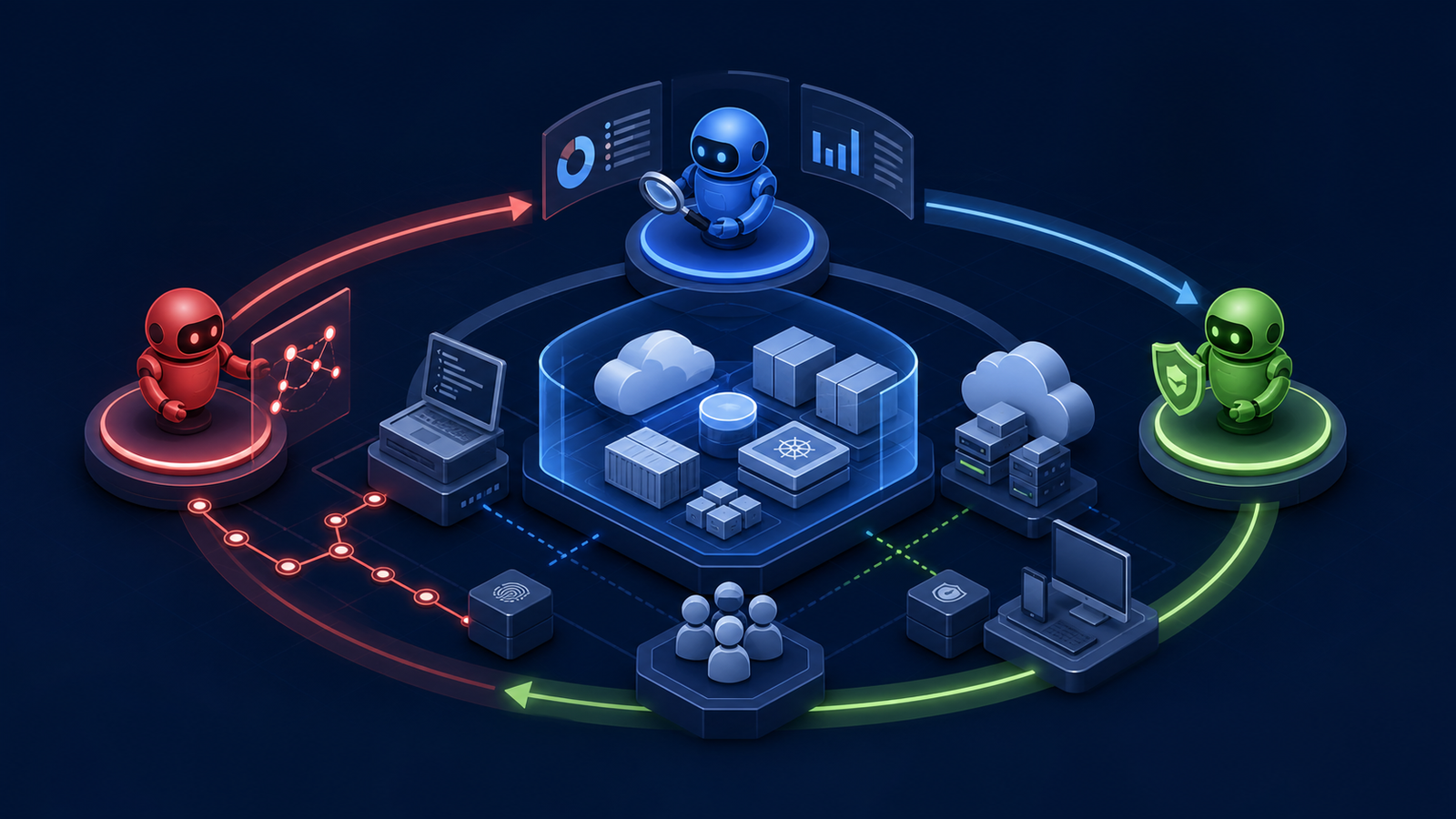
Microsoft says humans set objectives and guardrails, and that high-impact actions require human approval. Its product page also says decisions are intended to remain scoped, traceable and replayable. Those controls are central to the preview: the operational risk is not merely whether an agent finds the right vulnerability, but whether its proposed change is safe, attributable and reversible.
MAI-Cyber-1-Flash provides the first specialized workflow
The first announced scenario connects Project Perception with MDASH, Microsoft’s multi-agent vulnerability identification and remediation harness. MDASH uses MAI-Cyber-1-Flash, Microsoft’s first in-house cyber model, for most tasks and routes the most difficult work to a larger frontier model.
Microsoft reports that MAI-Cyber-1-Flash can handle up to 90% of MDASH tasks, with GPT-5.4 used for the remaining 10%. In Microsoft’s evaluation, the combined system reached 95.95% on CyberGym, a benchmark for reasoning over codebases to find exploitable vulnerabilities. The company also reports a 50% cost saving compared with its previous best MDASH configuration.
Those are vendor-reported results, not an independent production study. Microsoft says the model was assessed by a third party, but the published benchmark does not establish how the system will perform on every private codebase, cloud configuration or security program. False positives, incomplete context and unsafe fixes remain risks that preview customers will need to measure directly.
From alerts to guarded action
Project Perception’s architecture combines signals, security context, models, an orchestration harness, agents and what Microsoft calls actuators. Actuators are the mechanisms that turn a recommendation into an operational change. Microsoft says the first preview brings the coordinated agents into Microsoft Defender, with expansion across its broader security portfolio planned later.
Independent reporting from CSO described a launch demonstration in which agents mapped threat intelligence to an organization’s exposed assets, prioritized vulnerabilities, generated detection rules and proposed remediation. Possible actions included a web application firewall rule, a code fix and a patch submission to an internal repository.

This is the key distinction from a chat interface such as Security Copilot. A conversational assistant helps a human analyze information; an agentic system can coordinate work and invoke tools. That makes identity design, approval policy, change control and audit evidence part of the AI deployment itself.
What DevOps and platform teams should watch
Teams evaluating the preview should treat each agent as a privileged automation identity. Start with read-only access, isolate environments, use short-lived credentials and require approval before any repository merge, firewall update, identity change or production deployment. Every proposed remediation should pass through the same CI checks, policy gates and rollback controls used for human-authored changes.
The shared security context also deserves scrutiny. An agent that correlates identities, endpoints and cloud assets can reason more effectively, but the same context becomes sensitive operational data. Platform teams should document which telemetry is ingested, how tenant isolation works, where prompts and actions are retained, and which administrators can review or replay an agent’s decisions.
Cost controls will matter as well. Microsoft says Project Perception uses consumption-based pricing measured in Security Compute Units, with more intensive tasks consuming more units. The company’s multi-model routing is designed to reserve expensive reasoning for harder work, but preview users will still need per-workflow budgets, usage alerts and a way to connect spend with confirmed risk reduction.
For broader implementation context, GravityDevOps readers can review our guides to LLMOps controls, prompt engineering for developers and CI/CD tooling. The same principles—evaluation, observability, least privilege and gated delivery—apply when AI moves into security operations.
Balanced outlook
Project Perception signals a broader move toward multi-model security systems rather than reliance on one general-purpose frontier model. That could make continuous vulnerability work more affordable and tie findings more directly to fixes. It also concentrates consequential actions inside an orchestration layer that must be tested as rigorously as the models it calls.
During the preview, the most credible success measure will not be the number of vulnerabilities generated or alerts closed. It will be the rate of independently validated findings, safe remediations, avoided regressions and measurable reduction in exposure time. Until customers publish operational evidence, Microsoft’s benchmark and cost figures should be read as promising launch claims rather than settled outcomes.
Sources
Primary sources: Microsoft’s Project Perception announcement, Microsoft Project Perception product page, and Microsoft’s MAI-Cyber-1-Flash and MDASH technical announcement. Additional reporting: CSO and Axios.


