

BENGALURU, India, June 26, 2026, 9:52 a.m. IST – OpenAI published new economic research on Thursday showing that Codex, its agentic coding and work platform, is being used for longer and more delegated work than a conventional chatbot session, with organizational users adopting the tool more deeply than individual users.
The useful signal for developers, DevOps engineers and platform teams is not that every company should hand work to autonomous agents immediately. It is that frontier users are starting to treat agents as workflow systems: tools that inspect repositories, run commands, draft artifacts and coordinate repeated work under human review. That shift turns AI adoption from a prompt-writing question into an operations, security and governance question.
OpenAI said the research paper, The Shift to Agentic AI: Evidence from Codex, analyzes Codex usage across personal-account users, organizational-account users and OpenAI workers. The authors include researchers from OpenAI, Columbia Business School, the Wharton School of the University of Pennsylvania and Duke University’s Fuqua School of Business. OpenAI also summarized the findings in a company post, How agents are transforming work.
What OpenAI confirmed
The paper says weekly active Codex usage grew more than fivefold in the first half of 2026, with the fastest growth outside the original developer audience. By May 2026, OpenAI said 80.6 percent of sampled individual Codex users had made at least one request estimated to represent more than 30 minutes of work by an experienced human. The same sample showed 70.2 percent had made at least one request estimated above one hour, and 25.6 percent had made at least one request estimated above eight hours.
Those numbers need careful reading. OpenAI says the time thresholds are model-estimated and directional, not stopwatch measurements. The individual-user figures are based on a 0.1 percent random sample of users who allowed their queries to be used for training. The paper also notes that OpenAI’s own workplace is not representative of a typical company because internal users have unusually broad access, low marginal cost, strong familiarity with the tools and high organizational buy-in.
The adoption split is still important. OpenAI reported that, as of June 11, Codex accounted for 99.8 percent of output tokens generated across Codex and ChatGPT by OpenAI workers. Among organizational users outside OpenAI, Codex accounted for 63.3 percent of output tokens, while individual users remained much more chat-oriented, with Codex at 16.5 percent of output tokens and fewer than 1 percent of active individual ChatGPT or Codex users using Codex in the previous 28 days.
OpenAI also reported signs that heavy users are moving from one-off requests to repeatable workflows. The paper says more than 10 percent of users manage three or more concurrent Codex agents at some point each week, and 26.6 percent use skills, reusable instructions or capabilities that help standardize complex workflows.
Axios, which reported the paper on Thursday, highlighted the same divide: Codex use is accelerating, especially among organizations, but most AI users are still talking to chatbots rather than coordinating multiple agents. That makes the story less about universal adoption and more about where early production patterns are forming.
Why this matters for technical teams
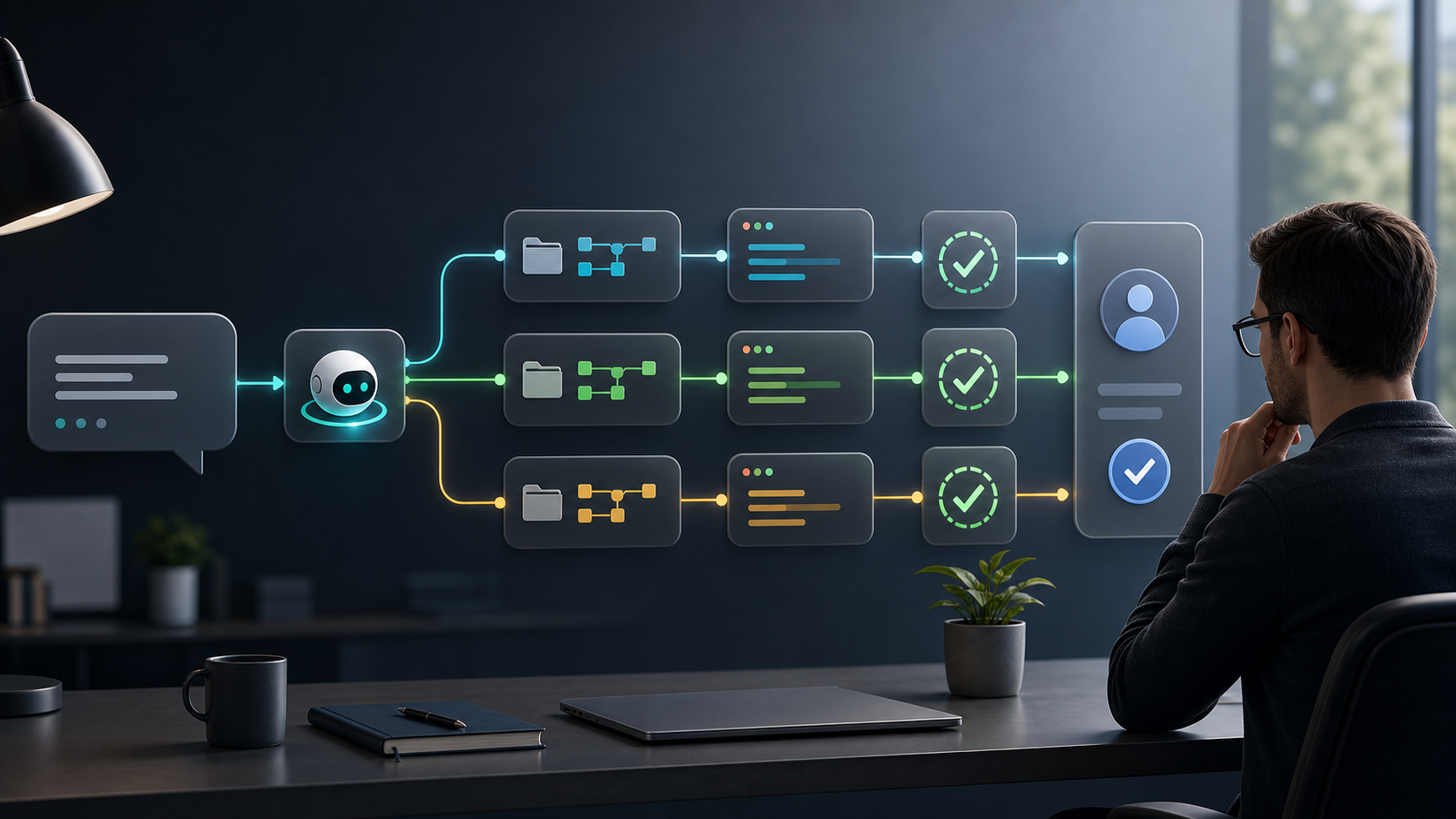
Agentic AI changes the unit of work. A chatbot answer can be read, copied and ignored. An agentic task can touch files, call tools, run shell commands, update a document, inspect a repository or prepare a pull request. In DevOps terms, that makes an AI agent closer to a privileged automation worker than a search box.
For platform teams, the practical question becomes: which tasks are safe to delegate, under which identity, in which sandbox, with what approval gates and audit trail? A coding agent that can refactor a service and run tests may be valuable. The same agent with broad access to production credentials, cloud consoles or deployment pipelines becomes an operational risk unless the organization has guardrails comparable to the ones it already uses for CI/CD and infrastructure automation.
The OpenAI paper also reinforces a pattern that teams already see in software delivery: adoption depends on surrounding systems. Organizations that have clean repositories, repeatable tests, documented workflows, least-privilege access, code review norms and clear ownership can hand agents more structured work. Teams with brittle environments and tribal knowledge may find that agents simply expose existing process debt faster.
The cloud and DevOps impact
For cloud engineers, the near-term impact is likely to show up in internal platform work before fully autonomous production operations. Useful tasks include writing migration scripts, summarizing incidents, checking configuration drift, drafting runbooks, preparing pull requests, updating documentation and creating small internal tools. These are high-context tasks where the agent can help but where a human still owns the change.
Security and compliance teams will need to treat agents as managed actors. That means scoped tokens, separate service identities, traceable tool calls, policy enforcement, secret handling, environment isolation and logs that let reviewers reconstruct what the agent saw and did. Microsoft’s 2026 Work Trend Index made a similar governance point for enterprises, arguing that organizations need evaluation infrastructure, human accountability and IT control planes as agents become more active in workflows.
The standards layer is also moving. The Linux Foundation said this week that it intends to launch Agent Name Service, an open standard built on DNS to help systems verify agent identity, ownership and capabilities. That is not a direct answer to enterprise governance, but it shows that agent identity and discovery are becoming infrastructure concerns rather than product features buried inside individual AI tools.

What remains uncertain
The new Codex data does not prove a broad productivity boom, and it should not be read as evidence that agents can replace complete engineering teams. The most striking internal OpenAI figures come from an environment designed around the tool. External individual adoption remains small, and the paper’s task-duration estimates are generated by models rather than independent time studies.
Still, the direction is useful. Agentic tools are moving from novelty demos toward delegated work in organizations that can absorb them. For GravityDevOps readers, the practical takeaway is to start designing the operating model before agents become another unmanaged shadow automation layer.
A sensible rollout starts with low-risk tasks, narrow permissions and clear review points. Give agents access to repositories and test environments before production systems. Route changes through pull requests. Record prompts, tool calls and outputs where policy permits. Measure defect rates, review time, rework and cloud cost, not just the number of tasks completed.
Teams that already have strong CI/CD, observability and LLMOps practices will have an advantage. If your organization is still building that foundation, GravityDevOps has background guides on LLMOps, RAG, prompt engineering for developers, generative AI basics and CI/CD tooling.
Source links
Sources for this brief include OpenAI’s June 25 company summary, the full Codex economic research paper, Axios coverage, Microsoft’s 2026 Work Trend Index and the Linux Foundation’s Agent Name Service announcement.


