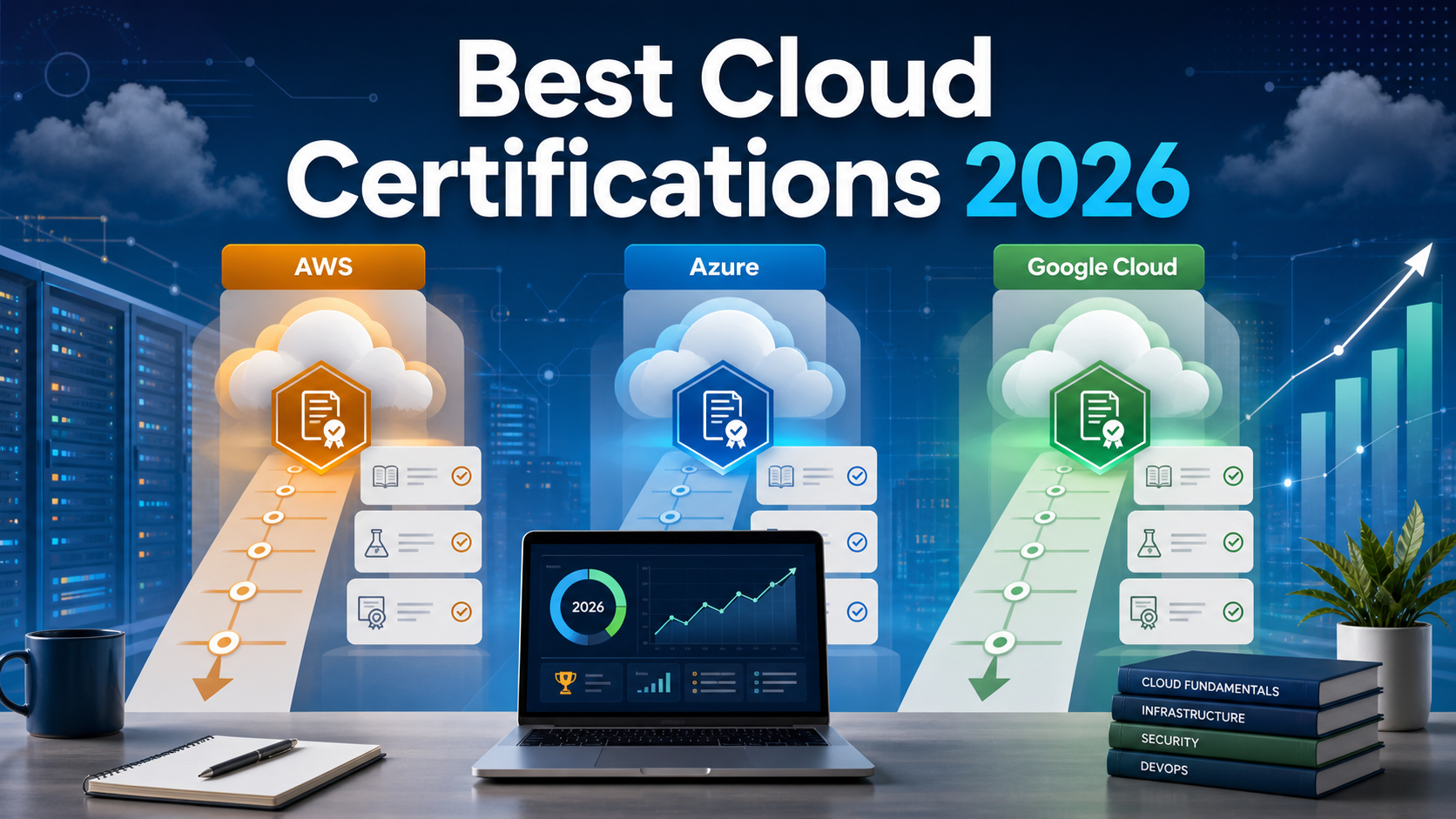

Quick Answer: The best cloud certification in 2026 depends on your target role. Choose AWS Certified Solutions Architect – Associate if you want the broadest infrastructure and architecture starting point, Microsoft Certified: Azure Administrator Associate if your company uses Microsoft 365, Entra ID, Windows Server, or enterprise Azure, and Google Cloud Associate Cloud Engineer if you want a practical Google Cloud operations path. For senior architects, compare AWS Solutions Architect Professional, Azure Solutions Architect Expert, and Google Professional Cloud Architect. For AI and data careers, pair a core cloud certification with vendor-specific AI, data engineering, or machine learning credentials.
Cloud certifications are not magic career tickets. They work best when they prove skills you have practiced: networking, identity, storage, compute, containers, monitoring, security, cost control, and deployment workflows. In 2026, the strongest candidates do not simply collect badges. They use certifications to structure hands-on learning and then show projects, architecture decisions, troubleshooting notes, and cost-aware tradeoffs.
This guide compares the best AWS, Azure, and Google Cloud certifications for beginners, cloud engineers, DevOps engineers, architects, security engineers, and AI/data practitioners. It also covers cost caveats, buyer-intent selection criteria, study plans, and practical recommendations for teams deciding which certification path to fund.
How to Choose a Cloud Certification in 2026
Start with your target environment, not the certificate name. A certification is valuable when it maps to the platform you will actually use, the jobs you are applying for, or the systems your team already runs.
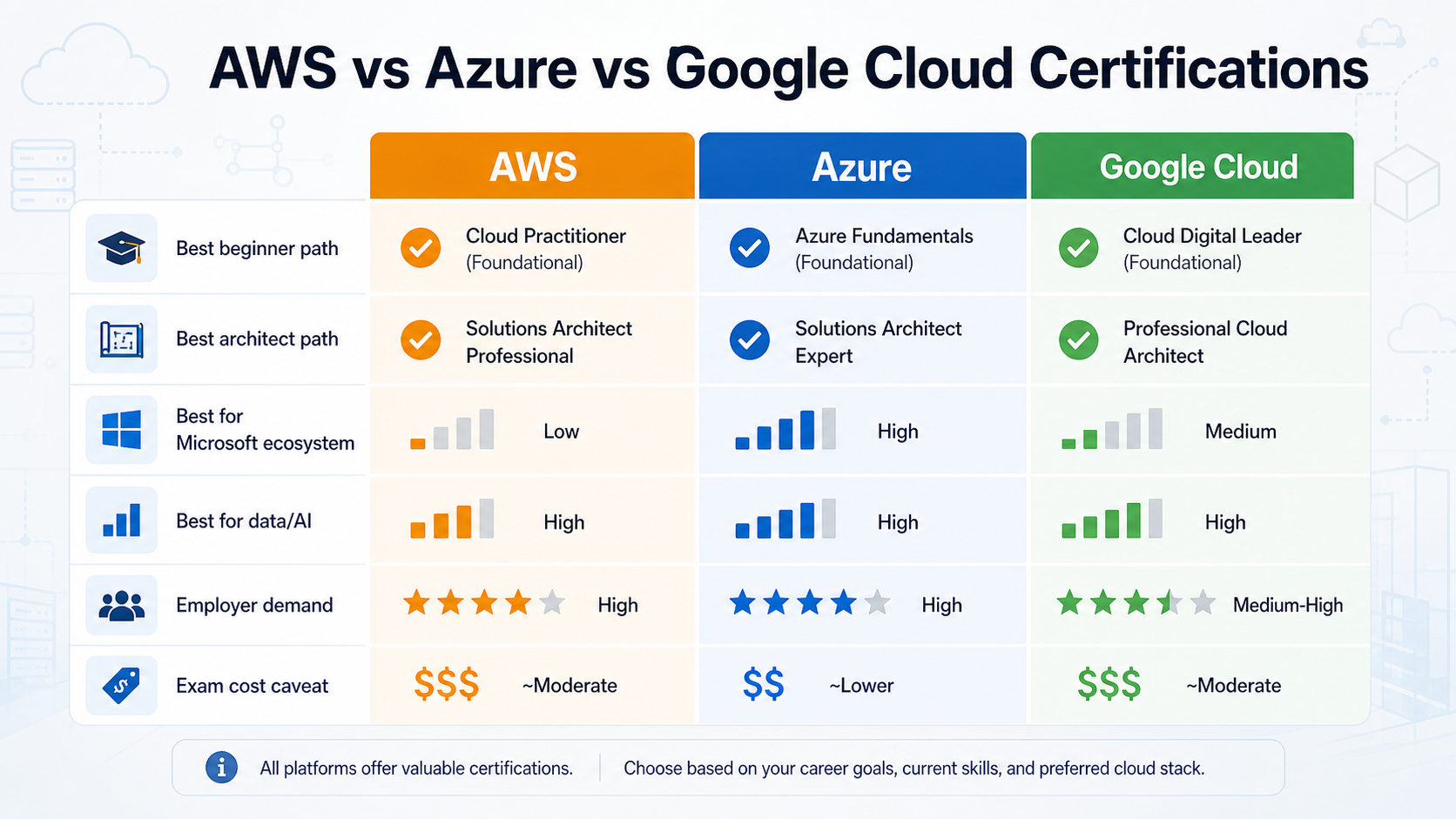
- Choose AWS if you want the broadest cloud infrastructure exposure, startup-to-enterprise market coverage, and strong architecture or DevOps alignment.
- Choose Azure if your organization is deeply invested in Microsoft 365, Microsoft Entra ID, Windows workloads, Power Platform, .NET, SQL Server, or enterprise governance.
- Choose Google Cloud if you are focused on data platforms, analytics, machine learning, Kubernetes-native patterns, or companies already using BigQuery, Vertex AI, and Google Cloud infrastructure.
- Choose multi-cloud only after one strong foundation. Multi-cloud learning is useful, but beginners often progress faster by becoming useful on one platform first.
If you are still deciding which cloud to learn first, read the related comparison: AWS vs Azure vs Google Cloud: Which to Learn in 2026.
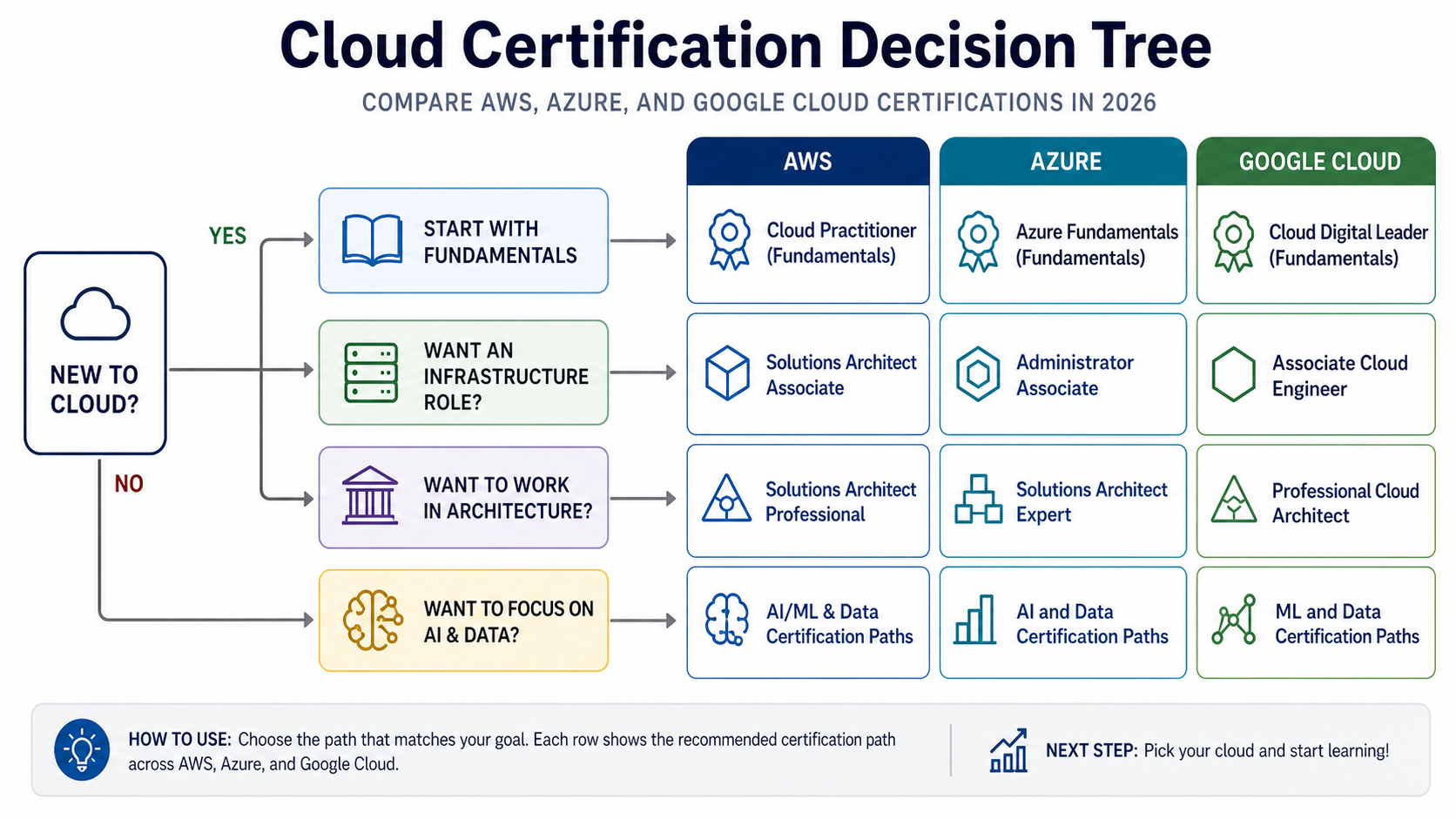
Best Cloud Certifications by Career Goal
| Career goal | Best AWS path | Best Azure path | Best Google Cloud path | Practical recommendation |
|---|---|---|---|---|
| Absolute beginner | AWS Certified Cloud Practitioner | Azure Fundamentals (AZ-900) | Cloud Digital Leader | Use fundamentals only if you need vocabulary, confidence, or a non-engineering entry point. |
| Cloud engineer | Solutions Architect Associate or SysOps Administrator Associate | Azure Administrator Associate | Associate Cloud Engineer | Best first professional-level target for hands-on operations roles. |
| Solutions architect | Solutions Architect Associate, then Professional | Azure Solutions Architect Expert | Professional Cloud Architect | Prioritize design tradeoffs, networking, reliability, security, and cost control. |
| DevOps or platform engineering | Developer Associate, SysOps Administrator Associate, DevOps Engineer Professional | Azure Administrator Associate, DevOps Engineer Expert | Associate Cloud Engineer, Professional Cloud DevOps Engineer | Pair with Kubernetes, CI/CD, Terraform/OpenTofu, observability, and incident response practice. |
| Security | AWS Security Specialty | Azure Security Engineer Associate or Identity and Access Administrator Associate | Professional Cloud Security Engineer | Do not start here unless you already understand IAM, networks, logging, and cloud operations. |
| AI, ML, and data | AWS Machine Learning Engineer Associate or AI Practitioner plus core cloud | Azure AI Engineer Associate or Azure Data Engineer Associate | Professional Machine Learning Engineer or Professional Data Engineer | Combine vendor AI services with model evaluation, data pipelines, and production architecture. |
AWS Certifications: Best for Broad Cloud Infrastructure Demand
AWS remains a strong default choice for cloud infrastructure learners because its certification ladder is clear: foundational, associate, professional, and specialty. AWS also publishes detailed exam guides and official preparation resources. According to AWS certification information, Cloud Practitioner is intended for foundational cloud knowledge, while Solutions Architect Associate validates design knowledge across common AWS workloads.
Best AWS certifications in 2026
- AWS Certified Cloud Practitioner: Best for non-technical learners, sales engineers, managers, project coordinators, and people who need cloud vocabulary before hands-on work.
- AWS Certified Solutions Architect – Associate: Best first serious AWS certification for cloud engineers, junior architects, DevOps engineers, and backend developers.
- AWS Certified Developer – Associate: Useful for developers building serverless, API, event-driven, and AWS-native applications.
- AWS Certified SysOps Administrator – Associate: Useful for operational roles focused on deployment, monitoring, reliability, and administration.
- AWS Certified Solutions Architect – Professional: Best for experienced architects who design multi-account, resilient, secure, and cost-aware AWS systems.
- AWS Certified DevOps Engineer – Professional: Strong for CI/CD, infrastructure automation, monitoring, and release engineering roles.
- AWS Security Specialty: Valuable after you already understand IAM, VPC networking, encryption, audit trails, and incident response.
Pricing caveat: AWS lists Cloud Practitioner at USD 100, associate exams at USD 150, and professional or specialty exams at USD 300, before applicable taxes or local pricing changes. Always confirm the latest price before booking because pricing and taxes can vary by country.
Azure Certifications: Best for Enterprise Microsoft Environments
Azure is often the practical choice when a workplace already depends on Microsoft 365, Microsoft Entra ID, Windows Server, Active Directory migration, Microsoft Defender, Sentinel, SQL Server, .NET, or enterprise governance. Microsoft certifications are organized across Fundamentals, Associate, Expert, and Specialty levels, and Microsoft states that eligible certifications can be renewed annually at no cost through an online assessment.
Best Azure certifications in 2026
- Microsoft Certified: Azure Fundamentals (AZ-900): Best for cloud vocabulary, business users, students, and people entering Microsoft cloud environments.
- Microsoft Certified: Azure Administrator Associate (AZ-104): Best first serious Azure certification for cloud administrators and engineers.
- Microsoft Certified: Azure Developer Associate (AZ-204): Best for application developers building Azure services, APIs, integrations, and event-driven systems.
- Microsoft Certified: Azure Solutions Architect Expert: Best for architecture roles. It requires design-level thinking across identity, governance, monitoring, storage, infrastructure, and business continuity.
- Microsoft Certified: DevOps Engineer Expert: Useful for teams using Azure DevOps, GitHub, CI/CD, infrastructure automation, and release governance.
- Microsoft Certified: Azure Security Engineer Associate: Best for engineers focused on identity, platform protection, security operations, and cloud controls.
- Microsoft Certified: Azure AI Engineer Associate: Useful for building AI-enabled apps with Azure AI services, search, and application integration.
Pricing caveat: Microsoft exam fees vary by country, exam, tax rules, and discounts. Do not rely on a universal global price. Open the exam page from Microsoft Learn, select your region during scheduling, and confirm the price before purchasing a voucher.
Google Cloud Certifications: Best for Data, AI, and Kubernetes-Oriented Teams
Google Cloud certifications are especially relevant for teams using BigQuery, Vertex AI, Google Kubernetes Engine, data engineering pipelines, and analytics-heavy workloads. Google Cloud recommends reviewing the official exam guide and sample questions for each selected certification before scheduling.
Best Google Cloud certifications in 2026
- Cloud Digital Leader: Best for non-technical professionals and business stakeholders who need Google Cloud vocabulary and product awareness.
- Associate Cloud Engineer: Best first hands-on Google Cloud certification for deploying, operating, and managing workloads.
- Professional Cloud Architect: Strong for solution architects designing secure, reliable, scalable, and cost-effective systems on Google Cloud.
- Professional Cloud DevOps Engineer: Useful for reliability, observability, service operations, and delivery roles.
- Professional Data Engineer: Strong for data platform engineers working with storage, processing, analytics, and pipelines.
- Professional Machine Learning Engineer: Useful for production ML and AI practitioners working with model development, evaluation, and responsible AI considerations.
- Professional Cloud Security Engineer: Best after you already understand IAM, networking, policy, logging, data protection, and incident response.
Pricing caveat: Google Cloud publishes certification-specific fees. For example, the Associate Cloud Engineer page lists a standard registration fee of USD 125 plus applicable tax, while Cloud Digital Leader is listed at USD 99 plus tax. Fees and renewal details can differ by certification and region, so confirm on the official certification page before booking.
Beginner Recommendation: Skip or Take Fundamentals?
Fundamentals certifications are useful, but they are not always necessary. If you already work with servers, Linux, networking, databases, or development, you may be able to go directly to an associate-level exam. If you are new to cloud or switching careers from a non-technical role, a fundamentals exam can make the rest of the path less intimidating.
Take a fundamentals certification if you need:
- basic cloud vocabulary: regions, availability zones, IAM, compute, storage, networking, managed services, shared responsibility, and billing;
- a low-risk first exam to build confidence;
- a business, sales, project management, or product role where architecture depth is not required;
- a structured introduction before labs and associate-level study.
Skip fundamentals and start at associate level if you can already explain subnets, security groups or firewall rules, object storage, virtual machines, managed databases, logging, and basic IAM.
Best First Certification for Most Learners
For most technical learners, the best first cloud certification is one of these:
| Platform | Best first technical certification | Why it is a strong first choice |
|---|---|---|
| AWS | AWS Certified Solutions Architect – Associate | Forces you to learn compute, storage, networking, IAM, resilience, databases, migration, and cost-aware design. |
| Azure | Azure Administrator Associate | Maps closely to real administrator and cloud engineer tasks in enterprise Microsoft environments. |
| Google Cloud | Associate Cloud Engineer | Focuses on deploying, configuring, operating, and monitoring Google Cloud environments. |
If your goal is DevOps or platform engineering, pair the first certification with CI/CD and automation practice. The Best CI/CD Tools 2026 comparison is a useful next read because cloud engineers are increasingly expected to understand delivery pipelines, not just cloud consoles.
Best Certification for Cloud Architects
Architect certifications are most valuable when you already have hands-on cloud experience. They test judgment more than memorization: when to use managed databases, where to terminate TLS, how to isolate accounts or subscriptions, how to design for outages, how to set recovery objectives, how to control cost, and how to avoid brittle network designs.
- AWS: Start with Solutions Architect Associate, then move to Solutions Architect Professional after real project experience.
- Azure: Azure Solutions Architect Expert is the natural path for enterprise architects working with Microsoft identity, governance, and infrastructure.
- Google Cloud: Professional Cloud Architect is the strongest fit for Google Cloud design roles and data-heavy cloud environments.
Do not rush professional-level exams just to look senior. A better sequence is: associate certification, two or three real projects, architecture review practice, then professional certification.
Best Certification for AI and Data Careers
AI and data roles need more than a cloud badge. In 2026, the practical stack includes data pipelines, vector search, model APIs, retrieval-augmented generation, prompt evaluation, observability, security, and cost controls. A cloud AI certification is strongest when paired with implementation work.
Recommended combinations:
- AWS: Solutions Architect Associate plus AWS AI, ML, or data-focused certification depending on your role.
- Azure: Azure Fundamentals or Administrator Associate plus Azure AI Engineer Associate for AI application builders.
- Google Cloud: Associate Cloud Engineer plus Professional Machine Learning Engineer or Professional Data Engineer for ML/data platform roles.
For AI fundamentals, also read What is Generative AI?, What is RAG?, and Prompt Engineering for Developers.
Best Certification for DevOps and Platform Engineering
Cloud DevOps roles are less about passing a single exam and more about connecting multiple skills: infrastructure as code, Git workflows, CI/CD, Kubernetes, monitoring, incident response, secrets management, and cost visibility. A cloud certification can provide the platform foundation, but you should build a lab that proves you can deploy and operate something.
A practical DevOps lab should include:
- a small web application deployed through a CI/CD pipeline;
- infrastructure created with Terraform, OpenTofu, Pulumi, or cloud-native templates;
- logging and metrics dashboards;
- basic alerting and runbooks;
- least-privilege IAM policies;
- a documented rollback process;
- a monthly cost estimate and cleanup plan.
This makes your certification more credible because you can discuss implementation tradeoffs during interviews.
Buyer-Intent Guide: Which Certification Should a Company Fund?
If you are choosing certifications for a team, do not buy random vouchers. Match training spend to business outcomes.
| Business need | Recommended certification investment | Why |
|---|---|---|
| Cloud migration | Associate-level cloud engineer/admin plus architect path | Teams need practical deployment skills and design judgment. |
| Cost reduction | Architect or administrator paths plus FinOps training | Certifications cover services, but cost optimization requires tagging, budgets, rightsizing, storage lifecycle, and accountability. |
| Security maturity | Core cloud certification first, then security specialty | Security engineers need platform fluency before advanced controls make sense. |
| AI adoption | Core cloud plus AI/data certification | AI projects fail without data, identity, networking, monitoring, and governance basics. |
| Developer productivity | Developer, DevOps, or platform engineering paths | Best fit for CI/CD, internal platforms, templates, and release automation. |
Selection criteria for teams
- Existing cloud footprint: fund the platform your team uses now unless a migration is approved.
- Role mapping: do not send developers to administrator exams unless their job requires operations ownership.
- Hands-on labs: budget for sandbox environments, not only video courses.
- Renewal policy: track expiration and renewal requirements before credentials lapse.
- Internal projects: require learners to apply the certification to a real backlog item or reference architecture.
- Cost controls: create guardrails for training labs so practice accounts do not become surprise bills.
Pros and Cons: AWS vs Azure vs Google Cloud Certifications
| Platform | Pros | Cons | Best fit |
|---|---|---|---|
| AWS | Broad market recognition, mature certification ladder, strong architecture and DevOps relevance. | Large service catalog can overwhelm beginners; professional exams require serious preparation. | Cloud engineers, architects, DevOps engineers, startups, and infrastructure-heavy roles. |
| Azure | Excellent fit for Microsoft-heavy enterprises, identity, governance, hybrid cloud, and business application environments. | Exam paths can feel role-specific; pricing and scheduling details vary by region. | Enterprise IT, administrators, architects, Microsoft ecosystem teams, security and identity roles. |
| Google Cloud | Strong data, analytics, AI, and Kubernetes relevance; practical associate and professional paths. | Job availability depends more heavily on local market and company stack. | Data engineers, ML engineers, GKE users, analytics teams, and Google Cloud-native organizations. |
90-Day Study Plan for Any Cloud Certification
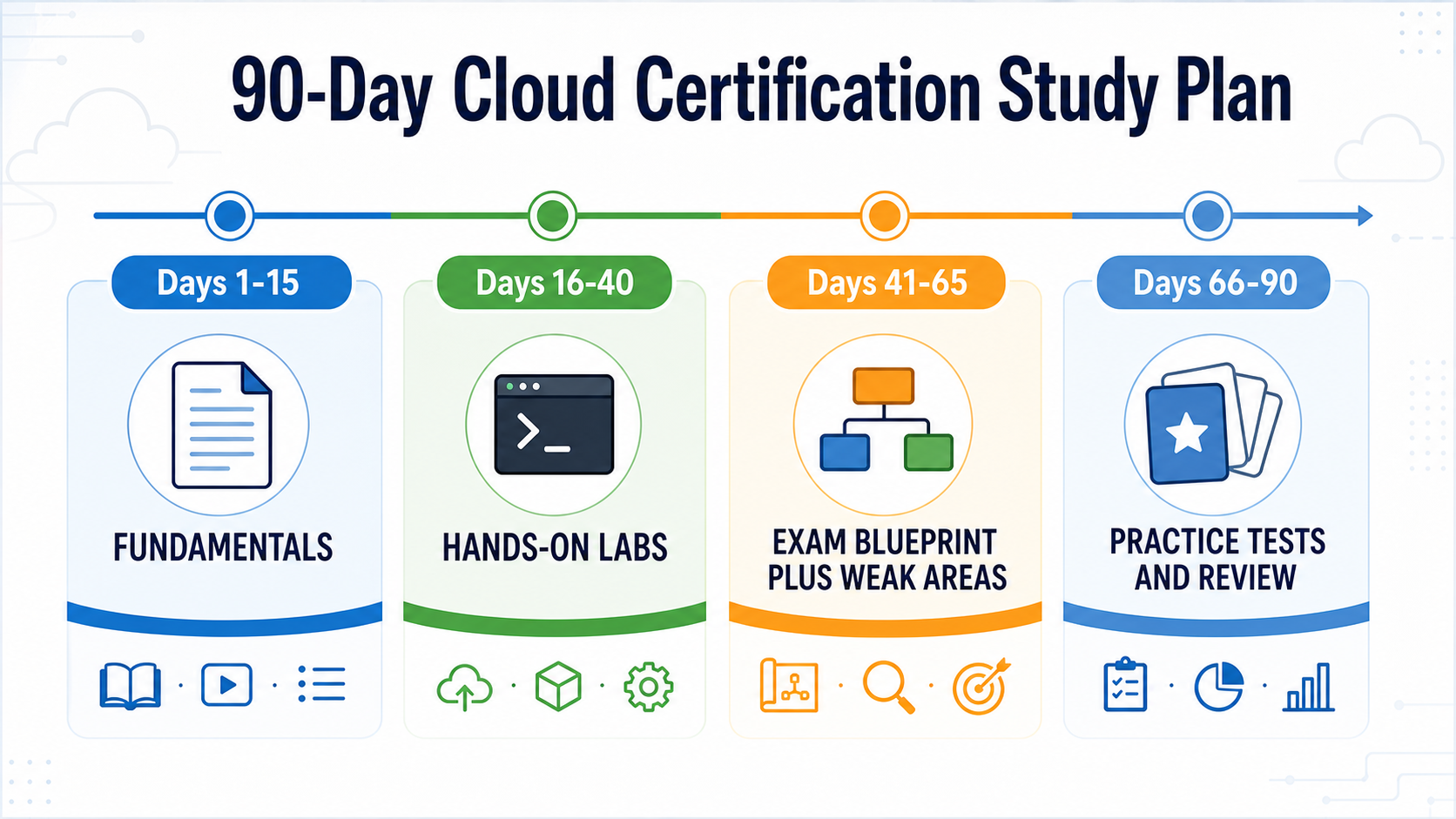
A good study plan spends more time building than watching videos. Use this 90-day structure for associate-level exams. For fundamentals, compress it. For professional-level exams, extend it and add architecture review practice.
Days 1-15: Learn the service map
- Read the official exam guide.
- Learn the platform’s identity, compute, storage, networking, database, monitoring, and billing services.
- Create a one-page service map in your own words.
- Set up a training account with budget alerts.
Days 16-40: Build hands-on labs
- Deploy a simple application.
- Create storage with lifecycle rules.
- Configure IAM roles or equivalent access policies.
- Create a private network, firewall rules, and subnets.
- Enable logging and metrics.
- Document every mistake and fix.
Days 41-65: Map weak areas to the exam blueprint
- Take a practice test.
- Group wrong answers by domain: networking, IAM, storage, compute, reliability, cost, or monitoring.
- Rebuild labs for your weakest domains.
- Read official documentation for services you keep confusing.
Days 66-90: Practice, review, and schedule
- Take timed practice exams only after hands-on work.
- Review why wrong answers are wrong, not just why the correct answer is correct.
- Memorize limits only when they are repeatedly tested or operationally important.
- Schedule the exam when practice results are stable, not after one lucky score.
Common Mistakes to Avoid
- Collecting beginner badges without building anything: one hands-on project beats three shallow credentials.
- Ignoring networking: VPCs, subnets, route tables, private endpoints, firewalls, DNS, and load balancers appear everywhere.
- Skipping IAM: identity and permissions are central to operations and security.
- Studying only dumps: dumps may be outdated, unethical, and poor preparation for real work.
- Forgetting cost: cloud engineers who cannot discuss cost are incomplete engineers.
- Taking professional exams too early: senior exams reward experience and tradeoff judgment.
Final Recommendation
If you need one direct answer: for AWS, start with Solutions Architect Associate; for Azure, start with Azure Administrator Associate; for Google Cloud, start with Associate Cloud Engineer. Choose fundamentals first only when you need a gentler entry point. Choose professional or specialty certifications only after real hands-on practice.
The best cloud certification in 2026 is the one that helps you become useful on real systems. Pick the platform that matches your market or employer, follow the official exam guide, build labs, document your architecture decisions, and connect the credential to practical work.
Sources and Official References
- AWS Certification overview
- AWS Certification FAQs and exam pricing
- AWS Certified Solutions Architect – Associate
- Microsoft Learn credentials overview
- Microsoft Certified: Azure Administrator Associate
- Exam AZ-305: Designing Microsoft Azure Infrastructure Solutions
- Google Cloud certifications overview
- Google Cloud Associate Cloud Engineer
- Google Cloud Digital Leader
FAQ
Which cloud certification is best in 2026?
For most technical beginners, the best first certifications are AWS Certified Solutions Architect – Associate, Microsoft Certified: Azure Administrator Associate, or Google Cloud Associate Cloud Engineer. Choose based on the cloud platform used by your employer, target jobs, or project work.
Is AWS certification better than Azure or Google Cloud?
AWS is often the broadest default for infrastructure roles, but it is not universally better. Azure may be better for Microsoft-heavy enterprises, and Google Cloud may be better for data, AI, analytics, and GKE-focused teams.
Should beginners take Cloud Practitioner, AZ-900, or Cloud Digital Leader first?
Beginners should take a fundamentals exam if they are new to cloud concepts or coming from a non-technical role. Technical learners with networking, Linux, development, or operations experience can often start with associate-level certifications.
Which cloud certification is best for DevOps engineers?
DevOps engineers should first build a strong platform foundation with AWS Solutions Architect Associate, Azure Administrator Associate, or Google Associate Cloud Engineer. Then they can move toward AWS DevOps Engineer Professional, Microsoft DevOps Engineer Expert, or Google Professional Cloud DevOps Engineer.
Which cloud certification is best for AI and machine learning?
For AI and ML, combine a core cloud certification with a data or AI credential. Good paths include AWS AI/ML certifications, Azure AI Engineer Associate, Google Professional Machine Learning Engineer, and Google Professional Data Engineer, depending on the platform you use.
Are cloud certifications worth it in 2026?
Cloud certifications are worth it when they structure hands-on learning and match your job goals. They are less valuable when collected without labs, projects, troubleshooting practice, or real architecture understanding.
How long does it take to prepare for a cloud certification?
Fundamentals exams may take a few weeks. Associate-level exams often take 8 to 12 weeks for learners who practice consistently. Professional-level exams can take several months and are best attempted after real project experience.
Can I learn multiple cloud platforms at once?
You can, but beginners usually learn faster by focusing on one platform first. After you understand identity, networking, compute, storage, monitoring, and cost control in one cloud, it becomes easier to compare other platforms.


