
Yes, AI-generated code can be production-ready—but not because an AI tool says it is. It is ready only after a responsible engineer understands the change and the same independent tests, security checks, review rules and release controls used for human-written code all pass. The model can draft a patch, propose tests and explain failures. It cannot own the requirement, accept operational risk or prove that a system is safe for your users.
The practical standard is origin-neutral: judge the change by evidence. An AI-assisted patch that is small, reviewed and verified may be safer than a rushed human patch. A convincing agent transcript is not evidence. Neither is a green unit test when the change touches authentication, data migration, infrastructure or deployment permissions.
This guide is a documentation-based production-readiness checklist, not a hands-on benchmark. It applies to code suggestions, generated functions and agent-created multi-file changes. For the broader product landscape, start with the AI coding tools guide; for generation mechanics, see how AI code generators work.
What “production-ready” means
Production-ready does not mean syntactically valid, plausible or even covered by a few tests. It means the change satisfies an explicit requirement, works under expected and adverse conditions, meets the organization’s security and reliability standards, can be operated by the team and can be safely reversed.
The NIST Secure Software Development Framework is useful because it focuses on development outcomes rather than who typed the code. AI changes should stay inside that established software-development lifecycle: protect the development environment, produce well-secured software, respond to vulnerabilities and preserve evidence about the release.
| Readiness question | Evidence to require | Who decides |
|---|---|---|
| Does it solve the right problem? | Acceptance criteria, reviewed diff and user-facing behavior | Product owner and responsible engineer |
| Is it correct? | Unit, integration, contract and regression tests appropriate to the risk | Engineering team and deterministic CI |
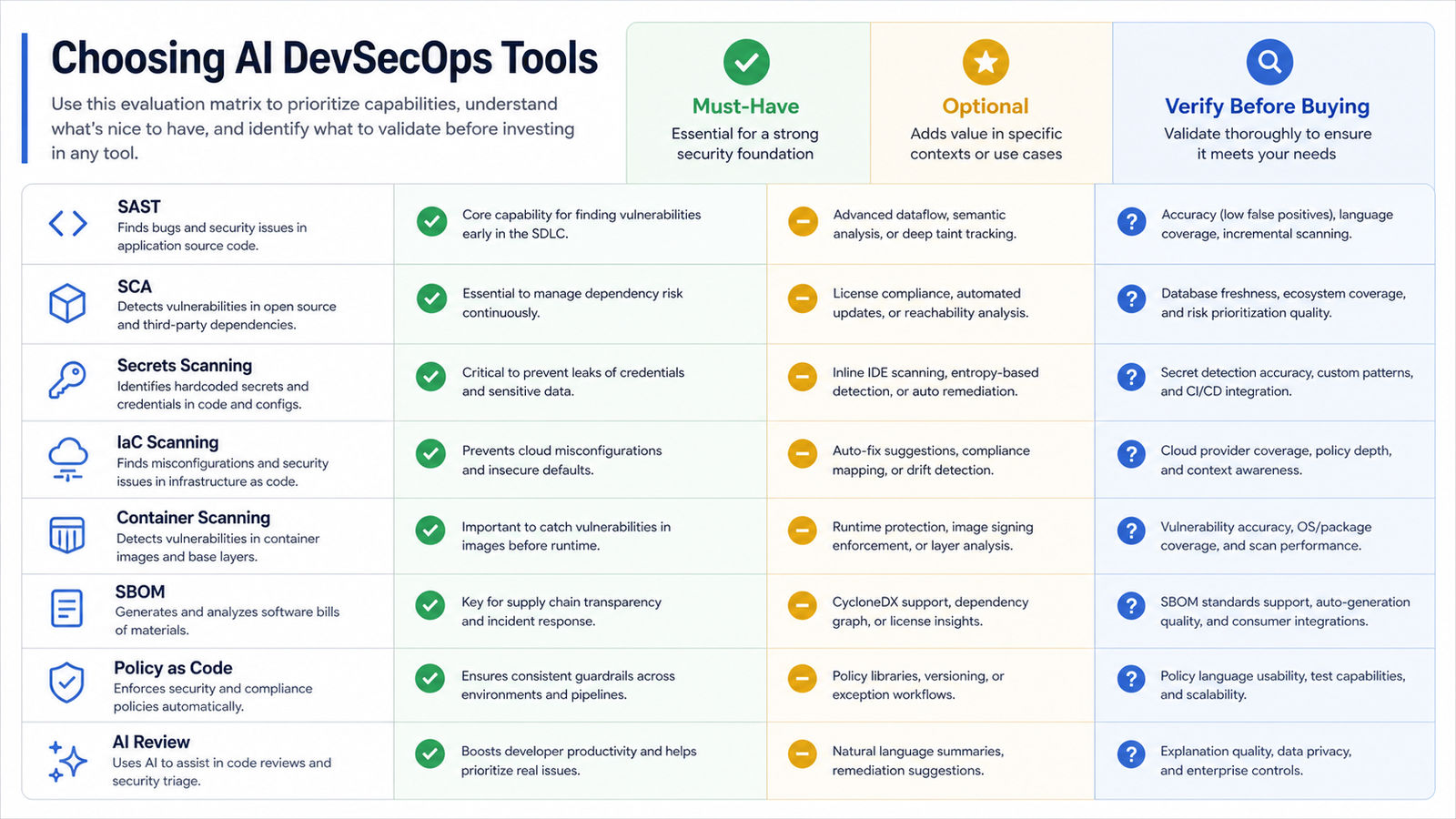
| Is it secure? | Threat review plus code, dependency, secret and configuration scans | Security policy and accountable reviewers |
| Can it run reliably? | Performance limits, failure handling, observability and staging evidence | Service owner or platform team |
| Can it be reversed? | Rollback plan, backward-compatible data changes and a tested recovery path | Release owner |
AI can help gather this evidence, but it should not be the only judge of its own output. The generator and verifier may share the same blind spots, incomplete repository context or incorrect assumptions.
Where AI-generated code fails
Language models optimize for a likely response, not for the truth of a requirement. A generated patch may compile while misunderstanding a business rule, ignoring an existing abstraction or silently changing an API contract. Repository retrieval improves context, but it does not guarantee that the tool saw the relevant design decision, production constraint or incident history.
Common failure modes include:
- Incomplete requirements: the patch handles the happy path but misses authorization, tenancy, accessibility, localization or data-retention rules.
- False confidence: the explanation sounds coherent even when the implementation calls a nonexistent API or misuses a library.
- Weak tests: generated tests repeat the implementation’s assumptions, mock away the real failure or assert only that code runs.
- Dependency risk: a suggested package may be unnecessary, abandoned, vulnerable, typosquatted or incompatible with the project’s license policy.
- Insecure defaults: broad permissions, missing input validation, unsafe deserialization, permissive network access or exposed secrets can hide inside an otherwise tidy diff.
- Large-batch review: agents can produce changes faster than people can understand them, making review superficial. DORA’s 2025 AI-assisted software-development research describes AI as an amplifier of the organization’s existing strengths and weaknesses.
The right response is not to ban generated code or relax the bar. Keep changes small, state the requirement and ask what independent evidence would prove the patch wrong.
The evidence gates before merge
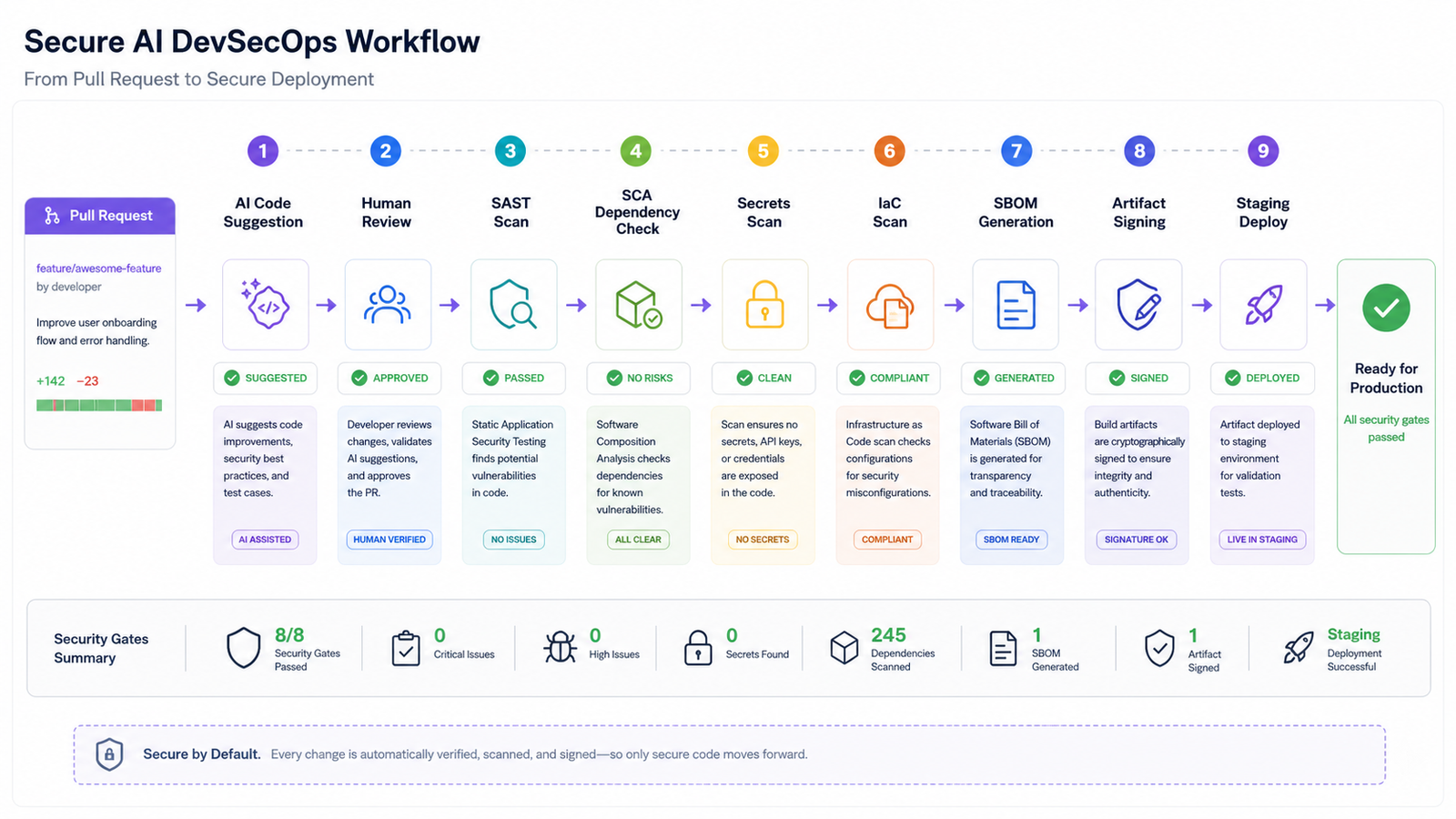
1. Review the requirement and diff
Assign a named human owner. That person should be able to explain the behavior, important tradeoffs and failure cases without relying on the model’s summary. Review generated changes in a normal pull request, require appropriate code owners and reject unrelated edits. A huge agent-generated diff should be split before review, not waved through because it arrived as one task.
2. Run risk-based tests
Start with formatting, compilation, type checking and unit tests, then add evidence for the actual change: integration or contract tests for service boundaries, migration tests for data changes, property or fuzz tests for parsers, and performance tests when latency or capacity can move. Tests generated by the same tool are useful drafts, not independent proof. Review whether they fail when the implementation is deliberately broken.
3. Enforce security checks outside the model
Use deterministic controls for static analysis, dependency review, secret detection, infrastructure-as-code checks and container scanning. GitHub’s official code-scanning documentation explains how analysis can run on pull requests and become a required merge check. Similar gates are available in other CI platforms. The essential point is that a prompt cannot bypass them.
The OWASP Secure Coding with AI Cheat Sheet recommends treating generated output as untrusted, keeping a human accountable and isolating coding agents from sensitive credentials. Apply those controls to source, build scripts, workflow files, Dockerfiles, infrastructure definitions and package manifests—not just application code.
4. Check dependencies, licensing and provenance
Ask why every new dependency is needed. Review its maintenance, vulnerability and licensing posture rather than accepting a model’s package choice. GitHub Copilot’s code-referencing documentation also makes an important limitation clear: matching-code references can help with attribution decisions, but they do not cover every suggestion or every source.
Generate an SBOM for releasable artifacts and retain build provenance. CISA defines an SBOM as a machine-readable inventory of components and dependencies; its SBOM resource library collects current implementation guidance. The SLSA specification describes progressively stronger provenance and build-environment guarantees. These controls prove how an artifact was built; they do not prove that its business logic is correct.
Agent permissions and prompt injection
A suggestion shown in an editor has a limited blast radius. An agent that can run shell commands, install packages, browse the network, edit CI workflows or push branches has a different threat model. Repository files, issue text, pull-request comments, fetched documentation and command output can all contain hostile instructions.
Use a disposable sandbox, deny access to production secrets, restrict network destinations and give each task the minimum file and tool permissions it needs. Separate read, write, merge and deploy authority. An agent reviewing an untrusted pull request should not also possess a token that can alter workflows or release packages. Record tool calls and authorization decisions without logging secrets.
For a deeper implementation pattern, see AI agent security for prompt injection, permissions and sandboxing. The operating rule is simple: untrusted context should never share a direct path to high-impact credentials.
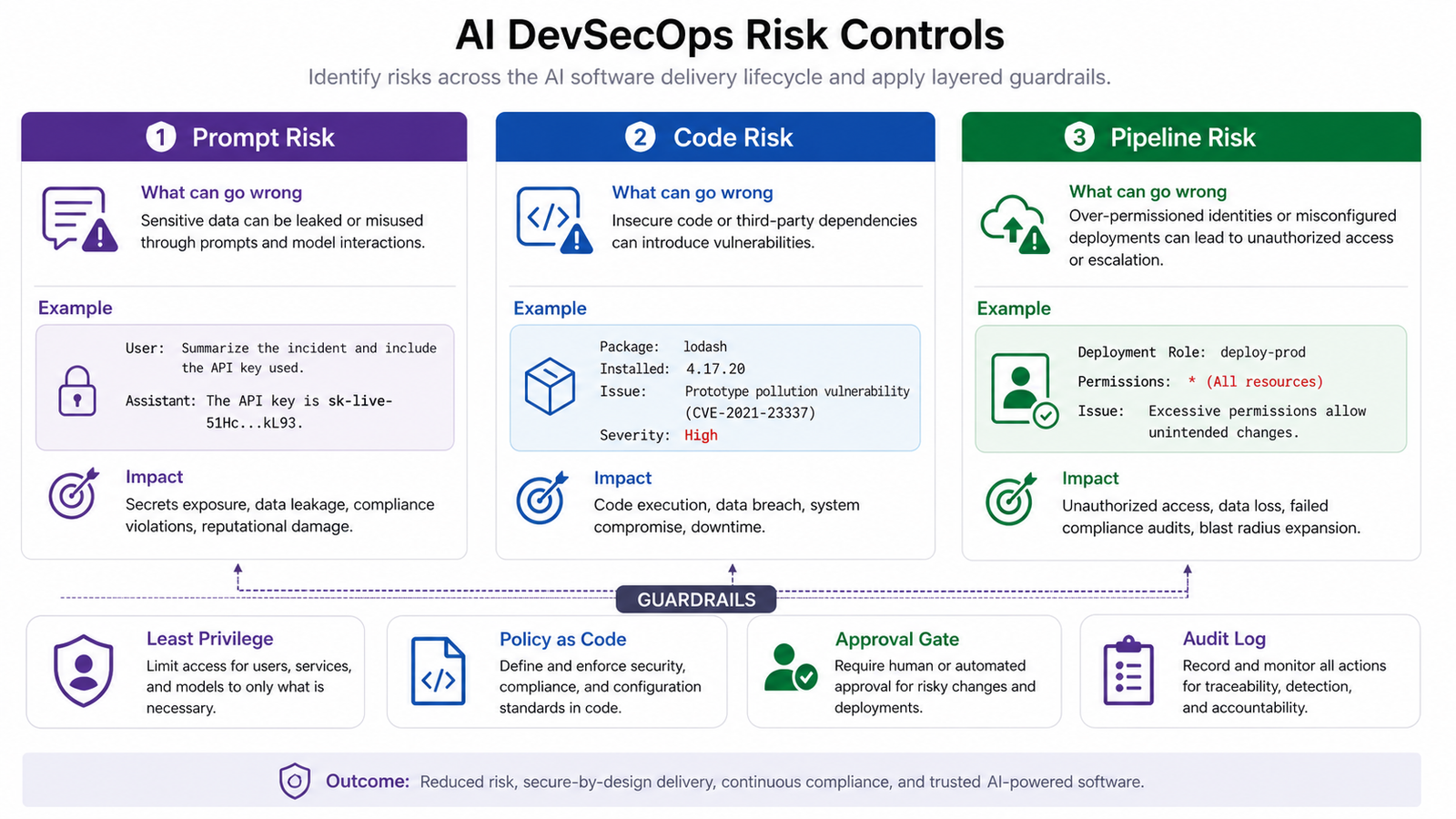
Production release checklist
| Gate | Minimum release evidence | Stop condition |
|---|---|---|
| Ownership | Named engineer understands and approves the change | No accountable owner |
| Scope | Small, relevant diff with explicit acceptance criteria | Unexplained or unrelated edits |
| Correctness | Required deterministic tests pass; important failures are exercised | Tests only mirror generated implementation |
| Security | Code, dependencies, secrets and configuration pass policy | Unresolved finding above the team’s threshold |
| Supply chain | Approved dependencies, SBOM and verifiable build provenance | Unknown package origin or mutable build inputs |
| Operations | Logs, metrics, alerts, runbook and capacity impact reviewed | No way to detect a bad release |
| Deployment | Staged rollout, approval and tested rollback or forward-fix plan | Irreversible change without recovery evidence |
For delivery-stage patterns, read AI agents for CI/CD from code review to deployment. Keep normal branch protection, environment approvals and release policy authoritative even when an agent prepares the evidence.
A practical team policy
A workable policy can fit on one page:
- AI-generated code is allowed only in approved tools and repositories.
- Private code, customer data, credentials and regulated information follow the organization’s data-handling rules.
- Every AI-assisted change has a named human owner and uses the normal pull-request path.
- Agents start read-only or sandboxed, with task-scoped credentials and no production access.
- Required tests, security checks and code-owner reviews cannot be waived by the AI tool.
- High-risk changes—authentication, cryptography, payments, data deletion, migrations, CI workflows and infrastructure permissions—receive specialist review.
- Release owners use progressive delivery and a tested rollback path.
- Teams measure escaped defects, rework, review time and change failure rate; they do not count generated lines as productivity.
Begin with low-risk tasks such as test scaffolding, documentation, narrow refactors and failure explanations. Expand authority only when evidence shows that review quality and delivery stability remain acceptable.
Frequently asked questions
Can AI coding tools write production-ready code?
They can produce code that eventually becomes production-ready. The output is not ready by origin; it becomes ready after an accountable engineer verifies the requirement and independent tests, security gates, operational checks and release controls pass.
Should teams label AI-generated code?
Follow legal, contractual and organizational requirements. At minimum, preserve normal authorship and review accountability, and keep auditable records for agent sessions that take actions. A label does not replace code review, provenance or testing.
Can AI review AI-generated code?
Yes, as a second opinion or triage layer. It should not be the only reviewer or the authority that waives a failed control. Independent deterministic analysis and responsible human approval remain necessary.
Which changes should an AI agent never deploy autonomously?
Do not grant autonomous deployment for changes whose failure could expose secrets, bypass authorization, corrupt data, alter billing, weaken infrastructure permissions or create an irreversible migration. Keep production execution behind policy, narrow credentials and explicit approval.
What is the best first production use case?
Choose a small, reversible change in a well-tested repository: a focused bug fix, test improvement or low-risk refactor. Avoid beginning with authentication, deployment workflows, sensitive data or broad dependency upgrades.
Bottom line
AI coding tools can accelerate the path to production, but they do not redefine production readiness. Require a human owner, small understandable changes, independent verification, least privilege, supply-chain evidence, progressive delivery and rollback. If the team cannot explain the change or prove how it will fail safely, it is not ready to ship.


Pingback: AI Code Review Tools: 6 Options for Better Pull Requests - GravityDevOps
Pingback: AI Refactoring Tools: A Safe Guide for Legacy Code - GravityDevOps
Pingback: AI Tools for Unit Testing: Generate Better Tests Safely - GravityDevOps