
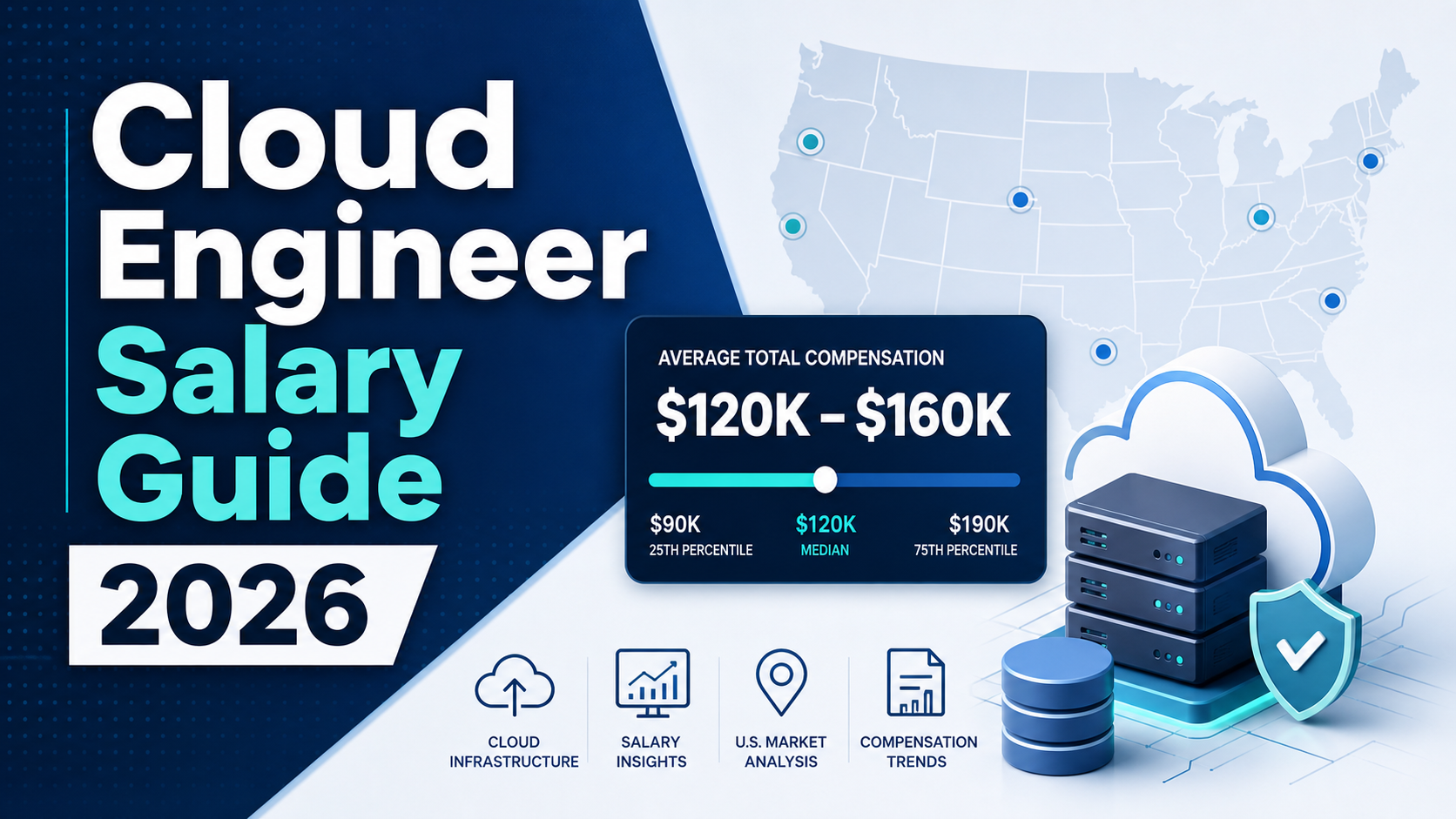

Quick Answer: Cloud Engineer Salary in 2026
A practical U.S. cloud engineer salary in 2026 is usually best benchmarked as a range, not one number. Current public salary sources show a wide spread: Salary.com lists an average base salary near $107,000, Indeed lists average base pay around $135,000, and Glassdoor reports average total pay around $152,000. For real-world planning, many experienced cloud engineers should expect roughly $120,000 to $160,000 base salary, while senior engineers, cloud architects, security-focused cloud engineers, and AI infrastructure specialists can push total compensation past $180,000.
The right number depends on seniority, location, company type, cloud platform, Kubernetes and infrastructure-as-code depth, security responsibility, FinOps impact, and whether the offer includes bonus or equity. This guide breaks down those variables for candidates, managers, recruiters, and cloud teams budgeting roles in 2026.
2026 Cloud Engineer Salary Benchmarks
Cloud salary data varies because different sites measure different things. Some report base salary only. Others include bonus, equity, profit sharing, or self-reported total compensation. Some pull from job postings; others rely on employer or employee submissions. That is why a serious salary benchmark should compare multiple sources and then adjust for the role you are actually evaluating.
| Source | 2026 U.S. benchmark | How to interpret it |
|---|---|---|
| Salary.com | About $107K average base salary, with a common range around $97K-$117K | Useful conservative base-pay baseline for a generic Cloud Engineer title. |
| Indeed | About $135K average base salary, with a broad low-to-high range around $89K-$205K | Useful job-market signal because it reflects recent postings and employer demand. |
| Glassdoor | About $152K average total pay, with 25th-75th percentile around $121K-$193K | Useful total-compensation signal, especially for experienced roles and high-paying industries. |
| BLS technology occupations | $105,990 median annual wage for computer and IT occupations in May 2024 | Useful macro baseline, but not cloud-specific and typically below specialized cloud roles. |
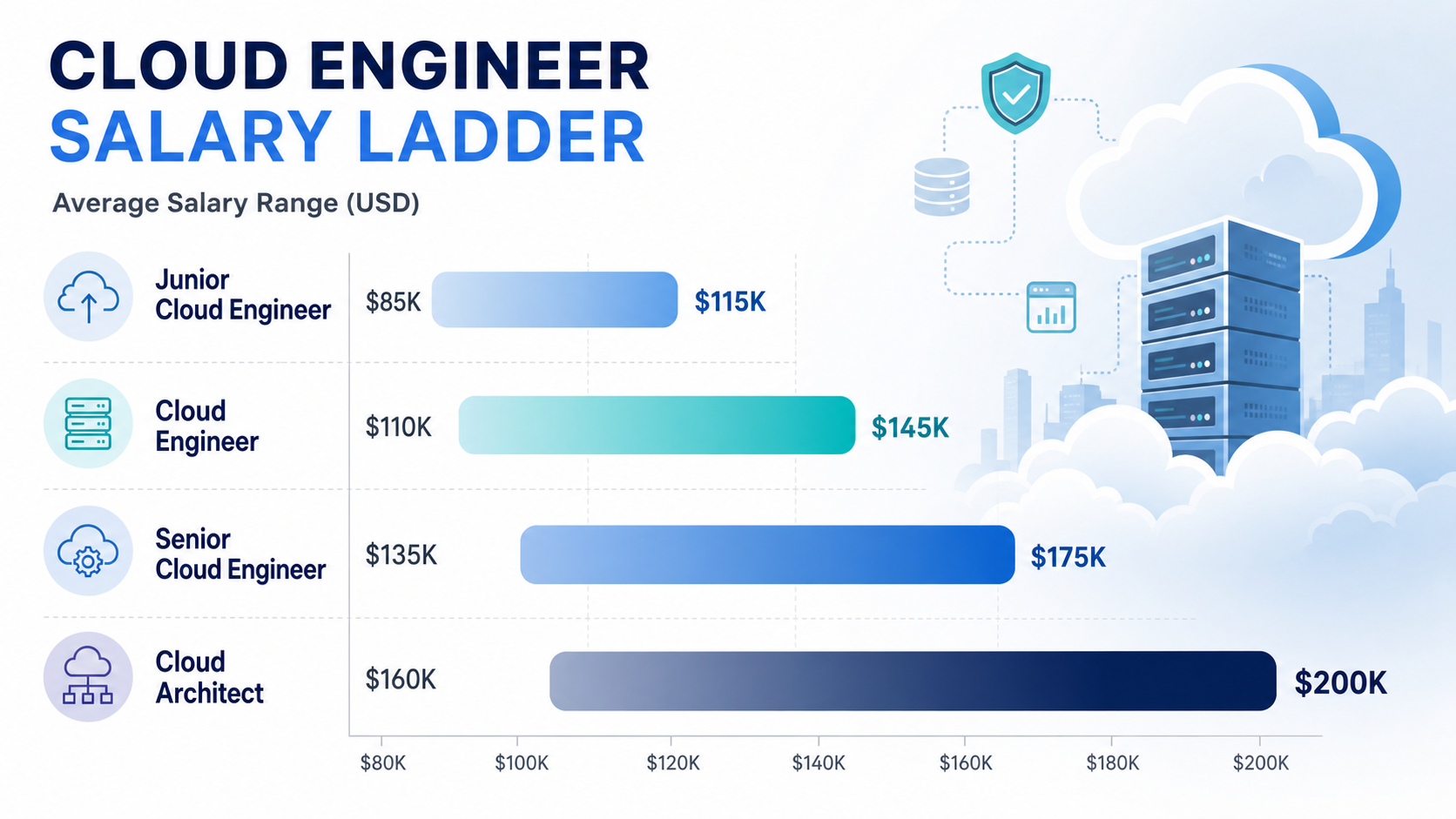
For hiring plans, use a tiered model rather than a single average. A junior cloud engineer might be competitive around $85K-$115K. A mid-level cloud engineer often lands around $110K-$145K. Senior cloud engineers commonly sit around $135K-$175K. Cloud architects, platform leads, and specialized security or AI infrastructure engineers can reach $160K-$200K+, especially when bonus and equity are included.
Cloud Engineer Salary by Experience Level
| Level | Typical 2026 U.S. base salary | What employers expect |
|---|---|---|
| Junior Cloud Engineer | $85K-$115K | Basic cloud services, Linux, networking fundamentals, IAM basics, ticket-based operations, and ability to follow runbooks. |
| Cloud Engineer | $110K-$145K | Production infrastructure ownership, IaC, CI/CD integration, observability, cost awareness, and incident response. |
| Senior Cloud Engineer | $135K-$175K | Architecture decisions, reliability design, security controls, Kubernetes, automation standards, and mentoring. |
| Cloud Architect or Platform Lead | $160K-$200K+ | Multi-team platform strategy, governance, migration planning, landing zones, executive tradeoff communication, and business impact. |
The fastest jumps usually happen when someone moves from cloud operations into engineering ownership. Resetting servers, clicking through consoles, and handling access requests are useful early skills. Higher compensation comes from building repeatable infrastructure, reducing operational toil, improving reliability, and making cloud decisions that lower risk or cost.
Role Specialization: Where Pay Moves Up
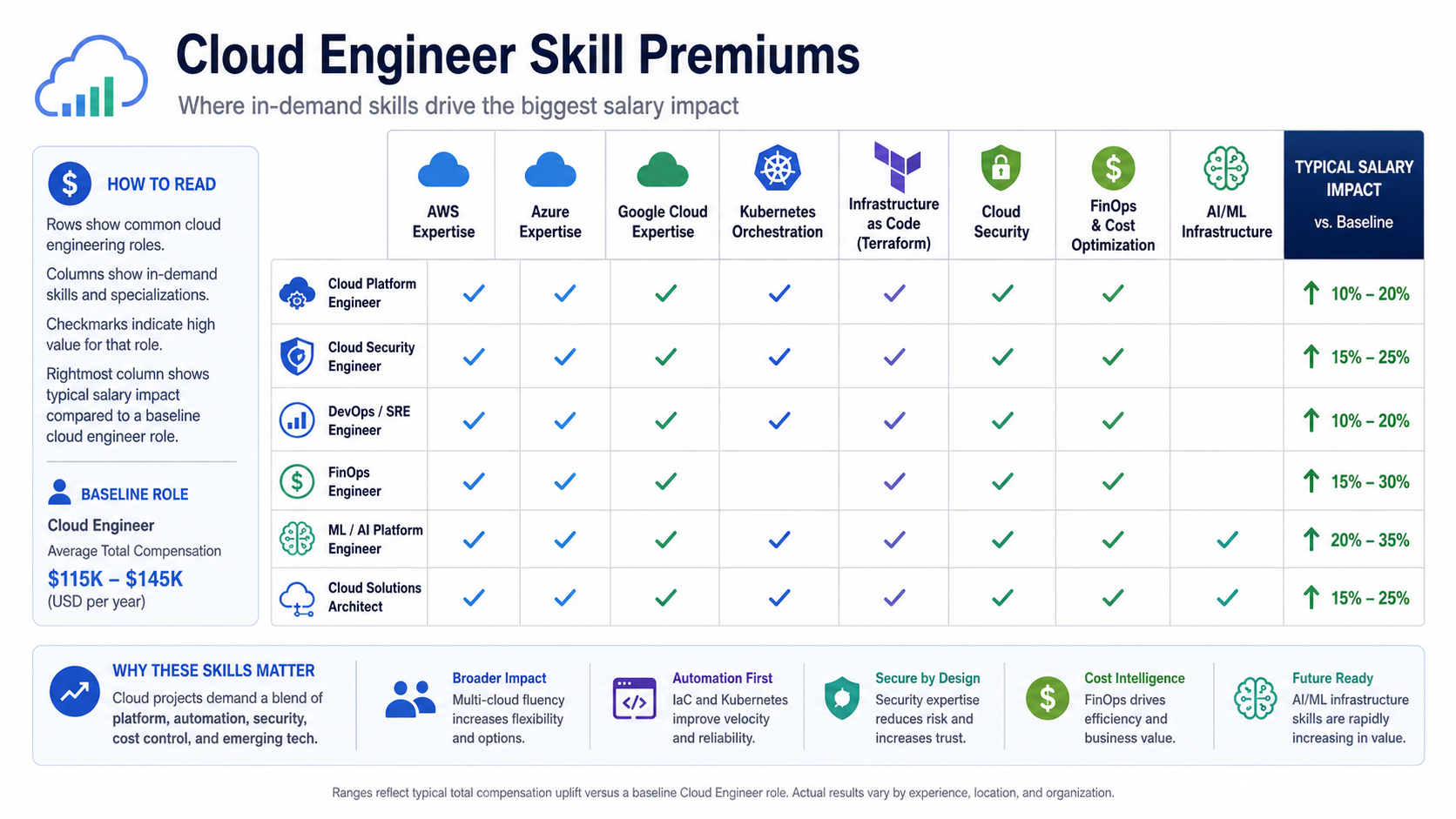
Cloud Engineer is a broad title. Two people with that title can have very different salaries if one is maintaining infrastructure and the other is designing a secure multi-account cloud platform for a regulated enterprise. In 2026, the strongest compensation premiums usually appear where cloud expertise overlaps with business-critical risk, scale, or automation.
| Specialization | Why it pays more | Evidence to show in interviews |
|---|---|---|
| Cloud Security Engineer | Misconfigured IAM, exposed storage, weak network controls, and compliance gaps create direct business risk. | Guardrails shipped, findings reduced, least-privilege patterns, policy-as-code, incident prevention. |
| Platform Engineer / SRE | Reliable internal platforms reduce developer friction and production incidents. | Golden paths, service templates, SLOs, deployment frequency, MTTR reduction, observability coverage. |
| Kubernetes Engineer | Many companies adopted Kubernetes but still struggle with cost, upgrades, networking, security, and developer experience. | Cluster upgrades, workload reliability, autoscaling, ingress design, secrets management, cost controls. |
| FinOps Engineer | Cloud waste is visible to finance leaders, so measurable savings convert directly into business value. | Rightsizing wins, reserved capacity strategy, tagging coverage, unit-cost dashboards, avoided spend. |
| AI / ML Infrastructure Engineer | AI workloads need scalable compute, GPUs, data pipelines, model deployment, governance, and cost controls. | Inference platforms, GPU utilization, model deployment automation, secure data access, cost per request. |
AWS vs Azure vs Google Cloud Salary Impact
Do not choose a cloud platform only because a salary survey says one pays more. Provider-specific pay is heavily distorted by employer mix. AWS has the largest cloud job market and is common in startups, SaaS, and platform teams. Azure is very strong in enterprise environments that depend on Microsoft identity, Windows workloads, and regulated business systems. Google Cloud often appears in data, analytics, AI, and modern platform teams.
| Platform focus | Best salary angle | Common buyer/hiring need | Career caveat |
|---|---|---|---|
| AWS | Broadest role availability and many senior infrastructure positions | Migration, serverless, EKS, landing zones, cost optimization, security | Competition is high; generic AWS knowledge is not enough. |
| Azure | Strong enterprise demand and good leverage for identity, hybrid, and governance skills | AKS, Entra ID, policy, networking, Windows modernization, enterprise data | Pay varies widely between traditional IT shops and high-scale product teams. |
| Google Cloud | Strong upside in data, analytics, AI infrastructure, and Kubernetes-native teams | GKE, BigQuery, Vertex AI, data platforms, modern app hosting | Fewer roles than AWS/Azure in many regions, so market depth matters. |
| Multi-cloud | Good leverage for architecture, consulting, platform, and governance roles | Portability, acquisitions, risk management, central platform standards | Multi-cloud without depth can become shallow resume padding. |
If you are choosing what to learn, start with the cloud used by your target employers, then add portable skills: Linux, networking, IAM, Terraform or OpenTofu, Kubernetes, CI/CD, observability, and security. For related career planning, see our guides to AWS vs Azure vs Google Cloud, Amazon EKS, and best cloud certifications in 2026.
Location, Remote Work, and Total Compensation
Location still matters, but the pattern is more complicated than “move to the Bay Area.” Large tech hubs can offer higher base salary and equity, but they also have higher living costs and more competition. Remote-first companies may use national bands, regional bands, or country-specific compensation. Some employers pay near-market rates anywhere in the U.S.; others discount offers outside major hubs.
Always compare total compensation, not base salary alone. For cloud engineers, total compensation can include annual bonus, equity refreshers, sign-on bonus, paid certifications, conference budget, on-call pay, overtime policy, healthcare, retirement match, and remote-work support. A $145K offer with strong bonus and equity can beat a $160K base salary with weak benefits, depending on risk and vesting terms.
Buyer-Intent Guide: How Companies Should Budget Cloud Roles
If you are hiring, avoid one generic “cloud engineer” band. The cheaper job description usually becomes expensive later when it attracts candidates who can operate tickets but cannot design the platform you need. Budget by outcome.
| Hiring need | Role to budget for | Compensation advice |
|---|---|---|
| Basic cloud operations and support | Junior or mid-level Cloud Engineer | Keep scope clear and provide senior review for security and architecture. |
| Cloud migration or landing zone buildout | Senior Cloud Engineer or Cloud Architect | Pay for proven architecture and governance experience; mistakes are costly. |
| Kubernetes platform ownership | Platform Engineer, SRE, or Kubernetes Engineer | Budget above generic cloud engineer ranges if the person owns production clusters. |
| Cloud security hardening | Cloud Security Engineer | Prioritize IAM, policy-as-code, detection, and compliance evidence over certificates alone. |
| Cloud cost reduction | FinOps Engineer or cloud engineer with cost accountability | Link compensation to measurable savings and operational maturity. |
| AI infrastructure | AI Platform Engineer or ML Infrastructure Engineer | Expect higher ranges for GPU, Kubernetes, data, model serving, and security experience. |
Certifications: Helpful, But Not a Salary Guarantee
Cloud certifications can help candidates get screened, especially early in a career or when changing platforms. They rarely justify a major salary jump by themselves. A certification becomes valuable when paired with evidence: deployed infrastructure, incident response, security controls, migration projects, cost savings, or platform automation.
For beginners, a practical path is one associate-level cloud certification, then Terraform or OpenTofu, Kubernetes fundamentals, Linux networking, and a portfolio project that deploys a real application with monitoring and documented cost controls. For senior engineers, architecture, security, and specialty certifications can support credibility, but interview loops will still test design judgment. Our cloud certification comparison goes deeper on which certifications are worth the time.
How to Increase Your Cloud Engineer Salary
The most reliable salary growth strategy is to move from task execution to measurable ownership. Hiring managers and compensation committees respond to business impact. Make your work visible in language that finance, product, security, and engineering leaders understand.
- Show cost impact: “Reduced monthly cloud spend by 18% through rightsizing, storage lifecycle policies, and reserved capacity planning.”
- Show reliability impact: “Improved service SLO from 99.5% to 99.9% by redesigning autoscaling and alerting.”
- Show delivery impact: “Cut environment provisioning from five days to 45 minutes with Terraform modules and CI/CD workflows.”
- Show security impact: “Closed high-risk IAM findings and implemented policy-as-code guardrails across production accounts.”
- Show platform impact: “Created reusable Kubernetes deployment templates adopted by 14 application teams.”
Those examples are stronger than saying “I know AWS” or “I have three years of cloud experience.” Employers pay for reduced risk, faster delivery, lower cost, and better reliability.
Negotiation Checklist for Cloud Engineers
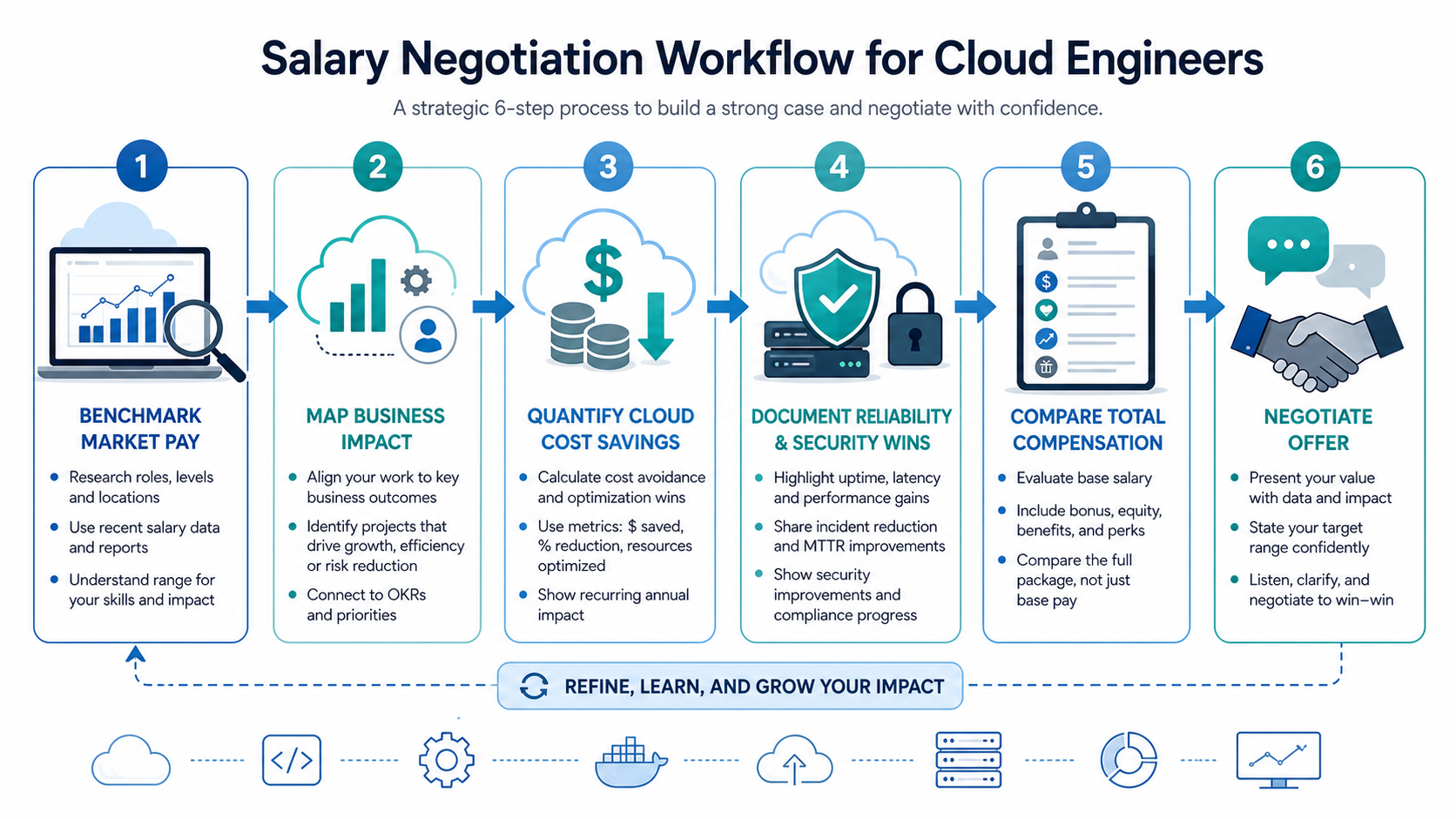
- Benchmark the role using at least three sources and separate base salary from total compensation.
- Match the offer to the real scope: operations, platform engineering, architecture, security, FinOps, or AI infrastructure.
- Quantify your impact with cost, reliability, delivery, security, and incident metrics.
- Ask about bonus, equity, on-call pay, certification reimbursement, remote policy, and promotion bands.
- Negotiate with a target range, not a single number, and explain the evidence behind it.
- Do not trade salary for vague promotion promises. Ask what written level, scope, and review cycle apply.
Common Mistakes When Reading Cloud Salary Data
- Comparing base pay to total compensation: Glassdoor-style total pay and Salary.com-style base pay are not interchangeable.
- Ignoring level: A junior cloud support role and a senior platform engineer role may both use “Cloud Engineer” in the title.
- Overvaluing certificates: Certifications help, but production impact is what moves compensation.
- Ignoring location policy: Remote roles can use national, regional, or country-specific bands.
- Skipping equity risk: Startup equity, public-company RSUs, and private options have very different risk profiles.
- Forgetting on-call load: A higher salary may not be better if the role has intense on-call without fair compensation or staffing.
Recommended Learning Path for Higher-Paying Cloud Roles
If you are trying to move into a higher salary band in 2026, focus on a stack that proves you can build and run production systems:
- Pick one primary cloud: AWS, Azure, or Google Cloud.
- Learn IAM, VPC networking, compute, storage, databases, logging, and monitoring.
- Build infrastructure with Terraform, Pulumi, or OpenTofu instead of console-only changes.
- Deploy containers to Kubernetes and understand autoscaling, ingress, secrets, and upgrades.
- Add observability with metrics, logs, traces, dashboards, and actionable alerts.
- Practice cloud security: least privilege, encryption, network segmentation, secrets, and policy-as-code.
- Track cost with tags, budgets, rightsizing, and unit-cost dashboards.
- Document the project clearly so a hiring manager can see your decisions and tradeoffs.
Useful next reads on GravityDevOps include Prometheus and Grafana monitoring, GitOps with Argo CD, Best CI/CD tools in 2026, and What is Generative AI? for engineers exploring AI infrastructure work.
FAQ: Cloud Engineer Salary 2026
What is a good cloud engineer salary in 2026?
A good U.S. cloud engineer salary in 2026 is usually around $120,000 to $160,000 in base pay for an experienced engineer, with total compensation higher at product companies, finance firms, AI infrastructure teams, and large enterprises. Entry-level roles often start below that range, while senior engineers and architects can exceed $180,000 depending on location, impact, and specialization.
Which cloud skills increase salary the most?
The strongest salary premiums usually come from combining cloud platform depth with Kubernetes, infrastructure as code, cloud security, FinOps, SRE practices, data platforms, and AI or machine learning infrastructure. A single certification helps, but employers pay more for engineers who can design reliable systems, reduce cost, automate delivery, and explain tradeoffs clearly.
Do AWS, Azure, or Google Cloud engineers earn more?
Pay depends more on employer, role scope, seniority, and specialization than on one cloud provider alone. AWS has the broadest job market, Azure is strong in enterprise and Microsoft-heavy environments, and Google Cloud can pay well in data, analytics, and AI-heavy companies. Multi-cloud fluency can improve bargaining power when it matches the employer’s stack.
Is cloud engineering still a good career in 2026?
Yes, but the bar is higher than it was during the early cloud migration wave. Employers increasingly expect automation, security awareness, cost discipline, Kubernetes familiarity, observability, and AI-era infrastructure judgment. Candidates who only know console operations are less competitive than engineers who can ship repeatable, secure, and measurable cloud platforms.
How should a cloud engineer negotiate salary?
Use recent salary data, compare the full compensation package, and connect your work to business outcomes: cloud spend reduced, deployment speed improved, incidents prevented, reliability increased, security findings closed, or platforms standardized. A negotiation backed by measurable impact is stronger than one based only on years of experience.
Sources and Methodology
This guide compares current public salary data from Salary.com, Indeed, Glassdoor, and the U.S. Bureau of Labor Statistics Occupational Outlook Handbook. Salary data changes frequently, so use these numbers as a benchmark, then adjust for role scope, location, level, company stage, bonus, equity, and on-call expectations.


